
Data Center Trend: Distributed Power in the White Space
Eaton · Jason Anderson
Argues for placing UPSs in the data hall close to the loads, instead of large centralised gray-space systems, for cloud and colocation operators.
On this page
Overview
The paper lists the benefits: incremental scaling, fewer points of failure, lower capex, right-sized efficiency and 480 V distribution without neutral. A 480 V UPS input and output needs no neutral (three wires instead of four) and thinner cables than 208 V, with a PDU next to the UPS stepping down to 208/120 V. Adding 100 kW to an existing modular UPS instead of buying a new one can save up to $35,000 upfront plus about $700 per year in footprint (at $150 per sq ft per year).
Distributed designs often avoid centralised downstream static switches, so a fault affects only a small portion of servers.
A white-space UPS needs modular vertical scaling, high efficiency at partial load, airflow options matching hot/cold aisle layouts, line-and-match cabinets, top/bottom cable entry, front access and integration with management software. White-space UPS models are quoted at 97% in double conversion and up to 99.1% in advanced modes, and UPSs are typically loaded below 50%.
On airflow, units should offer front-to-top (wall/row) and front-to-back (hot/cold aisle) airflow plus an optional chimney that leaves room for busway and trays.
Key points
- A 480 V UPS input/output needs no neutral (three wires) and thinner cables than 208 V; a PDU next to the UPS steps down to 208/120 V.
- Adding 100 kW to an existing modular UPS can save up to $35,000 upfront plus about $700 per year in footprint ($150 per sq ft per year).
- White-space UPS models are quoted at 97% in double conversion and up to 99.1% in advanced modes; UPSs are typically loaded below 50%.
- White-space UPSs should offer front-to-top and front-to-back airflow plus an optional chimney leaving room for busway and trays.
- Distributed designs often avoid centralised downstream static switches, so a fault affects only a small portion of servers.
Using it in design
- Allow UPS placement in the white space with an airflow-pattern attribute (front-to-back, front-to-top) and count its heat release in the hall cooling load.
- Check UPS airflow direction against aisle-containment orientation and require front-service clearance.
- Offer a distributed (per-row or per-cage) UPS topology template.
- Compute the blast radius per UPS.
Monthly newsletter · free
Keep your reading list current
Once a month: new library sources, changes to Turkish regulations and upcoming data centre events.
SoSo CAD
Review your power design in SoSo CAD
Inspect supply paths, equipment loads and UPS failure scenarios in one model.
Request a demo
Who should read it
Designers choosing UPS placement in cloud and colocation halls, and the decision makers funding them.
Related standards
- IEC 62040-3
- ASHRAE TC 9.9
Publication details
- Authors
- Jason Anderson
- Publisher
- Eaton
- Year
- 2013
- Document number
- WP153006EN
- Document language
- English
- Source type
- Manufacturer
- Access
- Free to read
- Licence
- Copyright retained; citation only — the publisher’s terms apply to the original document
Citation
Jason Anderson (2013). Data Center Trend: Distributed Power in the White Space. Eaton. WP153006EN. https://web.archive.org/web/20240722004109/https://www.eaton.com/content/dam/eaton/markets/data-center/DC-trend-distributed-power-in-white-space.pdf
All content and rights belong to the respective authors and publishers. SoSo CAD provides only the citation, its own summary and a link to the source, and is not responsible for the sources' content.
Related sources
All sources on this topic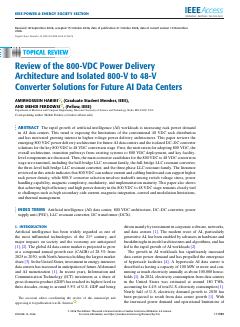
IEEE Access (Institute of Electrical and Electronics Engineers (IEEE)) 2026
Review of the 800-VDC Power Delivery Architecture and Isolated 800-V to 48-V Converter Solutions for Future AI Data Centers
Define 800 VDC unipolar, ±400 VDC bipolar and 48/54 VDC busbar as separate voltage classes in the single-line diagram, each with its own conductor ampacity, breaker pole count and clearance (IEC 60664-1) checks.
- The OCP Open Rack V3 PSU specification targets above 97.5% peak efficiency and at least 96.5% across 30%-100% load.

Springer Science and Business Media LLC (preprint) 2026
Design and Development of a Next-Generation Medium-Voltage Architecture for AI Data Centre Infrastructure
Make the 0.1-10 Hz oscillation, 1.40 peak-to-mean ratio and coincidence factor explicit inputs in the AI campus load model, and check storage and buffering against grid ramp limits.
- Conductor mass falls by 97.1%, electrical footprint by 58.1%, annual PUE from 1.42 to 1.11 and 15-year TCO by 32.4%.

Open Compute Project Foundation 2026
Diablo 400 Project: Rack and Power, Base Specification Version 0.7.0 (effective March 1, 2026)
Check that the facility's AC feed (480, 415 or 400 V, single or dual) and the rack power range match the planned IT block, including up to 1.1 MW per sidecar and the parallel option.
- AC input is 3-phase at 480, 415 or 400 Vrms +/-10%, single feed or dual N+N, 50/60 Hz +/-3 Hz.

Open Compute Project Foundation 2026
Mt. Diablo Disaggregated Power Rack Specification 1.0.0 (effective October 8, 2026)
Add a sidecar power-rack block (600/711 mm wide, about 1200 mm deep, 6000 lb) to AI row layouts with its own floor-load and clearance checks, and model +/-400 VDC distribution from it to IT racks.
- End-to-end efficiency at 480 VAC: >95% at 20% load, >98% at 50%, >97% at 100%.

Open Compute Project Foundation 2026
Open Data Center: Next-Generation ML Infrastructure Design Principles, Revision 0.7.0 (Design Specification, effective Aug 27, 2026)
Base floor and transport-route load checks on the 8,000 lb rack and the 15,000 lb rack-plus-sidecar combination, and include the weight of the moving equipment.
- Available quick connects currently top out at 2 in.

Open Compute Project Foundation 2023
Open Rack V3 48V BBU (Battery Backup Unit Module) Specification, Rev 1.4
Use 3 kW, 4 minutes and 6 hours recharge as default parameters for ORV3 BBU modules in the rack-power calculator.
- Peak load may reach 150% of rated power; in overload the droop extends linearly (47.25 V at 150% load).