
ENERGY STAR Program Requirements for Large Network Equipment, Version 1.1 (incl. Test Method Rev. Jan-2016)
U.S. Environmental Protection Agency (ENERGY STAR) · U.S. Environmental Protection Agency
The U.S. EPA's ENERGY STAR criteria for rack-mounted large network equipment (switches and routers with more than 11 ports). It sets PSU efficiency and power-factor floors, Energy Efficient Ethernet on copper ports, active-state reporting and input power and inlet-temperature telemetry; the bundled test method defines traffic profiles.
U.S. public domain — U.S. Government work; free to reuse
On this page
Overview
The document contains the ENERGY STAR partner commitments, the Version 1.1 eligibility criteria and the bundled test method (Rev. Jan-2016). Large network equipment (LNE) is network equipment mountable in a standard rack, supporting management protocols such as SNMP, with more than eleven physical network ports or aggregate port throughput above 12 Gb/s. Routers and switches are in scope; products with more than four ports of 100 Gb/s or higher, small network equipment, servers, storage and storage-networking products, security appliances, access point controllers, DSLAM/CMTS, network caching and load-balancing devices are excluded.
Power supplies are tested to the Generalized Internal Power Supply Efficiency Test Protocol Rev. 6.7. Single-output PSUs must reach 80/88/92/88% at 10/20/50/100% load and multi-output PSUs 85/88/85% at 20/50/100%. AC-DC PSU power factor is required at output of 75 W or more: multi-output 0.80/0.90/0.95 (20/50/100%); single-output up to 500 W the same values, 500-1,000 W with 0.65 added at 10% load, and above 1,000 W 0.80/0.90/0.90/0.95 (10/20/50/100%). Below 75 W power factor is only measured and reported.
Feature requirements must be enabled in the as-shipped configuration: remote administration of individual physical ports, adaptive active cooling on primary components (for example variable fan speed at lower ambient temperature; passive-cooled devices excluded) and compliance of all copper-based physical ports with IEEE 802.3 Clause 78 (Energy Efficient Ethernet, EEE). There is no numeric active-state efficiency floor; full power and performance must be measured and reported so EPA can evaluate them when setting Version 2.0 levels. Modular products are tested with a fully populated chassis and heterogeneous module configurations are allowed.
Telemetry: LNE products with nameplate power above 250 W must measure and report input power at product level (within +/-5% of actual above 200 W; at 200 W or less, within 10 W times the number of installed PSUs) and inlet air temperature (within +/-2 C, optional sampling). Data must be readable by third-party, non-proprietary management systems over a standard network connection, via a packaged service processor, embedded meter or iPDU. Input power is sampled at least every 10 seconds, timestamped environmental data at least every 30 seconds. Manufacturers may test with a half-port or full-port configuration.
The test method sets ambient at the airflow inlet above 22.0 C and below 28.0 C and relative humidity of 15-80%; the power meter needs 1% or better accuracy, at least 80.0 kHz bandwidth and 40.0 kHz sample rate. Traffic is IPv4 in the Simple IMIX distribution (40, 576 and 1500 byte IP packets). In the full-port test the maximum non-drop load Lmax is found first, then average power is measured for 15 minutes each at full load, 30% load and very low utilization (VLU = Lmax x 10 to the power -4); the half-port test uses 10% load as the middle point. Version 1.1 took effect on 1 March 2016.
Key points
- LNE is rack-mountable, manageable network equipment with more than 11 physical ports or aggregate throughput above 12 Gb/s.
- Excluded: products with more than four 100 Gb/s ports, small network equipment, servers, storage and storage networking, security appliances, AP controllers, DSLAM/CMTS, caching and load balancing.
- PSU efficiency: single-output 80/88/92/88% (10/20/50/100% load), multi-output 85/88/85% (20/50/100%).
- AC-DC PSU power factor is required at 75 W or more of output; for example single-output above 1,000 W needs 0.80/0.90/0.90/0.95 at 10/20/50/100% load.
- All copper-based physical ports must comply with IEEE 802.3 Clause 78 (Energy Efficient Ethernet).
- Remote port administration and adaptive active cooling must be enabled as shipped.
- There is no numeric active-state floor; full power and performance are measured and reported for EPA's Version 2.0 evaluation.
- Products above 250 W nameplate must report input power (+/-5% above 200 W) and inlet air temperature (+/-2 C); input power is sampled at least every 10 seconds.
- Test ambient is 22.0-28.0 C and 15-80% RH; traffic is Simple IMIX; the VLU load is Lmax x 10 to the power -4 for 15 minutes.
- Version 1.1 took effect on 1 March 2016; modular products are tested with a fully populated chassis.
Using it in design
- Network catalogue items (ToR and spine switches) should store ENERGY STAR status, PSU efficiency points and measured power at idle, VLU, 30% and maximum load so rack heat loads reflect real utilization.
- Flag copper switches without EEE in efficiency checks.
- Use the reported inlet-temperature capability as a DCIM integration attribute, and check input-power reporting on devices above 250 W nameplate.
- Record that test conditions were 22-28 C and specific load points (30% or 10%, VLU) and add a note when the design inlet temperature is higher.
- Use the PSU power-factor requirement (especially for PSUs above 1,000 W) as an input to UPS and distribution loading.
Monthly newsletter · free
Keep your reading list current
Once a month: new library sources, changes to Turkish regulations and upcoming data centre events.
SoSo CAD
Compare the cost of design decisions
Evaluate equipment costs, energy expenses and total cost of ownership (TCO) using your inputs and assumptions in SoSo CAD.
Request a demo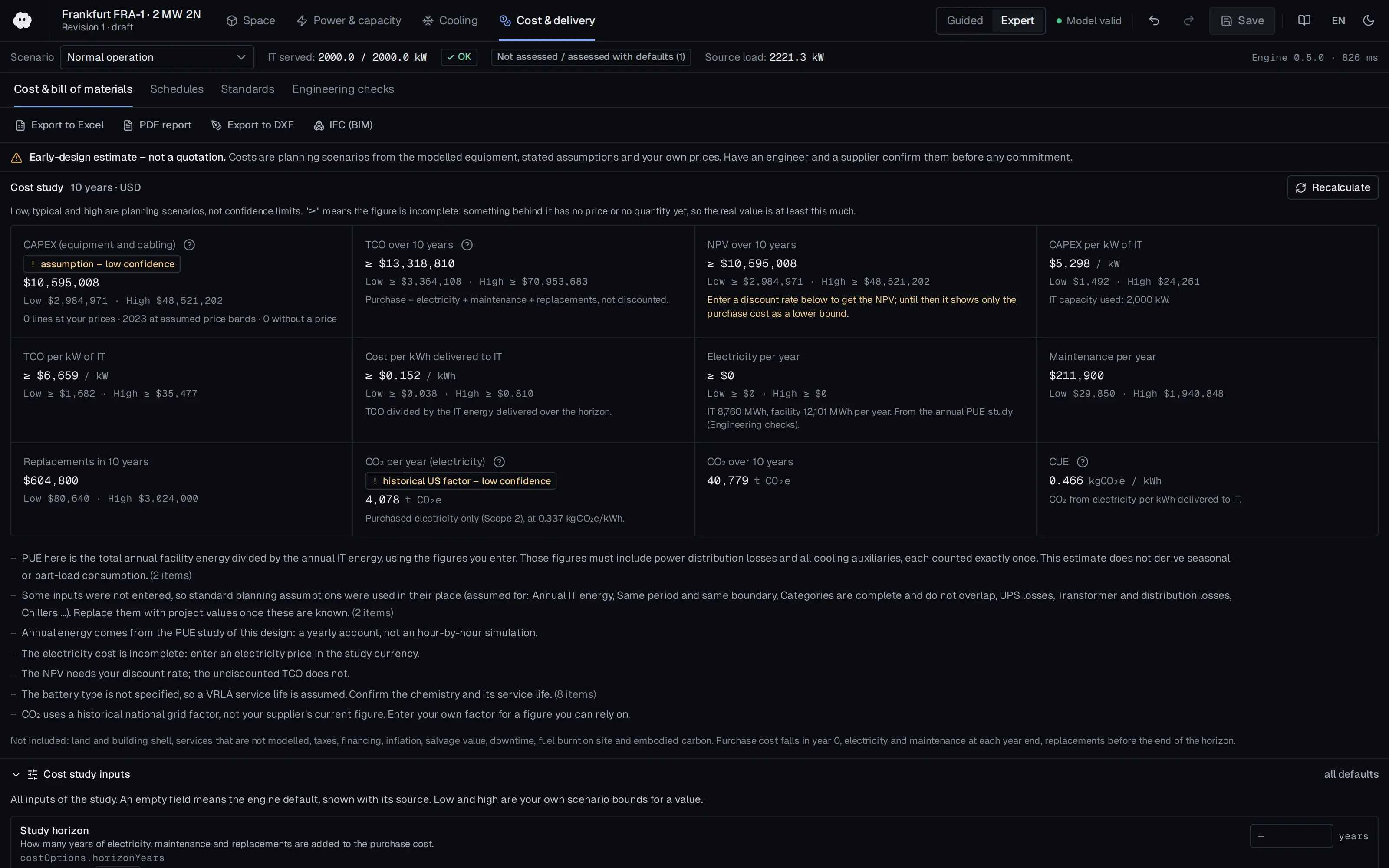
Who should read it
Designers who select rack switches and routers or add network equipment to energy models, manufacturers and certification specialists.
Document contents
- Partner Commitments
- Definitions
- Scope
- Certification Criteria
- Power Supply Requirements
- Energy Efficiency Feature Requirements
- Active State Efficiency Criteria for all LNE Products
- Standard Information Reporting Requirements
- Standard Performance Data Measurement and Output Requirements
- Testing
- Effective Date
- Considerations for Future Revisions
- Test Method (Rev. Jan-2016)
- Test Setup
- Test Conduct
- Test Procedure for All Products Except Modular Products
- Test Procedure for Modular Products
Related standards
- IEEE 802.3az
- ATIS-0600015.03
- EPRI Generalized Internal Power Supply Efficiency Test Protocol Rev. 6.7
Read the document
energystar-lne-spec-v1-1.pdf
U.S. public domain — U.S. Government work; free to reuse
The document is provided unaltered because its licence permits redistribution.
Publication details
- Authors
- U.S. Environmental Protection Agency
- Publisher
- U.S. Environmental Protection Agency (ENERGY STAR)
- Year
- 2016
- Document number
- ENERGY STAR LNE V1.1
- Document language
- English
- Source type
- Government / public
- Access
- Open licence — downloadable
- Licence
- U.S. public domain — U.S. Government work; free to reuse
- Licence evidence
- www.copyright.gov
Original licence note
Work of the U.S. Environmental Protection Agency ENERGY STAR program (federal agency publication on energystar.gov); not subject to copyright under 17 U.S.C. 105.
Citation
U.S. Environmental Protection Agency (2016). ENERGY STAR Program Requirements for Large Network Equipment, Version 1.1 (incl. Test Method Rev. Jan-2016). U.S. Environmental Protection Agency (ENERGY STAR). ENERGY STAR LNE V1.1. https://www.energystar.gov/sites/default/files/ENERGY%20STAR%20LNE%20Version%201.1%20Final%20Specification.pdf
Events on this subject
- Electricity Eurasia 2027
- BICSI Japan Conference & Exhibition
- ELECO 2026 Elektrik-Elektronik ve Biyomedikal Mühendisliği Konferansı
All content and rights belong to the respective authors and publishers. SoSo CAD provides only the citation, its own summary and a link to the source, and is not responsible for the sources' content.
Related sources
All sources on this topic
U.S. EPA / ENERGY STAR 2024
ENERGY STAR Program Requirements for Computer Servers, Version 4.0 (Partner Commitments, Eligibility Criteria, and Final Test Method Rev. April 2023)
Write ENERGY STAR Version 4.0 certification and the PSU efficiency steps (at 10% to 100% load points) into the server procurement specification; look especially at 10% and 20% load efficiency for redundant supplies that run lightly loaded.
- EffACTIVE = EXP(0.65 ln EffCPU + 0.30 ln EffMEMORY + 0.05 ln EffSTORAGE).
U.S. Environmental Protection Agency (ENERGY STAR) 2022
ENERGY STAR Program Requirements for Data Center Storage, Version 2.1 (Partner Commitments and Eligibility Criteria)
Catalogue entries for storage should carry ENERGY STAR status, PSU efficiency curve points (20/50/100%) and power factor, so the rack power model can derive input power and heat from IT load rather than nameplate.
- PSU power factor minimums: 0.80/0.90/0.95 at 20/50/100% load.
U.S. EPA / ENERGY STAR 2017
ENERGY STAR Program Requirements for Uninterruptible Power Supplies (UPSs) - Partner Commitments, Eligibility Criteria Version 2.0, and Test Method (Rev. Dec-2017)
Write the Version 2.0 thresholds into UPS procurement as a floor; for VFI units above 10,000 W compute the minimum from 0.0058 x ln(P) + 0.886 for the actual rating.
- Modular UPSs in the 1,500-10,000 W range receive an efficiency allowance (EMOD) of 0.004.
U.S. Environmental Protection Agency (ENERGY STAR) 2017
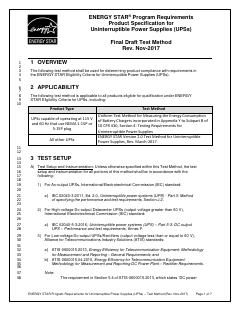
ENERGY STAR Program Requirements for Uninterruptible Power Supplies (UPSs): Test Method (Rev. Nov-2017), Version 2.0
Store efficiency at 25/50/75/100% load for each normal mode (double-conversion, eco/ESS) in UPS catalogue entries, measured to IEC 62040-3.
- The boundary between high-voltage and low-voltage dc output is 60 V.
IEEE Access (Institute of Electrical and Electronics Engineers (IEEE)) 2026
Review of the 800-VDC Power Delivery Architecture and Isolated 800-V to 48-V Converter Solutions for Future AI Data Centers
Define 800 VDC unipolar, ±400 VDC bipolar and 48/54 VDC busbar as separate voltage classes in the single-line diagram, each with its own conductor ampacity, breaker pole count and clearance (IEC 60664-1) checks.
- The OCP Open Rack V3 PSU specification targets above 97.5% peak efficiency and at least 96.5% across 30%-100% load.
arXiv preprint (University of Michigan) 2026
Grid Integration of AI Data Centers: A Critical Review of Energy Storage Solutions (arXiv preprint)
Layer storage by timescale (chip/server sub-ms to ms, rack ms to seconds, UPS and GiUPS sub-second to 10 s, BESS minutes to hours) and show each layer's duty in the coordination scheme.
- Rapid AI load variations often induce 5-10% voltage swings within milliseconds.