
Reporting requirements on the energy performance and sustainability of data centres for the Energy Efficiency Directive - Task C report: EU repository for the reporting obligation of data centres
European Commission, DG ENER (Viegand Maagoe and COWI) · Viegand Maagoe, COWI
The study specifies the European database (e-platform) for EED data centre reporting: input fields, validation rules, derived metrics, published summary statistics, user roles and the annual reporting cycle. The document is marked as a draft version.
CC BY 4.0 — share with attribution
On this page
Overview
Task C describes how the EU-wide repository will work and notes that it will use technical options from existing Commission IT platforms such as EU Login. The report covers five topics: the input data for reporting, the outputs calculated from it, the aggregated statistics made public, the users of the repository and their access levels, and the reporting cycle from granting access to publishing statistics. The document is dated 22 November 2023 and the cover page marks it as a Draft version.
Input fields fall into four groups, each defined by data type, unit, reporting frequency and a validation rule. These are building information (reporting entity, data centre name/ID, postal code, type), domain of control (physical building, mechanical and electrical plant, data floor, racks, IT equipment, operating system/virtualisation layer, software, business process), operation data (electrical and cooling redundancy level, modular capacity steps or separately provisioned halls, number of racks) and indicators. Data centre type can only take three values: enterprise, colocation or co-hosting.
Indicator inputs are annual: total and computer room floor area (m2), rated IT electrical load (kW), total energy, backup generator energy and fuel consumed (kWh), fuel type, grid functions, average battery capacity (kW) and battery time (hours), ICT equipment energy, total and potable water input, waste heat reused (kWh) and its average temperature, cooling degree days, renewable energy (split by GoO, PPA and on-site), server and storage capacity, and incoming/outgoing traffic. Validation rules include computer room area not exceeding building area, ICT energy not exceeding rated IT load times 8760 or total energy, waste heat temperature between 20 and 99 degrees, and rated IT load consistent with floor area at 1-10 kW/m2.
Four metrics are computed as outputs: PUE (total energy / ICT energy), WUE (annual water input / ICT energy), ERF (energy reused / total energy) and REF (renewable energy / total energy). Individual data and metrics are visible only to the Commission (all EU) and Member States (their own territory); the public sees only aggregated statistics. Statistics are presented by installed IT power size class - small 500-1000 kW, medium 1-2 MW, large 2-10 MW, very large above 10 MW - and by data centre type, as average PUE, WUE, ERF and REF.
The reporting cycle follows one of two methods: the operator reports directly to the EU e-platform, or, in Member States with a national scheme, reports to the competent authority, which uploads bulk data. In the direct method each data centre gets its own account, the competent authority opens and closes the reporting calendar, reopens the task if validation finds deviations, and the Commission then publishes summary statistics. The document defines fields and rules; it does not detail meter or measurement methods, which are handled in the other task reports and the regulation.
Key points
- Every input field is defined by data type, unit, reporting frequency and a validation rule, intended to reduce user entry errors.
- Data centre type takes only three values: enterprise, colocation, co-hosting.
- Annual inputs include total and computer room area (m2), rated IT load (kW), total, ICT and fuel energy (kWh), battery capacity (kW) and time (hours), water, waste heat, cooling degree days and renewable energy.
- Validation: computer room area cannot exceed building area; ICT energy cannot exceed rated IT load x 8760 or total energy; reused heat cannot exceed total energy; potable water cannot exceed total water input.
- Average waste heat temperature must be within 20-99 degrees, and rated IT load is checked against floor area at 1-10 kW/m2.
- Incoming and outgoing data traffic (PB) must be less than the corresponding bandwidth (Gbps) x 3.942.
- Computed metrics are PUE, WUE (water input / ICT energy), ERF and REF; the GoO, PPA and on-site renewable items cannot exceed total renewable energy.
- Individual data is visible only to the Commission (all EU) and Member States (own territory); only aggregated statistics are published.
- Size classes by installed IT power: small 500-1000 kW, medium 1-2 MW, large 2-10 MW, very large above 10 MW.
- Two reporting methods exist: the operator enters data directly on the e-platform via EU Login with one account per data centre, or reports to the Member State authority, which bulk-uploads.
Using it in design
- Plan an "EED report export" in the design and operations model that can pre-fill the EU database template: rated IT kW, floor areas, energy, water, heat reuse and renewable fields.
- Apply the repository's own validations in input forms: ICT kWh <= total kWh, ICT kWh <= rated IT kW x 8760, reused heat <= total energy, waste heat temperature 20-99 degrees.
- Divide rated IT load by computer room area and flag results outside 1-10 kW/m2 as a likely data entry error or area-definition question.
- In the metering plan define separate measurement points for total energy, ICT energy, backup generator energy and fuel, water input (potable separate) and renewable energy (GoO, PPA, on-site).
- Store battery capacity in kW and autonomy in hours as separate fields, since the repository asks for them separately.
Monthly newsletter · free
Keep your reading list current
Once a month: new library sources, changes to Turkish regulations and upcoming data centre events.
SoSo CAD
Bring standards pre-checks into your project
Review model-based TS EN 50600 and Tier pre-checks, missing inputs and items requiring engineering review in SoSo CAD.
Request a demo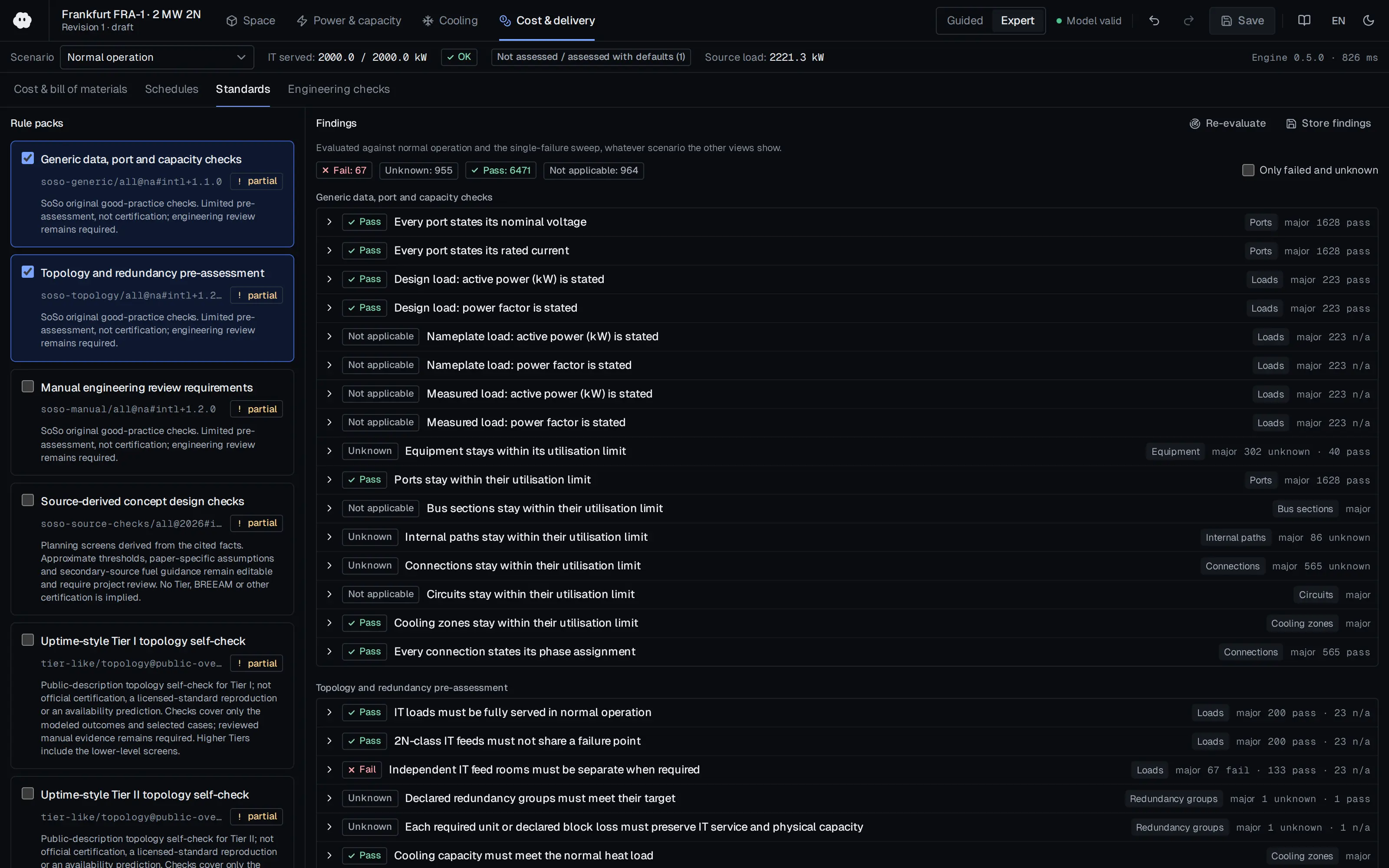
Who should read it
Engineers and software teams designing a data model, metering plan or export function for EU data centre reporting.
Document contents
- Introduction
- Objectives
- Structure and objectives of this document
- Input data
- Building information
- Domain of control
- Operation data
- Indicators
- Output data
- Metrics (PUE, WUE, ERF, REF)
- Summary statistics for publication
- Member state / EU level
- Examples of visualization
- User management in the e-platform
- Reporting cycle and workflow
- Data centre operator reporting directly to the EU e-platform
- Data centre operator reporting to Member State
Related standards
- Directive (EU) 2023/1791
- Delegated Regulation (EU) 2024/1364
Read the document
eu-eed-dc-reporting-task-c-2023.pdf
CC BY 4.0 — share with attribution
The document is provided unaltered because its licence permits redistribution.
Publication details
- Authors
- Viegand Maagoe; COWI
- Publisher
- European Commission, DG ENER (Viegand Maagoe and COWI)
- Year
- 2023
- Document language
- English
- Source type
- Government / public
- Access
- Open licence — downloadable
- Licence
- CC BY 4.0 — share with attribution
- Licence evidence
- op.europa.eu
Original licence note
Copyright page: Commission reuse policy, Decision 2011/833/EU; reuse authorised under CC BY 4.0 unless otherwise noted.
Citation
Viegand Maagoe; COWI (2023). Reporting requirements on the energy performance and sustainability of data centres for the Energy Efficiency Directive - Task C report: EU repository for the reporting obligation of data centres. European Commission, DG ENER (Viegand Maagoe and COWI). https://doi.org/10.2833/61682
Events on this subject
Browse the events calendarAll content and rights belong to the respective authors and publishers. SoSo CAD provides only the citation, its own summary and a link to the source, and is not responsible for the sources' content.
Related sources
All sources on this topic
European Commission 2026
Report from the Commission to the European Parliament and the Council on the energy efficiency of data centres in the EU - COM(2026) 500 final
Set the PUE target for new designs against the bands in the report (below 1.2 excellent, above 1.5 needs improvement) and possible future minimum-standard thresholds, noting that the 500-1000 kW class averaged 1.64.
- EU data centres consumed 68 TWh of electricity in 2024, expected to reach 114 TWh by 2030 (3.2% of EU electricity).
European Commission 2026
Annexes 1 to 3 to Commission Delegated Regulation C(2026) 3472 - EU data centre energy (PUE) and water (WUE) efficiency classes, data centre label, and amendments to Delegated Regulation (EU) 2024/1364
Translate PUE and WUE targets into A-G classes: class A needs a design PUE of 1.15 or below and WUE of 0.1 or below; the class D boundary is 1.5 and 0.6. Write the class target into the design specification.
- WUE classes: A <= 0.1; B 0.1-0.2; C 0.2-0.4; D 0.4-0.6; E 0.6-0.8; F 0.8-1.0; G > 1.0.

European Commission 2026
Commission Delegated Regulation C(2026) 3472 of 21.9.2026 supplementing Directive (EU) 2023/1791 and amending Delegated Regulation (EU) 2024/1364 as regards the establishment of a common Union rating scheme for data centres (main act)
As labels will be issued every year from 15 August 2027, set PUE and WUE class targets (Annex I) at design stage for new and existing sites and build the metering infrastructure to the reporting requirements.
- Labels are generated automatically by the European database every year from 15 August 2027 and are publicly available electronically in all official Union languages.
European Commission, DG ENER (AIT, Borderstep Institute, EY) 2025
Assessment of next steps to promote the energy performance and sustainability of data centres in EU, including the establishment of an EU-wide rating scheme - Second technical report
Align the PUE target of new designs with the proposed MPS: design PUE below 1.3 and operational PUE below 1.4 in the first three years; for existing sites plan the path to below 1.5 by 2030.
- MPS feasibility was tested across 27 data centre archetypes with selected best available techniques (BAT).

European Commission JRC 2024
Energy Consumption in Data Centres and Broadband Communication Networks in the EU (JRC135926, EUR 31841 EN)
In grid connection and permitting discussions account for regional concentration (data centres are 18% of national electricity in Ireland); in dense markets grid capacity and permitting can be a critical risk.
- EU data centres used an estimated 45-65 TWh of electricity in 2022, 1.8-2.6% of total EU electricity use.
European Commission 2024
Commission Recommendation (EU) 2024/2002 of 24 July 2024 setting out guidelines for the interpretation of Article 11 of Directive (EU) 2023/1791 as regards energy management systems and energy audits
Show in the operations module whether site annual energy crosses 10 TJ (audit) or 85 TJ (certified ISO 50001 energy management system); in unit terms 10 TJ is about 2.78 GWh and 85 TJ about 23.6 GWh.
- A cited study gives audit payback of 3.1 years or less, and under 1.16 years for enterprises above 10 TJ.