
Advanced Wireless Communication and Tracking Tutorial: 4. Survivability, Reliability, and Availability
CDC / National Institute for Occupational Safety and Health · National Institute for Occupational Safety and Health (NIOSH)
This chapter of the NIOSH mining communications tutorial separates system reliability, survivability and availability, and illustrates repairable availability with series and parallel configurations.
On this page
Overview
The chapter's main contribution is to separate three concepts: reliability (operating without failure over a mission), survivability (continuing to function after an event) and availability (being operational at any given moment). They are often confused in data centers too: 99.99% availability does not rule out one long outage. A single long outage and many short ones can give the same annual percentage but very different operational consequences.
For a repairable system, availability is estimated as MTBF divided by (MTBF + MTTR), so the result depends on both the failure interval and the repair duration. For instance, an MTBF of 1,000 hours and an MTTR of 10 hours gives availability of about 0.990; this is a simple application of the formula, not the document's own number. The chapter also uses diagrams to show how series and parallel configurations affect availability.
The limit is that the equations are general examples and the operating context is underground communications; there is no data-center failure data. An availability estimate should be kept distinct from mission reliability and verified operational uptime, with the failure and repair assumptions behind it stated. Survivability describes continued function after an event; in a data center the equivalent is the rest of the system continuing to run when one zone is lost.
Key points
- The document treats system reliability, survivability and availability as distinct concepts.
- Repairable availability is estimated as MTBF / (MTBF + MTTR).
- The result depends on both the failure interval and the repair duration.
- Series and parallel configurations are illustrated through availability.
- The context is underground mine communications; the equations are general examples.
Using it in design
- Write the MTBF and MTTR assumptions beside every availability estimate.
- Show availability as a metric separate from mission reliability and verified operational uptime.
- Tie MTTR to inputs such as spares and response time and show the sensitivity.
Monthly newsletter · free
Keep your reading list current
Once a month: new library sources, changes to Turkish regulations and upcoming data centre events.
SoSo CAD
Assess redundancy through scenarios
Compare normal operation and equipment failures in SoSo CAD, with supplied loads and capacity shortfalls in one view.
Request a demo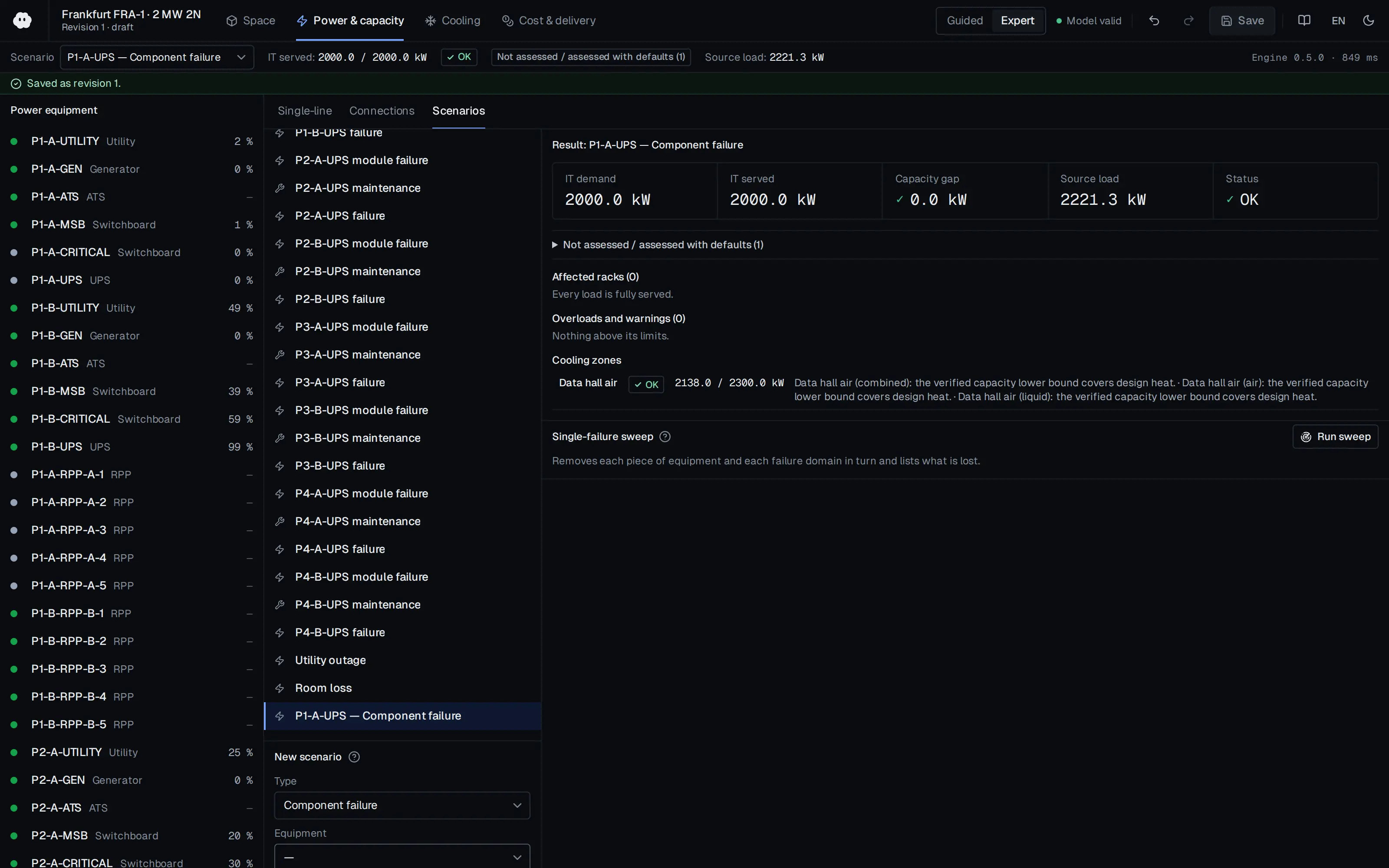
Who should read it
Designers who calculate an availability figure and must explain what that figure does and does not prove.
Publication details
- Authors
- National Institute for Occupational Safety and Health (NIOSH)
- Publisher
- CDC / National Institute for Occupational Safety and Health
- Year
- 2019
- Document number
- Tutorial chapter 4
- Document language
- English
- Source type
- Government / public
- Access
- Free to read
- Licence
- Copyright retained; citation only — the publisher’s terms apply to the original document
Citation
National Institute for Occupational Safety and Health (NIOSH) (2019). Advanced Wireless Communication and Tracking Tutorial: 4. Survivability, Reliability, and Availability. CDC / National Institute for Occupational Safety and Health. Tutorial chapter 4. https://archive.cdc.gov/www_cdc_gov/niosh/mining/content/emergencymanagementandresponse/commtracking/advcommtrackingtutorial4.html
Events on this subject
Browse the events calendarAll content and rights belong to the respective authors and publishers. SoSo CAD provides only the citation, its own summary and a link to the source, and is not responsible for the sources' content.
Related sources
All sources on this topic
Fire (MDPI AG) 2026
Reframing Data Center Fire Safety as a Socio-Technical Reliability System: A Systematic Review
Ask for a fire-safety design file that covers a lifecycle plan (aligned with NFPA 75 and NFPA 76) including emergency response, damage control and post-fire recovery, not only prevention and suppression.
- The search found 806 records (Scopus 330, Web of Science 476); twelve empirical studies were synthesised and benchmarked against NFPA 75 and NFPA 76.
Journal of Engineering Research and Sciences (Journal of Engineering Research and Sciences) 2026
CFD Analysis of Data Center Hall Cooling Performance under Normal and Failure Modes with Control Strategies and Airflow Leakages
Do thermal verification of failure mode (two ACUs offline) with realistic air leakage (cabinet gaps, HAC panel joints); a leak-free model can comply while the leaky model exceeds 32 °C.
- The grid study selected 7,288,454 cells with the standard k-epsilon model and wall functions.
IEEE Access (Institute of Electrical and Electronics Engineers (IEEE)) 2026
GRAPE-UPS: Direction-Constrained Peer Anomaly Detection for Weak Batteries in Data-Center UPS Strings
Require block-level (per-unit) voltage and resistance monitoring in UPS battery monitoring rather than string totals, citing that one weak unit in a series string limits the whole string's capacity.
- On an independent electrochemical simulation benchmark, directed peer scoring achieved AUPRC 0.848 under nominal conditions and 0.850-0.877 under operating shifts.
Buildings (MDPI AG) 2025
Dynamic Maintenance Cost Optimization in Data Centers: An Availability-Based Approach for K-out-of-N Systems
Plan UPS maintenance from a condition table that maps each unit's state to MTBF and MTTR, then pick the units to maintain that meet target availability at the lowest cost.
- Maintenance service options and costs are based on the APC Symmetra PX 500 kW UPS; the case has ten 500 kW modular UPS units.
World Electric Vehicle Journal (MDPI AG) 2023
Research on Calendar Aging for Lithium-Ion Batteries Used in Uninterruptible Power Supply System Based on Particle Filtering
Plan UPS battery replacement from the RUL of the weakest cell rather than the string average; in a series string one cell sets the replacement date for the whole string even when others have years of life left.
- Per-cell SOH estimation RMSE ranged from 0.15% to 9.07% (MAPE 0.16% to 6.85%).

Open Compute Project Foundation 2022
Leak Detection and Intervention, Revision 1.0 (OCP Advanced Cooling Solutions white paper)
Run a probability-and-impact leak risk analysis at project start, specify BSPP/O-ring joints for serviceable connections and check the O-ring compound against the coolant chemistry using the full wetted-materials list.
- A UQD2 dry-break quick disconnect is specified to drip less than 0.063 cc when disconnected at 200 psi.