
Understanding Uptime Institute's Tier III Standard: A Guide to Data Center Electrical System Design
POWER Magazine · Nguyen Cong Sang
A trade-press guide by Nguyen Cong Sang in POWER Magazine that explains Tier III electrical design through a regional project. It gives a useful practitioner checklist but repeats two misconceptions Uptime no longer endorses.
On this page
Overview
The article explains a Tier III electrical system through a regional project: dual A/B distribution to each rack, N+1 UPS, standby generators with at least 12 hours of fuel, dual-corded IT load and transfer switching. The practitioner view is valuable because these components form the backbone of a Tier III-intent single-line diagram. The article's first problem is that it lists the availability figures 99.671% / 99.741% / 99.982% / 99.995% for Tiers I-IV, which Uptime withdrew in 2009.
The second is that it describes Tier IV as '2N+1', which conflicts with Uptime's current position, since the standard defines an outcome (fault tolerance) rather than a topology. The maintenance section also mentions a 72-hour backup runtime target, but that is project-specific and not a Tier requirement. The 12 hours given as the fuel baseline matches the widely published Tier III baseline. This document sits in the library less as a positive reference than as an example of the misconceptions the app wants to avoid spreading.
The reader should take the practical elements, A/B paths, N+1 UPS and dual-corded IT, and reject the percentage figures and the '2N+1' definition. The article's fuel and topology advice matches the widely published Tier III baselines: summaries of the Topology standard also cite at least 12 hours of fuel and a concurrently maintainable fuel system. The difference is that the article attaches a wrong numeric availability claim to those baselines.
Key points
- States Tier III generator fuel storage of at least 12 hours
- Lists legacy availability figures 99.671% / 99.741% / 99.982% / 99.995% for Tiers I-IV (Uptime withdrew these in 2009)
- Describes Tier III as N+1 with dual A/B paths to each rack and dual-corded IT
- Describes Tier IV as '2N+1', which conflicts with Uptime's current position
- Mentions a 72-hour backup runtime target that is project-specific, not a Tier requirement
- Best read as a positive checklist and a negative test case together
Using it in design
- Use it as a negative test case: the app's Tier explanations must not hard-code availability percentages or equate Tier IV with '2N+1'
- Keep A/B paths, N+1 UPS, the 12 h fuel baseline and dual-corded IT in the Tier III rule set
- Present the 72 h backup runtime as a user-editable project target, not a Tier rule
Monthly newsletter · free
Keep your reading list current
Once a month: new library sources, changes to Turkish regulations and upcoming data centre events.
SoSo CAD
Review your power design in SoSo CAD
Inspect supply paths, equipment loads and UPS failure scenarios in one model.
Request a demo
Who should read it
Engineers drawing a Tier III electrical single-line for the first time, and the team auditing the app's content for accuracy.
Related standards
- Uptime Tier Standard: Topology
Publication details
- Authors
- Nguyen Cong Sang
- Publisher
- POWER Magazine
- Year
- 2024
- Document language
- English
- Source type
- Expert / community
- Access
- Free to read
- Licence
- Copyright retained; citation only — the publisher’s terms apply to the original document
Citation
Nguyen Cong Sang (2024). Understanding Uptime Institute's Tier III Standard: A Guide to Data Center Electrical System Design. POWER Magazine. https://www.powermag.com/understanding-uptime-institutes-tier-iii-standard-a-guide-to-data-center-electrical-system-design
Events on this subject
- Electricity Eurasia 2027
- ELECO 2026 Elektrik-Elektronik ve Biyomedikal Mühendisliği Konferansı
- ICCI 2027 – Uluslararası Enerji ve Çevre Fuarı ve Konferansı
All content and rights belong to the respective authors and publishers. SoSo CAD provides only the citation, its own summary and a link to the source, and is not responsible for the sources' content.
Related sources
All sources on this topic
Energies (MDPI AG) 2023
Reliability Assessment of the Configuration of Dynamic Uninterruptible Power Sources: A Case of Data Centers
When choosing among DRUPS or UPS configurations, first screen with the graph-based method to identify the best candidates, then do the detailed RBD calculation for that candidate only.
- Single system: λ = 3.10 × 10^-6 1/h, A = 0.999949, MTBF 306,600 h (35 years).
U.S. DoD (UFC) 2023
UFC 3-540-01 Engine-Driven Generator Systems for Prime and Standby Power Applications (1 August 2014, Change 3, 26 January 2023)
Include transient and steady-state loads, transformer inrush, motor starting and UPS load in the generator sizing study, and calculate UPS charging load using the minimum charging current allowed while on generator.
- Harmonic analysis is required when switching power supplies make up 25% or more of the system load.
FEMA 2014
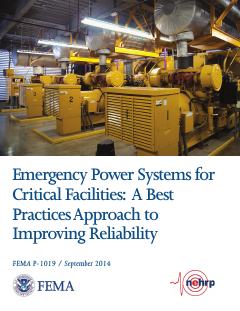
FEMA P-1019, Emergency Power Systems for Critical Facilities: A Best Practices Approach to Improving Reliability (September 2014)
At critical-facility data centers, place generators, ATS, fuel tanks and pumps above the greatest of BFE + 3 ft, DFE + 1 ft and 500-year elevation + 1 ft, and prefer elevation to dry floodproofing.
- Generators over 300 kW are almost exclusively diesel-fueled.
Headquarters, Department of the Army (U.S. Army Corps of Engineers PREP) 2006
TM 5-698-5 Survey of Reliability and Availability Information for Power Distribution, Power Generation, and Heating, Ventilating and Air Conditioning (HVAC) Components for Commercial, Industrial, and Utility Installations (22 July 2006)
When modelling the power and cooling chain use these values as starting failure rates and MTBF/MTTR inputs and convert them into availability with the method of TM 5-698-1.
- Diesel engine generators overall: 0.528 failures/yr, MTBF about 16,590 h, MTTR 24.22 h, operational availability 0.99399.
Consulting-Specifying Engineer 2026
Know the electrical, power components in a data center
Seed facility-type templates with default UPS/generator redundancy and fuel autonomy from Table 1.
- Generators should be loaded to at least 30% to avoid wet stacking.
Uptime Institute 2026
Uptime Institute Annual Outage Analysis 2026 (8th annual) — press release (with 2025 findings)
Weight UPS, ATS/STS and generator failure modes highest in the reliability model
- About 1 in 10 outages has serious or severe impact