
Understanding BESS: Battery Energy Storage Systems for Data Centers
Schneider Electric · Patrick Donovan
This paper defines BESS components, functions and use cases in a data-centre context. It explains how BESS differs from UPS batteries and when it might complement or reduce generator runtime.
On this page
Overview
The paper defines battery energy storage systems (BESS) from a data-centre viewpoint. Components are listed as battery racks, power conversion system, BMS and EMS. Functions and use cases include peak shaving, demand response, renewables integration and reduced reliance on diesel generators. A key distinction is between UPS batteries and BESS. UPS batteries typically provide 5 to 15 minutes while generators start, whereas a BESS can deliver energy over hours. The paper discusses when roughly 2 hours of BESS might complement or replace generator runtime.
Technical and market figures are given: an example module is a 500 kW BESS in a 20-ft container, and the preferred chemistries are LFP and NMC. The BESS market is projected to grow at about 23 percent CAGR over 2023 to 2032, and Li-ion pack cost is projected to fall from a historical level around $7,500/kWh to about $80/kWh by 2030. The main breaker may take about 50 ms to open, a point to consider in islanding design. The paper offers guidance on conditions that favour behind-the-meter Li-ion BESS, but its cost projections are forecasts and should be validated for each project.
In a design tool, BESS can be added as a site energy asset with kW, kWh and chemistry inputs, and use cases such as peak shaving and backup should be selectable. If BESS is considered as a replacement for generator backup it must meet the target autonomy, which should be compared with 24 to 48 hours of genset fuel. BESS sizing should be kept separate from UPS battery sizing.
Key points
- UPS batteries typically provide 5-15 minutes for gensets to start
- Example module: 500 kW BESS in a 20-ft container
- BESS market growing at about 23 percent CAGR (2023-2032)
- Li-ion pack cost fell from about $7,500/kWh historically; about $80/kWh projected by 2030
- LFP and NMC are the preferred chemistries
- Main breaker may take about 50 ms to open (islanding consideration)
- Components: battery racks, power conversion system, BMS, EMS
Using it in design
- Add BESS as a site energy asset with kW, kWh and chemistry inputs
- Make use cases selectable (peak shaving, backup)
- If BESS replaces generator backup, it must meet the target autonomy; compare with 24-48 h of genset fuel
- Keep BESS sizing separate from UPS battery sizing
Monthly newsletter · free
Keep your reading list current
Once a month: new library sources, changes to Turkish regulations and upcoming data centre events.
SoSo CAD
Compare the cost of design decisions
Evaluate equipment costs, energy expenses and total cost of ownership (TCO) using your inputs and assumptions in SoSo CAD.
Request a demo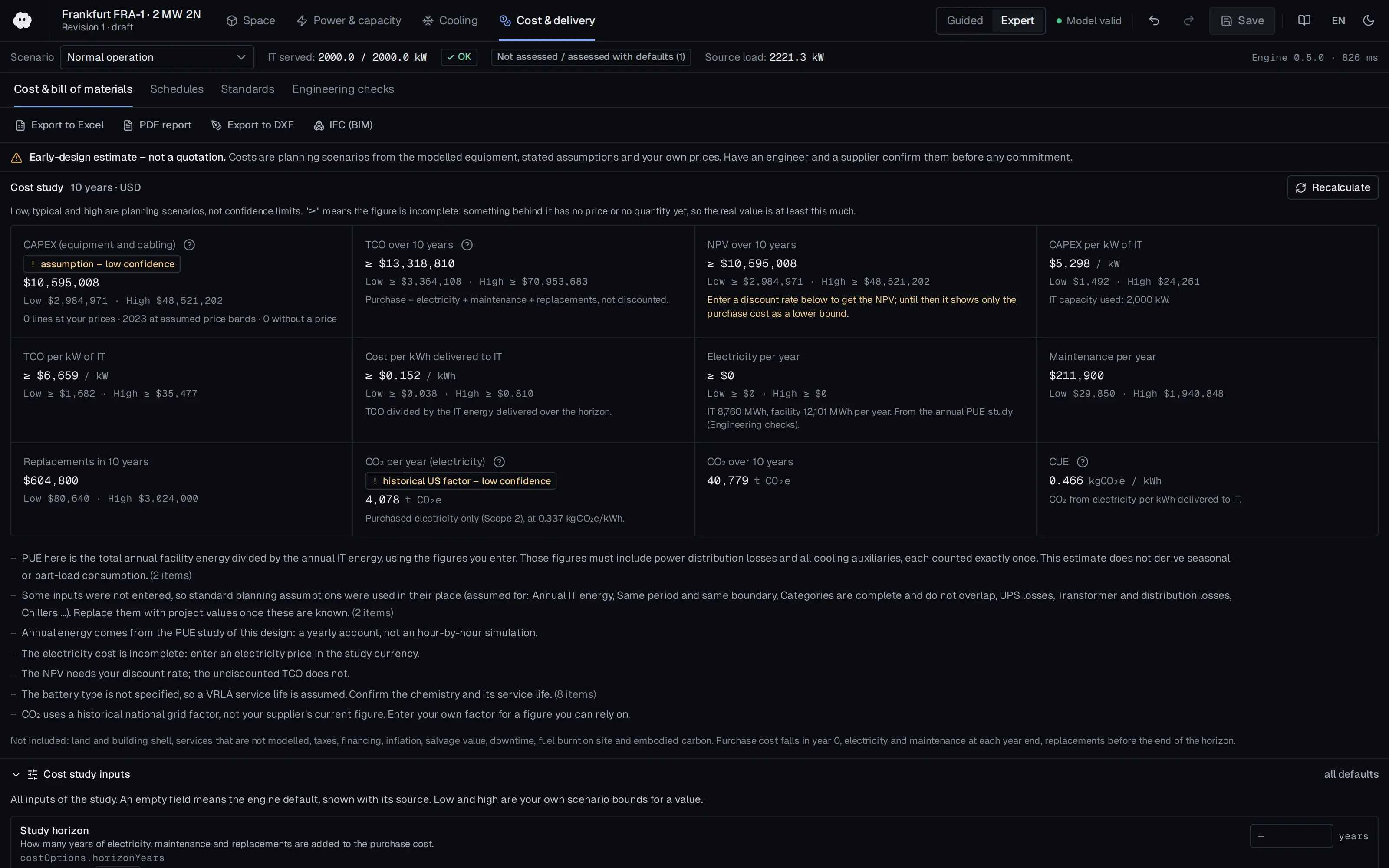
Who should read it
Data-centre designers and energy managers evaluating backup power and sustainability strategy.
Related standards
- NFPA 855
- UL 9540
- UL 9540A
- IEC 62933
Publication details
- Authors
- Patrick Donovan
- Publisher
- Schneider Electric
- Year
- 2024
- Document number
- WP 185
- Document language
- English
- Source type
- Manufacturer
- Access
- Free to read
- Licence
- Copyright retained; citation only — the publisher’s terms apply to the original document
Citation
Patrick Donovan (2024). Understanding BESS: Battery Energy Storage Systems for Data Centers. Schneider Electric. WP 185. https://download.schneider-electric.com/files?p_Doc_Ref=SPD_WP185_EN
Events on this subject
- ICCI 2027 – Uluslararası Enerji ve Çevre Fuarı ve Konferansı
- The smarter E Europe (Intersolar Europe, ees Europe, Power2Drive, EM-Power)
- Electricity Eurasia 2027
All content and rights belong to the respective authors and publishers. SoSo CAD provides only the citation, its own summary and a link to the source, and is not responsible for the sources' content.