
WP#78 - An Introduction to Coolant Distribution Units
The Green Grid · Jason Zeiler, Andrew Wasielewski et al.
The Green Grid's introduction to coolant distribution units (CDUs), which supply coolant at stable flow and temperature under changing load, including cost and risk perceptions of liquid cooling.
On this page
Overview
This white paper (WP 78) is an introduction to coolant distribution units (CDUs). It is dated 17 December 2018; its editor is Jason Zeiler (CoolIT) and it has many co-authors. Download is restricted to members. The paper explains to readers evaluating liquid cooling what a CDU does and why it is needed. This makes CDU selection one of the first steps in a liquid-cooled design.
The main purpose of a CDU is to supply coolant at a stable flow rate and temperature under changing loads. A CDU is typically required to enable a liquid cooling deployment at very high rack densities. According to the paper, liquid cooling can yield CapEx savings despite the added plumbing. The CDU is therefore treated as a critical component of a liquid-cooled system, both for the stability of heat rejection and for protecting the equipment.
The document also discusses perceptions of liquid cooling: perceived risk to IT equipment is a key barrier to adoption. As a limit, the content is known only from the summary on The Green Grid library page; numerical capacity or design values are not part of this record. The paper therefore offers a conceptual introduction rather than detailed selection criteria.
Key points
- Dated 17 December 2018; editor Jason Zeiler (CoolIT); download restricted to members.
- Main CDU purpose: supply coolant at stable flow rate and temperature under changing loads.
- A CDU is typically required to enable liquid cooling at very high rack densities.
- Liquid cooling can yield CapEx savings despite added plumbing.
- Perceived risk to IT equipment is a key barrier to adoption.
- Related references: ASHRAE TC 9.9 Liquid Cooling Guidelines and OCP CDU specifications.
Using it in design
- In the CDU catalog, hold capacity (kW) at approach temperature, flow, pump head and redundancy.
- Size CDUs from the TCS heat load.
- Check the approach temperature against the facility water temperature.
- In client presentations, add a section addressing the risk perception of liquid cooling.
Monthly newsletter · free
Keep your reading list current
Once a month: new library sources, changes to Turkish regulations and upcoming data centre events.
SoSo CAD
Check cooling capacity alongside your design
Review zone heat loads, available capacity and the capacity balance after the largest unit is lost in SoSo CAD.
Request a demo
Who should read it
Cooling engineers designing liquid cooling and decision makers selecting CDUs.
Related standards
- ASHRAE TC9.9 Liquid Cooling Guidelines
- OCP CDU specifications
Publication details
- Authors
- Jason Zeiler; Andrew Wasielewski; Bob Spears; David Christoffel; Dev Kulkarni; Fred Rebarber; Michael Ellsworth; Yasuhito Nakamura; Peter Frantellizzi; Hitoshi Sakamoto
- Publisher
- The Green Grid
- Year
- 2018
- Document number
- WP 78
- Document language
- English
- Source type
- Industry body
- Access
- Citation only
- Licence
- Copyright retained; citation only — the publisher’s terms apply to the original document
Original licence note
Download requires a free TGG account sign-in (Causeway/member level) and is governed by The Green Grid Terms of Use; summary and facts from the public library landing page; full text not redistributed.
Citation
Jason Zeiler; Andrew Wasielewski; Bob Spears; David Christoffel; Dev Kulkarni; Fred Rebarber; Michael Ellsworth; Yasuhito Nakamura; Peter Frantellizzi; Hitoshi Sakamoto (2018). WP#78 - An Introduction to Coolant Distribution Units. The Green Grid. WP 78. https://www.thegreengrid.org/en/resources/library-and-tools/491-WP%2378---An-Introduction-to-Coolant-Distribution-Units
Events on this subject
- ISK-SODEX Istanbul 2027
- SC26 – International Conference for High Performance Computing, Networking, Storage and Analysis
- ASHRAE Winter Conference
All content and rights belong to the respective authors and publishers. SoSo CAD provides only the citation, its own summary and a link to the source, and is not responsible for the sources' content.
Related sources
All sources on this topicThe Green Grid 2023
WP#91 Liquid Cooling TCO tool Handbook (English)
Take the structure of the app's air-vs-liquid TCO comparison from this document: capex, energy, water, space and maintenance by solution category.
- Published 2023 by the Liquid Cooling Standing Work Group.
The Green Grid 2016
WP#70 - Liquid Cooling Technology Update
In the liquid cooling module, use consistent boundary terms (FWS/TCS loops, CDU).
- Related document: ASHRAE TC 9.9 Liquid Cooling Guidelines.
Fluids (MDPI AG) 2026
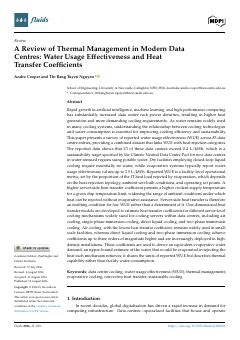
A Review of Thermal Management in Modern Data Centres: Water Usage Effectiveness and Heat Transfer Coefficients
Set WUE targets from the heat-rejection topology (dry, free-cooling, hybrid, evaporative) and not only the server-side cooling technology; WUE depends on the share of heat rejected by evaporation.
- Dry facilities with closed-loop liquid cooling need essentially no water, while evaporative systems typically report WUE up to 2.5 L/kWh.

Open Compute Project Foundation 2026
Base Specification for Two-Phase Dielectric Fluid-Based Heat Transfer Fluid (Cold Plate), Version 1.0.0
Record ASHRAE 34 safety class, GWP, ODP, boiling point and latent heat in the two-phase cold-plate fluid catalogue.
- Operating temperature 4-75 C and storage -20 to 60 C; fluid purity monitored annually.
Open Compute Project Foundation 2026
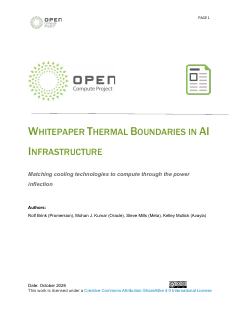
Whitepaper: Thermal Boundaries in AI Infrastructure - Matching cooling technologies to compute through the power inflection, Version 1.00 (October 2026)
Choose cooling architecture against target rack power and each method's usable envelope: a 45 kW air ceiling (60-80 kW with rear doors), 120-250 kW class cold-plate racks, and the paper's anchor values for announced 600 kW-class racks.
- Practical air-cooled rack ceiling is taken as 45 kW, extendable to about 60-80 kW with rear-door heat exchangers.

Open Compute Project Foundation 2026
Guidelines for Using Dielectric Heat Transfer Fluids in Two-Phase Cold Plate-Based Liquid-Cooled Racks, Revision 1.1 (March 2026)
Apply refrigerant-specific rules to two-phase DLC designs in place of water-loop rules: GWP below 700, A1 safety class, and vapour/liquid line sizing with under 0.2 bar evaporator-to-condenser loss.
- Minimal filtration is about 100 um; ambient during operation should stay within 5-35 C.