
Uptime Institute Global Data Center Survey 2023 (13th annual) - press release
Uptime Institute · Uptime Institute, D. Donnellan et al.
Press release for the 13th edition of Uptime Institute's annual survey, summarising industry-wide PUE, rack density, outage frequency and workload placement.
On this page
Overview
This document is the press release for the 13th edition of the Uptime Institute Global Data Center Survey, published every year. The survey ran online between February and April 2023, with more than 850 data center owners and operators and nearly 700 vendors and consultants responding. The release gives a short snapshot of where the industry is heading and points readers to a separate executive summary for the detailed findings. One headline finding is that average global PUE has stayed essentially flat for four years.
Another concerns rack density: the average is below 6 kW per rack, and most operators do not have a single rack above 20 kW. In other words, despite the attention given to AI-driven density, the typical installation in the field is still air-cooled and moderate in density. On outages, the release reports that 55% of respondents had an outage at their site in the past three years, the lowest share recorded so far.
The share of enterprise workloads hosted in on-premises facilities also fell below half for the first time. On staffing, it notes that roughly 8% of the data center workforce are women. Because this is a press release, it gives headline results rather than methodology or underlying data, and the sample consists of industry participants who chose to respond. The figures should be read as industry averages, not design targets, and verified against the full report where precision matters.
Key points
- Survey ran online February-April 2023; more than 850 owners/operators and nearly 700 vendors/consultants took part.
- Average global PUE has been flat for four years.
- Average rack density is below 6 kW per rack.
- Most operators have no racks above 20 kW.
- 55% reported a site outage in the past three years, the lowest share recorded.
- Share of enterprise workloads in on-premises facilities fell below half for the first time.
- Roughly 8% of the data center workforce are women.
Using it in design
- Keep the default rack-density preset for enterprise facilities below about 6-8 kW.
- Do not make direct liquid cooling (DLC) the default; offer it as an option for the minority of racks above 20 kW.
- When setting a PUE target, use the flat industry average as a benchmark and demonstrate any improvement through the design itself.
Monthly newsletter · free
Keep your reading list current
Once a month: new library sources, changes to Turkish regulations and upcoming data centre events.
SoSo CAD
Assess redundancy through scenarios
Compare normal operation and equipment failures in SoSo CAD, with supplied loads and capacity shortfalls in one view.
Request a demo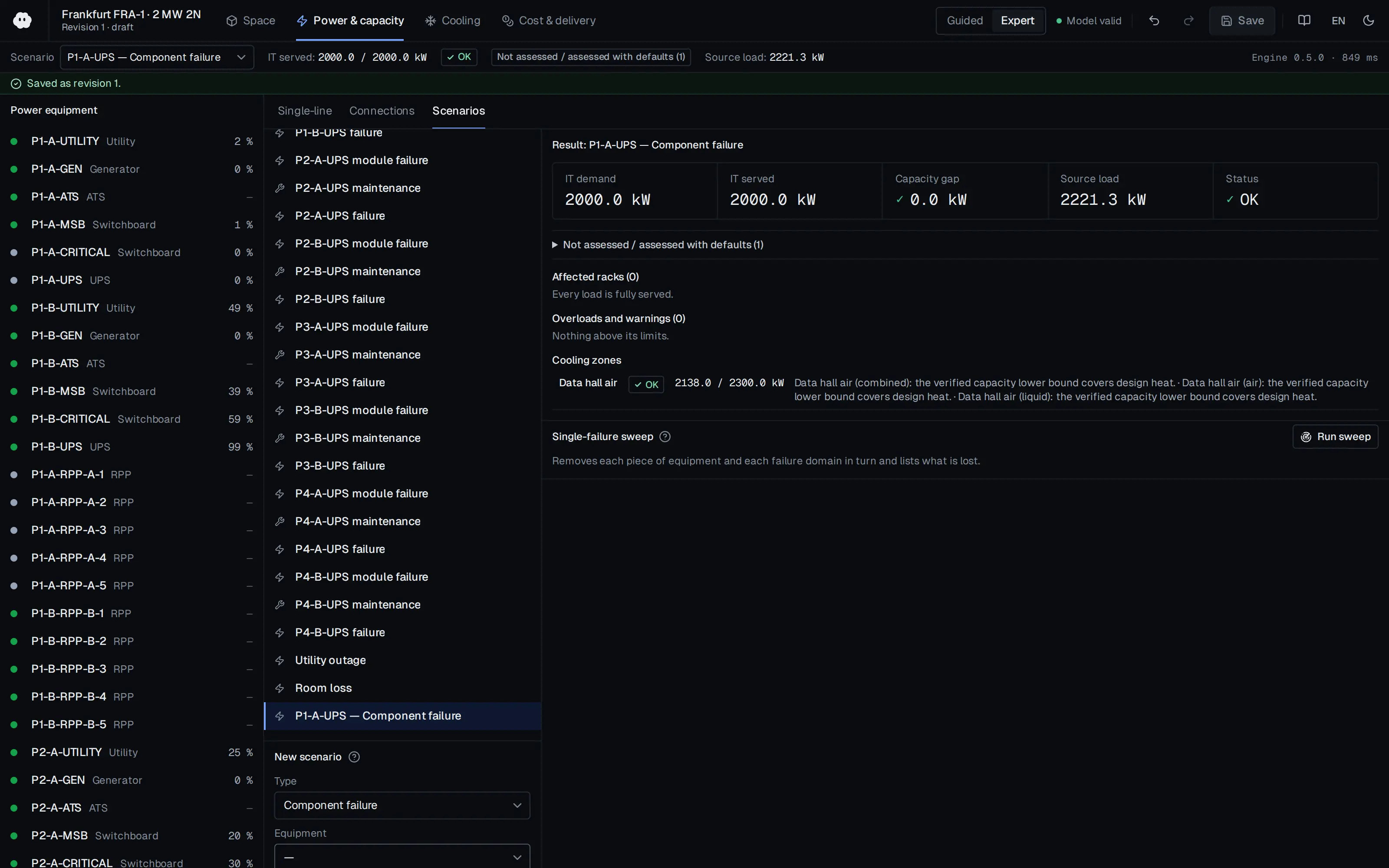
Who should read it
Data center designers, operations managers and decision makers who want to see current industry averages.
Publication details
- Authors
- Uptime Institute; D. Donnellan; D. Bizo; J. Davis; A. Lawrence; O. Rogers; L. Simon; M. Smolaks
- Publisher
- Uptime Institute
- Year
- 2023
- Document language
- English
- Source type
- Industry body
- Access
- Free to read
- Licence
- Copyright retained; citation only — the publisher’s terms apply to the original document
Original licence note
Publisher press release / public web page; copyright Uptime Institute, no open licence. Citation only.
Citation
Uptime Institute; D. Donnellan; D. Bizo; J. Davis; A. Lawrence; O. Rogers; L. Simon; M. Smolaks (2023). Uptime Institute Global Data Center Survey 2023 (13th annual) - press release. Uptime Institute. https://uptimeinstitute.com/about-ui/press-releases/uptimes-13th-annual-global-data-center-survey-shows-widening-range-of-challenges
Events on this subject
Browse the events calendarAll content and rights belong to the respective authors and publishers. SoSo CAD provides only the citation, its own summary and a link to the source, and is not responsible for the sources' content.