
Uptime Institute Global Data Center Survey 2026 (16th annual) — press release
Uptime Institute
Press summary of the 2026 survey: high-density racks are spreading fast, PUE improved only marginally, and more than half of operators now record water consumption.
On this page
Overview
The survey covers 800+ respondents, 52% of them in North America and Europe. That split is a reminder that the results reflect mainly Western markets rather than the whole world. The source is a press release; raw tables and the full report were not used. The clearest shift is density: a growing number of operators report peak rack densities of 30 kW or more. Average PUE improved only slightly, which the release attributes to legacy facilities limiting global progress.
New builds may be efficient, but the weight of the existing estate holds the average in place. The water and carbon gap stands out: more than 50% of operators now record water consumption, while carbon-emissions tracking remains a minority practice. On outages, fewer operators report an impactful outage over three years, but one in ten outages is still serious or severe and costs are climbing. Over half of respondents report difficulty hiring qualified staff.
Against the prior year's survey the main message is continuity plus a jump in density. The limit is that the source is a short press summary with little methodological detail. Reading the two surveys together helps: the 2025 survey put average PUE at about 1.54, essentially flat for six years, while the 2026 release mentions only a marginal improvement without giving a new number. The 1.54 figure can therefore stay in use as a year-stamped benchmark.
Key points
- A growing number of operators report peak rack densities of 30 kW or more
- Average PUE showed only minor improvement in 2026; legacy infrastructure limits global progress
- More than 50% of operators record water consumption; carbon-emissions tracking is a minority practice
- One in ten outages is classified serious or severe
- 52% of respondents in North America and Europe; 800+ responses
- Over half of respondents struggle to hire qualified staff
Using it in design
- Make 30 kW/rack the threshold where the app moves from 'enhanced air' guidance to 'liquid-ready' guidance (rear-door heat exchanger / direct liquid cooling)
- Make water metering (WUE inputs) a default-on metering point in the design checklist
- Offer carbon tracking as an optional metering point rather than a mandatory one
Monthly newsletter · free
Keep your reading list current
Once a month: new library sources, changes to Turkish regulations and upcoming data centre events.
SoSo CAD
Compare the cost of design decisions
Evaluate equipment costs, energy expenses and total cost of ownership (TCO) using your inputs and assumptions in SoSo CAD.
Request a demo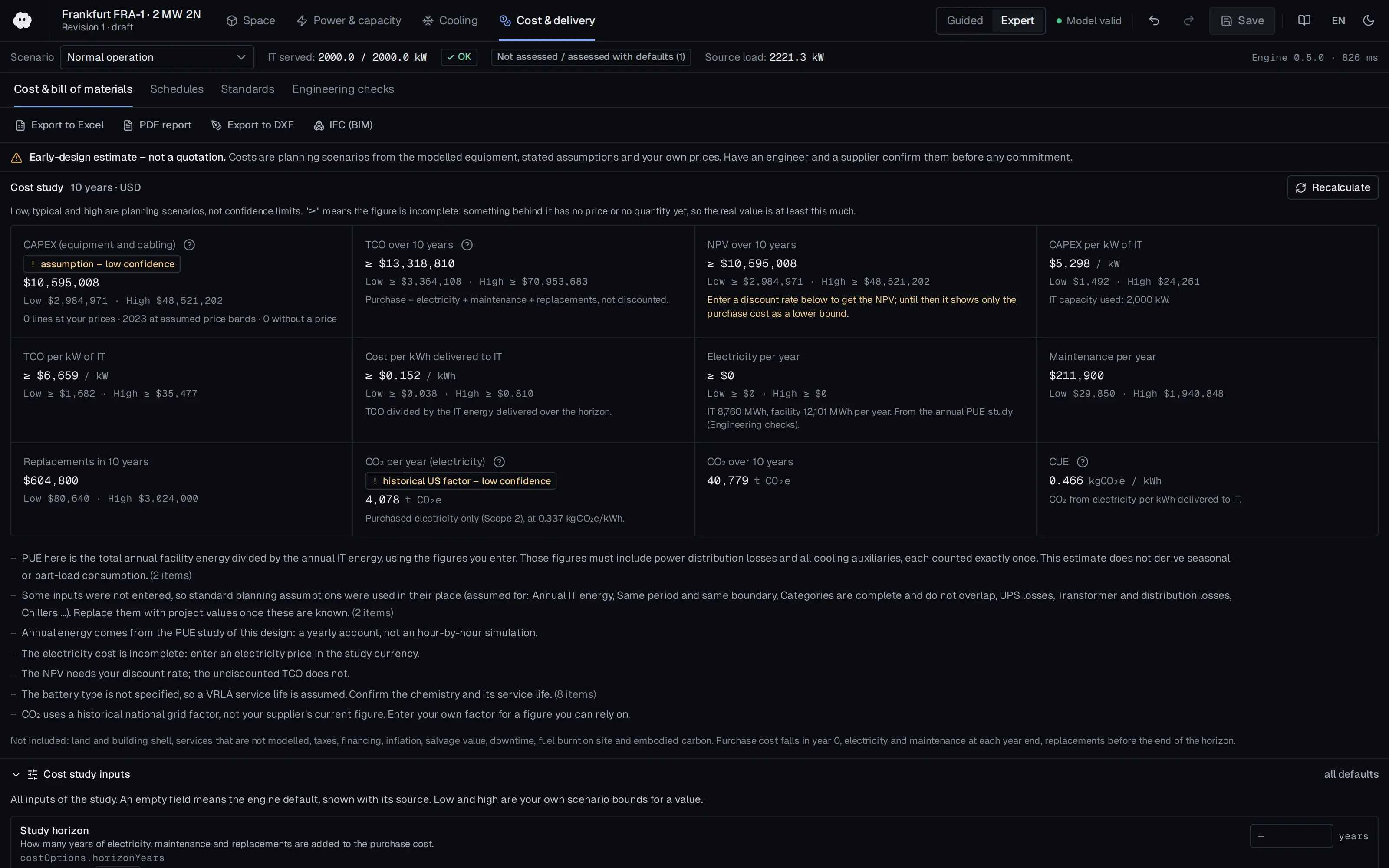
Who should read it
Engineers moving to high-density design, operators setting up sustainability reporting, and metering designers.
Related standards
- ISO/IEC 30134-2
- ISO/IEC 30134-9
Publication details
- Authors
- Uptime Institute
- Publisher
- Uptime Institute
- Year
- 2026
- Document language
- English
- Source type
- Industry body
- Access
- Free to read
- Licence
- Copyright retained; citation only — the publisher’s terms apply to the original document
Citation
Uptime Institute (2026). Uptime Institute Global Data Center Survey 2026 (16th annual) — press release. Uptime Institute. https://uptimeinstitute.com/about-ui/press-releases/16th-annual-2026-global-data-center-survey-deployment-of-high-density-racks-rising-fast-operators-face-continued-recruiting-and-retention-pressures
Events on this subject
Browse the events calendarAll content and rights belong to the respective authors and publishers. SoSo CAD provides only the citation, its own summary and a link to the source, and is not responsible for the sources' content.