
Smarter safety: IEC low- and medium-voltage arc flash mitigation solutions for greater protection and productivity
ABB
An ABB application guide that groups arc-flash protection into passive, active and preventive measures and serves as a comparison table of mitigation options for main switchboards.
On this page
Overview
Passive measures are arc-resistant construction and containment; active measures detect and clear the arc fast, or divert it; preventive measures are remote operation and predictive maintenance. The guide stresses that incident energy is directly proportional to arc current and arc duration, which is why clearing time is the main lever. The internal-arc test standards are IEC TR 61641 Ed.3 for LV switchgear (up to 0.5 s), IEC 62271-200 for MV switchgear (up to 1 s) and IEC 62271-202 for compact secondary substations (IAC AB up to 20 kA 1 s).
Without active mitigation the arc clearing time is typically 0.2-0.4 s; damage thresholds shown are about 0.1 s for a cable fire, 0.15 s for a copper fire and 0.2 s for a steel fire. Optical arc detection (TVOC-2, REA) operates in 1-2.5 ms, giving total clearing of 45-50 ms with an LV breaker and 50-100 ms with an MV breaker.
The Ultra-Fast Earthing Switch operates in about 1.5 ms, and combined with optical detection total arc duration is under 4 ms. Combining UFES with current-limiting fuses can reduce incident energy below 1 cal/cm2 (hazard risk category 0). The guide tabulates operating and total clearing times to compare the options; the figures belong to ABB products.
Key points
- Internal-arc tests: IEC TR 61641 Ed.3 for LV (up to 0.5 s), IEC 62271-200 for MV (up to 1 s), IEC 62271-202 for compact secondary substations (IAC AB up to 20 kA 1 s).
- Without active mitigation clearing time is typically 0.2-0.4 s; damage thresholds about 0.1 s cable fire, 0.15 s copper fire, 0.2 s steel fire.
- Optical arc detection (TVOC-2, REA) operates in 1-2.5 ms; total clearing 45-50 ms with an LV breaker, 50-100 ms with an MV breaker.
- The Ultra-Fast Earthing Switch operates in about 1.5 ms; with optical detection total arc duration is under 4 ms.
- UFES plus current-limiting fuses can cut incident energy below 1 cal/cm2 (risk category 0).
- Incident energy is directly proportional to arc current and duration; clearing time is the main lever.
Using it in design
- Keep internal-arc classification and test duration fields in the switchgear catalog, and arc-mitigation device type with operating time in the protection catalog.
- In the arc-flash estimate let the user pick a mitigation scheme and replace the protective device clearing time with the tabulated total clearing time.
- Warn when MV/LV main boards rely on breaker clearing times of 0.2-0.4 s without mitigation.
Monthly newsletter · free
Keep your reading list current
Once a month: new library sources, changes to Turkish regulations and upcoming data centre events.
SoSo CAD
Review your power design in SoSo CAD
Inspect supply paths, equipment loads and UPS failure scenarios in one model.
Request a demo
Who should read it
Electrical designers and safety engineers comparing arc-flash mitigation options for main switchboards.
Related standards
- IEC TR 61641
- IEC 62271-200
- IEC 62271-202
- IEEE 1584-2018
Publication details
- Authors
- ABB
- Publisher
- ABB
- Year
- 2021
- Document number
- 1SFC170004B0201 rev D
- Document language
- English
- Source type
- Manufacturer
- Access
- Free to read
- Licence
- Copyright retained; citation only — the publisher’s terms apply to the original document
Citation
ABB (2021). Smarter safety: IEC low- and medium-voltage arc flash mitigation solutions for greater protection and productivity. ABB. 1SFC170004B0201 rev D. https://library.e.abb.com/public/53de1e8dfbed4e34a58d9aca1b288b00/1SFC170004B0201%20revD_Arc%20Flash%20Mitigation%20Solutions.pdf
Events on this subject
Browse the events calendarAll content and rights belong to the respective authors and publishers. SoSo CAD provides only the citation, its own summary and a link to the source, and is not responsible for the sources' content.
Related sources
All sources on this topicABB 2013
5 reasons - other than safety - to use arc-flash resistant switchgear
Add an 'arcResistant' field to the switchgear catalog with classification (for example IEC 62271-200 IAC / IEC TR 61641 / IEEE C37.20.7).
- Maintenance on arc-resistant gear can be done without Category 3 or 4 PPE.
ABB 2013
Industrial-strength solutions to reduce risk in the data center
In the operations module include DCIM/EPMS integration points per device (protocol: Modbus, IEC 61850).
- Typical ROI for an industrial-grade control platform in a data centre is given as 12-18 months.
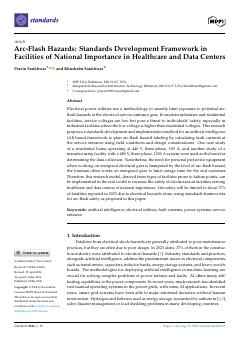
Standards (MDPI AG) 2026
Arc-Flash Hazards: Standards Development Framework in Facilities of National Importance in Healthcare and Data Centers
Schedule the arc-flash study after the coordination study and make that order a mandatory step in the project plan and model.
- Example studies assumed available utility fault current of 21,000 A for the 440 V residential service and 21,000-40,000 A for the 480 V/1200 A commercial service.
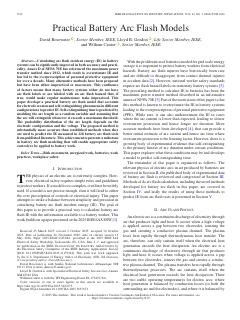
IEEE Transactions on Industry Applications (Institute of Electrical and Electronics Engineers (IEEE)) 2026
Practical Battery Arc Flash Models
In battery-room arc-flash labelling, calculate the self-extinguishing model alongside the maximum power method rather than using the latter as the only reference, and check cases where excessive PPE categories make maintenance impractical.
- An arc-in-a-box coefficient of 1.52, based on the value calculated for panelboards, was used for enclosed-space experiments.
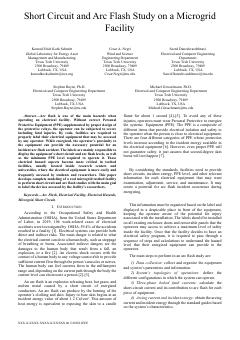
arXiv (Texas Tech University) 2021
Short Circuit and Arc Flash Study on a Microgrid Facility
In a data-centre LV system with generator backup, run the arc-flash study for both grid-connected and islanded topologies, and check that the much lower islanded fault current (1,296 A instead of 22,793 A) does not lengthen clearing time.
- A factor of 1.4 was applied to the datasheet maximum short-circuit current of inverter-based sources as a safety band.
Headquarters, Department of the Army (U.S. Army Corps of Engineers) 2007
TM 5-698-1 Reliability/Availability of Electrical & Mechanical Systems for Command, Control, Communications, Computer, Intelligence, Surveillance and Reconnaissance (C4ISR) Facilities (19 January 2007)
When writing an availability target into a data centre specification, state the measurement interval as well; the same downtime gives 95.83 or 99.86 percent depending on the interval.
- With exponentially distributed failures, reliability at an operating time equal to the MTBF is only about 37 percent (e^-1 = 0.368).