
TM 5-698-1 Reliability/Availability of Electrical & Mechanical Systems for Command, Control, Communications, Computer, Intelligence, Surveillance and Reconnaissance (C4ISR) Facilities (19 January 2007)
Headquarters, Department of the Army (U.S. Army Corps of Engineers) · Headquarters, Department of the Army
An Army manual on reliability, availability and maintainability (RAM) analysis of the electrical and mechanical systems of mission-critical facilities. It gives the definitions, redundancy rules, block-diagram, Markov and Monte Carlo modelling methods and weak-link identification, with worked examples.
U.S. public domain — U.S. Government work; free to reuse
On this page
Overview
TM 5-698-1 gives facility managers the information and procedures needed to baseline the reliability and availability of their facilities, identify weak links and choose cost-effective ways to improve them. Its scope is the electrical and mechanical systems of C4ISR (command, control, communications, computer, intelligence, surveillance and reconnaissance) facilities, which in practice resemble military data centres. It supersedes the edition of 14 March 2003 and reflects the move toward commercial practices.
Chapter 1 defines the basic terms: availability is the proportion of time a system is ready to perform its required function, written as 0.99999 or 99.999 percent; reliability is the probability of no failure; maintainability is the ease of restoring an item. The text notes that the electric power industry has historically used reliability to mean availability. Chapter 2 covers probability, reliability calculation and availability calculation (block diagrams, series and parallel structures, MTBF and MTTR combinations).
Chapter 3 describes the improvement process on two tracks. For new facilities: set the availability requirement, derive reliability and maintainability requirements, develop one-line diagrams, predict by analysis and test. For existing facilities: collect data, measure baseline performance, identify shortfalls and rank improvements by cost-benefit analysis. Redundancy and reliability-centered maintenance (RCM) are treated as improvement tools. Chapter 4 presents the modelling methods (minimal cut sets, network reduction, Boolean algebra, Markov, Monte Carlo) and worked examples.
The central warning is that results are extremely sensitive to assumptions, method and data, and that no result should be distributed without documentation of those attributes. The text also notes that UPS battery life was historically assumed to be limitless, that standby equipment has different failure distributions from primary equipment, and that upstream effects of failures, such as a breaker that fails to open, are missed by simple top-down models. The manual dates from 2007; the methods remain sound, but component data should come from TM 5-698-5.
Key points
- Availability is the fraction of time a system can perform its function, written for example as 0.99999 or 99.999 percent (five nines).
- With exponentially distributed failures, reliability at an operating time equal to the MTBF is only about 37 percent (e^-1 = 0.368).
- Inherent availability Ai = MTBF / (MTBF + MTTR) x 100; a 95 percent requirement might be met with an MTBF of at least 600 h and an MTTR of at most 3.5 h.
- Observed availability A = uptime / (uptime + downtime); 10 h of downtime gives 95.83 percent over 240 h but 99.86 percent over 7,200 h, so contracts must state the measurement interval.
- A five-subsystem example (MTBFs of 750-4,000 h, MTTRs of 1-4 h, some duplicated) yields 99.7236 percent availability over 10,000 Monte Carlo trials of 1,000 h; the lowest-MTBF subsystem contributes 32 percent of system unreliability even with dual redundancy.
- An existing facility has three ways to raise availability: selective redundancy that removes single points of failure (generators, chillers, fuel supply), RCM to optimise maintenance, and replacing low-reliability subsystems.
- For a new facility the sequence is availability requirement, derived reliability and maintainability requirements, one-line diagram, predictive analysis, testing, design revision and continuing assessment in operation.
- The reliability of a series system is the product of component reliabilities (Lusser's law); the eight-step analysis process in chapter 4 requires validation throughout.
- For simple systems cut-set, network reduction and Boolean methods give similar results when assumptions are equal; larger systems and time-dependent failures (belts, valves, batteries) call for simulation.
- When one redundant unit fails it must be repaired or replaced to keep the intended redundancy, which is the basic argument for a maintenance programme.
Using it in design
- When writing an availability target into a data centre specification, state the measurement interval as well; the same downtime gives 95.83 or 99.86 percent depending on the interval.
- Convert the user-facing target (operational availability) into controllable design measures (MTBF, MTTR, inherent availability) and allocate targets to each subsystem.
- Model power and cooling topologies with block diagrams or Monte Carlo; find which subsystem contributes most to unreliability (32 percent in the example) and concentrate redundancy there.
- Do not assume unlimited UPS battery life, and treat the different failure distribution of standby equipment and failures with upstream effect, such as a breaker failing to open, separately.
- Document the source and uncertainty of the MTBF and MTTR data used as model input; the text names the data as the single point of vulnerability of the model.
- In maintenance planning remember that redundancy reduces the probability of system-level loss but does not reduce the total number of failures.
Monthly newsletter · free
Keep your reading list current
Once a month: new library sources, changes to Turkish regulations and upcoming data centre events.
SoSo CAD
Assess redundancy through scenarios
Compare normal operation and equipment failures in SoSo CAD, with supplied loads and capacity shortfalls in one view.
Request a demo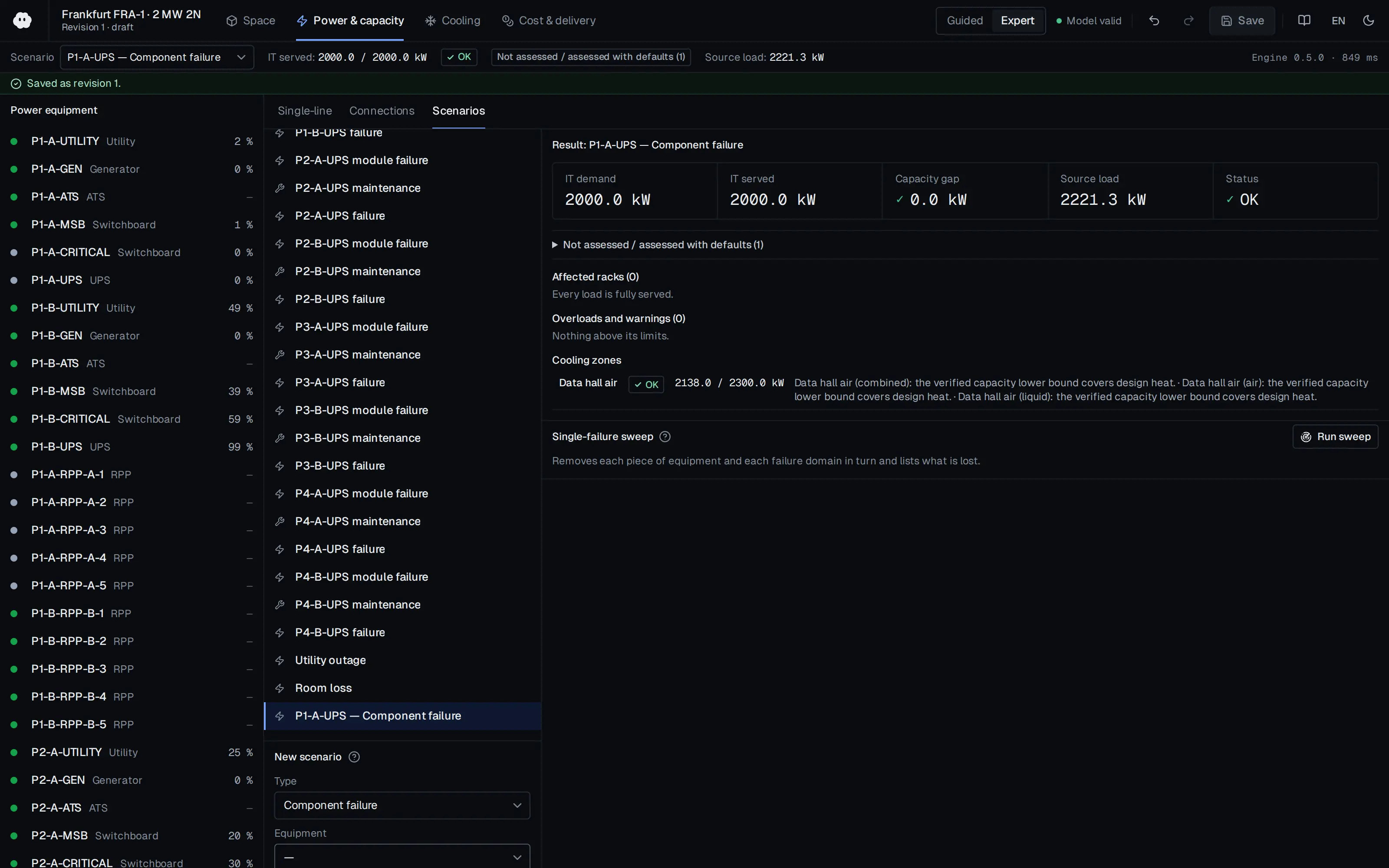
Who should read it
Design and operations engineers who set availability targets, compare topologies and carry out RAM modelling.
Document contents
- Chapter 1 Introduction: purpose, scope, definitions, historical perspective
- 1-6 Relationship among reliability, maintainability, and availability
- 1-7 The importance of availability and reliability to C4ISR facilities
- 1-8 Improving availability of C4ISR facilities
- Chapter 2 Basic Reliability and Availability Concepts
- 2-1 Probability and statistics
- 2-2 Calculating reliability
- 2-3 Calculating availability
- 2-4 Predictions and assessments
- Chapter 3 Improving Availability of C4ISR Facilities
- 3-2 New facilities / 3-3 Existing facilities
- 3-4 Improving availability through addition of redundancy
- 3-5 / 3-6 Improving availability through reliability-centered maintenance (RCM)
- Chapter 4 Assessing Reliability and Availability of C4ISR Facilities: methods, modeling examples, modeling complexities
- Appendix B The Mathematics of Reliability
- Appendix C Point Estimates and Confidence Bounds
- Appendix D Factors Influencing Field Measures of Reliability
Read the document
usace-tm-5-698-1-reliability.pdf
U.S. public domain — U.S. Government work; free to reuse
The document is provided unaltered because its licence permits redistribution.
Publication details
- Authors
- Headquarters, Department of the Army
- Publisher
- Headquarters, Department of the Army (U.S. Army Corps of Engineers)
- Year
- 2007
- Document language
- English
- Source type
- Government / public
- Access
- Open licence — downloadable
- Licence
- U.S. public domain — U.S. Government work; free to reuse
- Licence evidence
- www.copyright.gov
Original licence note
DoD/USACE criteria marked "Approved for public release; distribution unlimited"; work of the U.S. Government (17 U.S.C. 105).
Citation
Headquarters, Department of the Army (2007). TM 5-698-1 Reliability/Availability of Electrical & Mechanical Systems for Command, Control, Communications, Computer, Intelligence, Surveillance and Reconnaissance (C4ISR) Facilities (19 January 2007). Headquarters, Department of the Army (U.S. Army Corps of Engineers). https://www.wbdg.org/FFC/ARMYCOE/COETM/tm_5_698_1.pdf
Events on this subject
Browse the events calendarAll content and rights belong to the respective authors and publishers. SoSo CAD provides only the citation, its own summary and a link to the source, and is not responsible for the sources' content.
Related sources
All sources on this topicUptime Institute 2026
Uptime Institute Tier Classification System
Model 'reliability.target' as an enum {TierI..TierIV} driving topology defaults: Tier I single path N; Tier II N+1 capacity components, single path; Tier III N+1 components AND two distribution paths (one may be passive), concurrently maintainable; Tier IV 2N or 2(N+1), two active physically compartmentalized paths and continuous cooling with UPS-backed pumps/fans.
- Over 4,300 Tier Certification awards in 120+ countries (2026).
Siemens 2025
The quest for 99.999%: Increasing levels of resilience
In the rating module, map Uptime Tier to EN 50600 class (I/1, II/2, III/3, IV/4) as an approximate equivalence with a caveat tooltip.
- Five nines = 99.999%, about 5.3 min/yr.
Schneider Electric 2012
Data Center Projects: Advantages of Using a Reference Design
Store reference designs as structured objects with required attribute fields (IT kW range, redundancy N/N+1/2N for power and cooling, density kW/rack, annualized PUE, heat rejection type, estimated cost) plus linked one-lines, layouts and BOM lines (part number, qty, supplier).
- Graphics: electrical, mechanical and IT one-lines; layouts with dimensions and clearances of racks, PDUs, CRAC/CRAHs, UPSs, generators, switchboards, ATSs; 3D views.
Headquarters, Department of the Army (U.S. Army Corps of Engineers PREP) 2006
TM 5-698-5 Survey of Reliability and Availability Information for Power Distribution, Power Generation, and Heating, Ventilating and Air Conditioning (HVAC) Components for Commercial, Industrial, and Utility Installations (22 July 2006)
When modelling the power and cooling chain use these values as starting failure rates and MTBF/MTTR inputs and convert them into availability with the method of TM 5-698-1.
- Diesel engine generators overall: 0.528 failures/yr, MTBF about 16,590 h, MTTR 24.22 h, operational availability 0.99399.
Journal of Engineering Research and Sciences (Journal of Engineering Research and Sciences) 2026
CFD Analysis of Data Center Hall Cooling Performance under Normal and Failure Modes with Control Strategies and Airflow Leakages
Do thermal verification of failure mode (two ACUs offline) with realistic air leakage (cabinet gaps, HAC panel joints); a leak-free model can comply while the leaky model exceeds 32 °C.
- The grid study selected 7,288,454 cells with the standard k-epsilon model and wall functions.
U.S. DOE FEMP 2010
Operations & Maintenance Best Practices: A Guide to Achieving Operational Efficiency, Release 3.0 (August 2010)
Choose maintenance strategy by equipment criticality: predictive for critical equipment with random failures, preventive for equipment subject to wear, reactive for small non-critical items; build a master equipment list and priority matrix.
- Boiler combustion tuning and related O&M can yield fuel savings of 2% to 20%.