
The quest for 99.999%: Increasing levels of resilience
Siemens
This six-page 2025 Siemens brochure sets the ISO/IEC 22237 (EN 50600) availability classes beside the Uptime Tier I-IV classification and explains N, N+1 and 2N redundancy. It collects the annual downtime figures commonly attributed to each Tier in one table.
On this page
Overview
The brochure compares two frameworks. EN 50600 / ISO 22237 defines classes 1-4 as low, medium, high and very high resilience, while Uptime uses Tiers I-IV. The approximate mapping reads I/1, II/2, III/3 and IV/4, but the two systems come from different bodies with different methods and are not strictly equivalent. For power paths and cooling it explains N, N+1 and 2N, and the key distinction is that class 3 is concurrently maintainable while class 4 is fault tolerant: in class 4 a single fault or a maintenance action does not cause a loss of service.
The definition puts weight on how the paths are separated rather than on how many redundant units exist. It reproduces the commonly cited Tier availability figures: Tier I 99.67% (28.8 h/yr), Tier II 99.75% (22 h), Tier III 99.98% (1.6 h), Tier IV 99.99% (0.8 h). Five nines, 99.999%, equals about 5.3 minutes a year. For example, in class 3 taking one path out for maintenance does not cut service, but a second fault during that work could; class 4 covers that case too.
The role of BMS and EPMS is presented as the operational contribution needed to reach five-nines operation. These numbers are not official Uptime values; Uptime no longer publishes availability percentages, and the brochure presents them only as commonly cited figures. As a six-page vendor brochure it offers a decision-maker summary rather than a worked calculation. The gap between Tier IV's 0.8 h/yr and five nines' 5.3 minutes shows the classification alone does not guarantee five nines.
Key points
- EN 50600/ISO 22237 availability classes 1-4: low, medium, high, very high resilience.
- Commonly cited Tier availability: I 99.67% (28.8 h/yr), II 99.75% (22 h), III 99.98% (1.6 h), IV 99.99% (0.8 h).
- Five nines = 99.999%, about 5.3 min/yr.
- Class 3 = concurrently maintainable; class 4 = fault tolerant (single fault or maintenance without loss).
- Standards covered: ISO/IEC 22237, EN 50600-1, EN 50600-2-2, EN 50600-2-3.
Using it in design
- In the rating module, map Uptime Tier to EN 50600 class (I/1, II/2, III/3, IV/4) as an approximate equivalence with a caveat tooltip.
- Show per-Tier availability numbers only labelled as commonly cited, not official Uptime values.
- Run single-point-of-failure checks on the maintenance path for class 3 and on the failure path for class 4.
- Translate a target availability into annual downtime (for example 99.999% is about 5.3 min) when presenting it to users.
Monthly newsletter · free
Keep your reading list current
Once a month: new library sources, changes to Turkish regulations and upcoming data centre events.
SoSo CAD
Assess redundancy through scenarios
Compare normal operation and equipment failures in SoSo CAD, with supplied loads and capacity shortfalls in one view.
Request a demo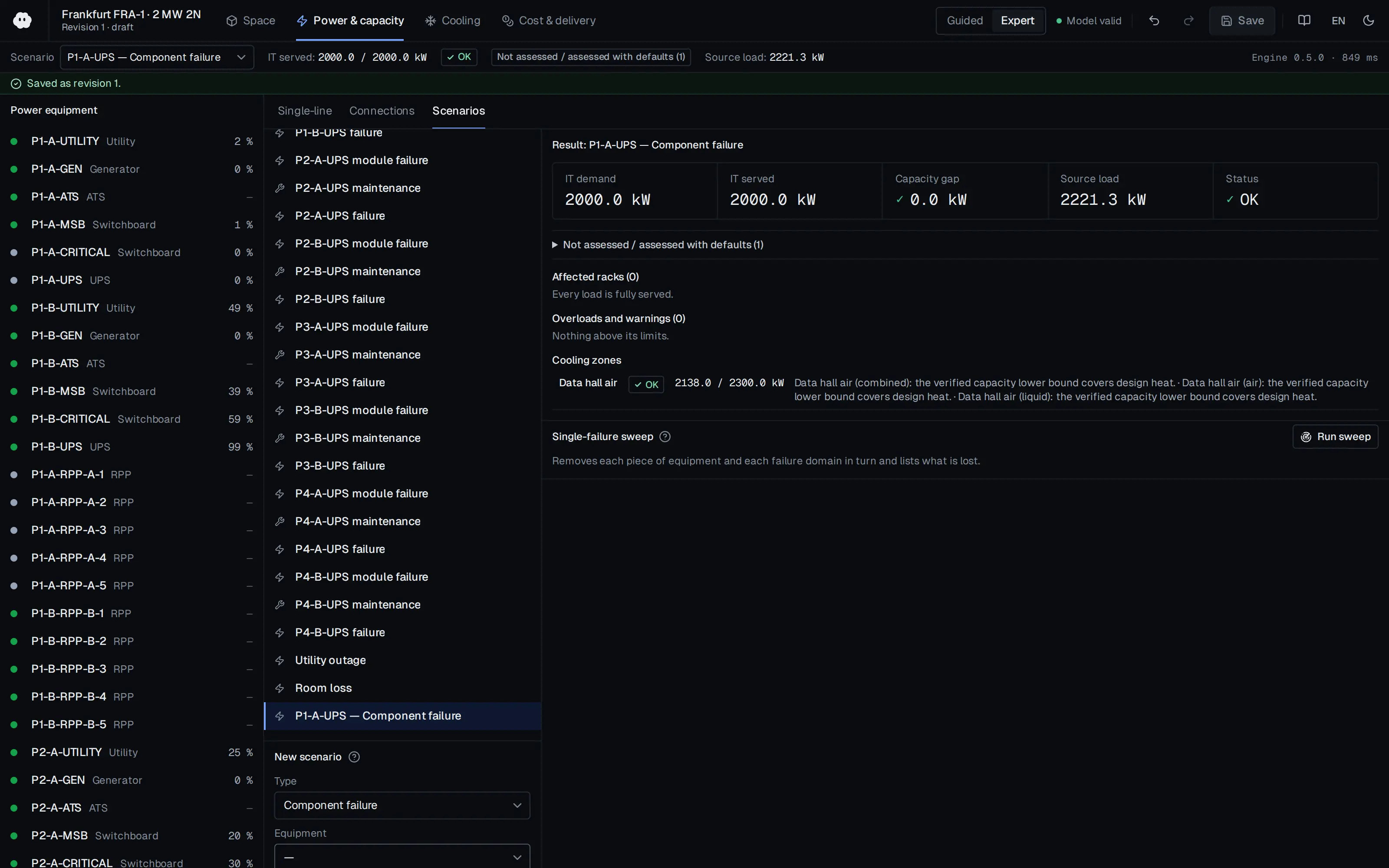
Who should read it
Engineers and managers choosing between Tier and EN 50600 classes or explaining resilience targets to leadership.
Related standards
- ISO/IEC 22237
- EN 50600-1
- EN 50600-2-2
- EN 50600-2-3
- Uptime Tier Standard: Topology
Publication details
- Authors
- Siemens
- Publisher
- Siemens
- Year
- 2025
- Document language
- English
- Source type
- Manufacturer
- Access
- Free to read
- Licence
- Copyright retained; citation only — the publisher’s terms apply to the original document
Citation
Siemens (2025). The quest for 99.999%: Increasing levels of resilience. Siemens. https://assets.new.siemens.com/siemens/assets/api/uuid:34aace9c-ac2a-4090-bd6f-db92566b5c92/Data-Centers-RefArch-Quest-99_original.pdf
Events on this subject
Browse the events calendarAll content and rights belong to the respective authors and publishers. SoSo CAD provides only the citation, its own summary and a link to the source, and is not responsible for the sources' content.
Related sources
All sources on this topic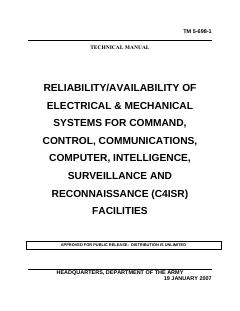
Headquarters, Department of the Army (U.S. Army Corps of Engineers) 2007
TM 5-698-1 Reliability/Availability of Electrical & Mechanical Systems for Command, Control, Communications, Computer, Intelligence, Surveillance and Reconnaissance (C4ISR) Facilities (19 January 2007)
When writing an availability target into a data centre specification, state the measurement interval as well; the same downtime gives 95.83 or 99.86 percent depending on the interval.
- With exponentially distributed failures, reliability at an operating time equal to the MTBF is only about 37 percent (e^-1 = 0.368).
Uptime Institute 2026
Uptime Institute Tier Classification System
Model 'reliability.target' as an enum {TierI..TierIV} driving topology defaults: Tier I single path N; Tier II N+1 capacity components, single path; Tier III N+1 components AND two distribution paths (one may be passive), concurrently maintainable; Tier IV 2N or 2(N+1), two active physically compartmentalized paths and continuous cooling with UPS-backed pumps/fans.
- Over 4,300 Tier Certification awards in 120+ countries (2026).
Schneider Electric 2012
Data Center Projects: Advantages of Using a Reference Design
Store reference designs as structured objects with required attribute fields (IT kW range, redundancy N/N+1/2N for power and cooling, density kW/rack, annualized PUE, heat rejection type, estimated cost) plus linked one-lines, layouts and BOM lines (part number, qty, supplier).
- Graphics: electrical, mechanical and IT one-lines; layouts with dimensions and clearances of racks, PDUs, CRAC/CRAHs, UPSs, generators, switchboards, ATSs; 3D views.
Journal of Engineering Research and Sciences (Journal of Engineering Research and Sciences) 2026
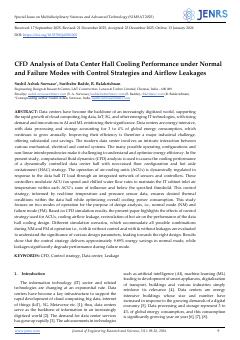
CFD Analysis of Data Center Hall Cooling Performance under Normal and Failure Modes with Control Strategies and Airflow Leakages
Do thermal verification of failure mode (two ACUs offline) with realistic air leakage (cabinet gaps, HAC panel joints); a leak-free model can comply while the leaky model exceeds 32 °C.
- The grid study selected 7,288,454 cells with the standard k-epsilon model and wall functions.
U.S. DOE FEMP 2010
Operations & Maintenance Best Practices: A Guide to Achieving Operational Efficiency, Release 3.0 (August 2010)
Choose maintenance strategy by equipment criticality: predictive for critical equipment with random failures, preventive for equipment subject to wear, reactive for small non-critical items; build a master equipment list and priority matrix.
- Boiler combustion tuning and related O&M can yield fuel savings of 2% to 20%.
U.S. Army Corps of Engineers (Headquarters, Department of the Army) 2006
TM 5-698-4 Failure Modes, Effects and Criticality Analyses (FMECA) for Command, Control, Communications, Computer, Intelligence, Surveillance, and Reconnaissance (C4ISR) Facilities (29 September 2006)
At design stage run a functional FMEA of each critical system (power, generators, cooling); do not start without schematics, bill of materials, block diagram and the mission requirement.
- The Risk Priority Number is Severity (1-10) x Occurrence (1-10), optionally multiplied by Detection: RPN = S x O x D.