
Uptime Institute Tier Classification System
Uptime Institute
Uptime Institute's public page summarises its four-level Tier system for site infrastructure. It stresses that Tiers are performance-based rather than prescriptive, and that a higher Tier is not inherently better but should be matched to business need.
On this page
Overview
The four levels are defined as Tier I Basic Capacity (UPS, dedicated cooling, generator), Tier II Redundant Capacity Components, Tier III Concurrently Maintainable and Tier IV Fault Tolerant. Each Tier includes all lower-Tier requirements. Tier I and II need a site-wide shutdown for maintenance, and in Tier II distribution failures still affect the site. In Tier III every capacity component and distribution path can be removed on a planned basis without affecting IT, though the site stays exposed to unplanned failure and operator error.
In Tier IV a single equipment failure or distribution-path interruption does not affect IT, which requires physical isolation (compartmentalization) of redundant systems and continuous cooling. To realise the benefit, all IT equipment must have a fault-tolerant (dual-corded) power design. The page states that the second half of the classification is Operational Sustainability, so certification covers operating practice as well as topology.
Building codes, climate, security and property issues are explicitly outside the Tier standard. It reports over 4,300 Tier Certification awards in 120+ countries as of 2026. This is a marketing-level overview; detailed criteria live in the Tier Standard: Topology document and are not here. The availability percentages that circulate in older sources are not given on this page as official Uptime values.
Key points
- Four Tiers: I Basic Capacity, II Redundant Capacity Components, III Concurrently Maintainable, IV Fault Tolerant; each includes all lower-Tier requirements.
- Tier III: every capacity component and distribution path can be removed on a planned basis without impacting IT; still exposed to unplanned failure and operator error.
- Tier IV: a single equipment failure or distribution-path interruption does not impact IT; requires physical isolation and continuous cooling.
- Tier IV needs all IT equipment to be dual-corded to realise its benefit.
- Tier I and II require site-wide shutdowns for maintenance; Tier II distribution failures still impact the site.
- Operational Sustainability is the second half of the classification.
- Over 4,300 Tier Certification awards in 120+ countries (2026).
Using it in design
- Model 'reliability.target' as an enum {TierI..TierIV} driving topology defaults: Tier I single path N; Tier II N+1 capacity components, single path; Tier III N+1 components AND two distribution paths (one may be passive), concurrently maintainable; Tier IV 2N or 2(N+1), two active physically compartmentalized paths and continuous cooling with UPS-backed pumps/fans.
- Add a rule checker that flags single points of failure on the maintenance path (Tier III) or the failure path (Tier IV).
- In UI copy say 'designed to Tier III topology intent', never 'Tier III certified'; Tier is a trademarked Uptime classification.
- For a Tier IV target, ask the user explicitly to confirm the dual-corded IT equipment assumption.
Monthly newsletter · free
Keep your reading list current
Once a month: new library sources, changes to Turkish regulations and upcoming data centre events.
SoSo CAD
Assess redundancy through scenarios
Compare normal operation and equipment failures in SoSo CAD, with supplied loads and capacity shortfalls in one view.
Request a demo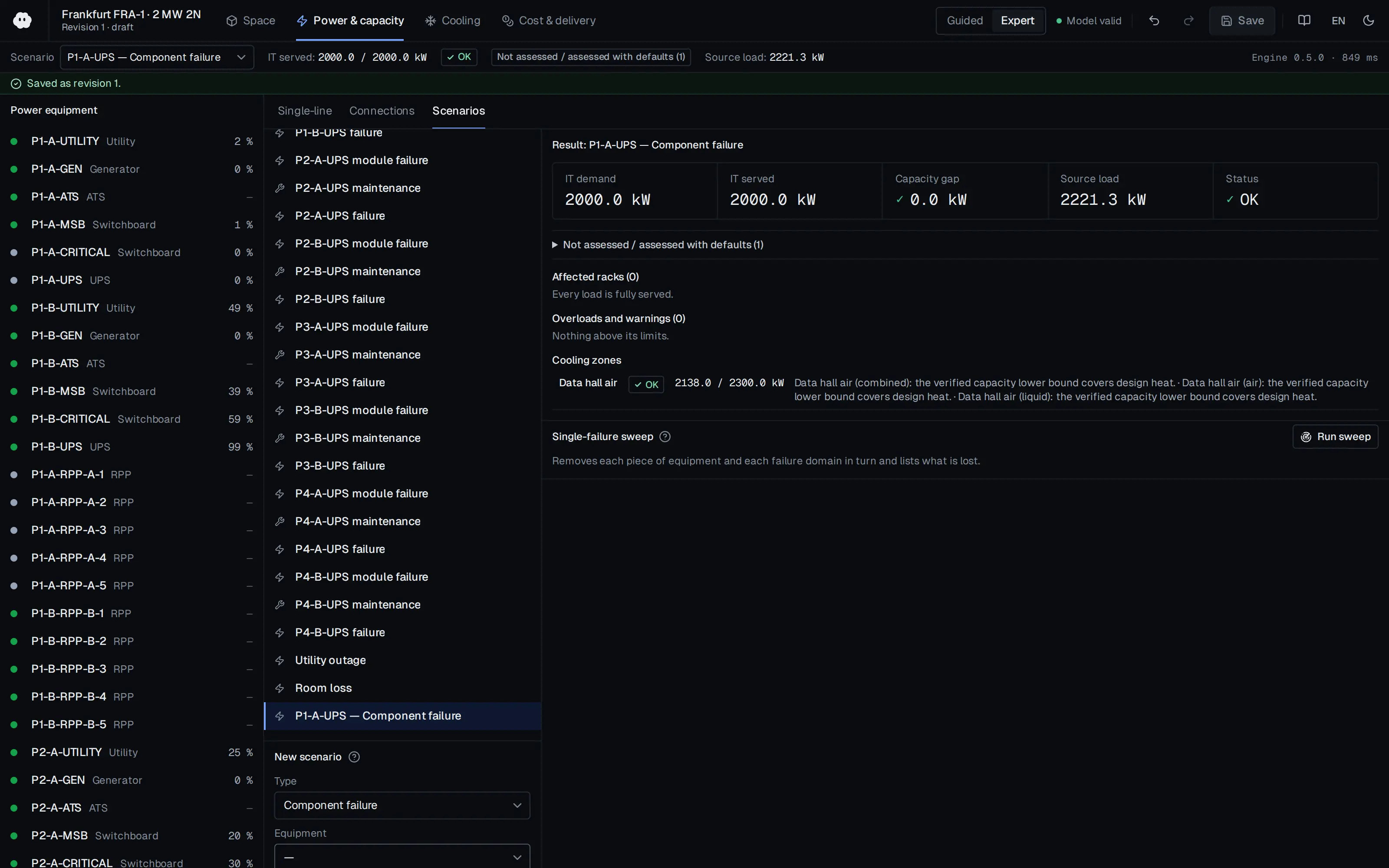
Who should read it
Designers and decision makers choosing a target reliability tier and mapping it to topology decisions.
Related standards
- Uptime Tier Standard: Topology
- Uptime Tier Standard: Operational Sustainability
- TIA-942
- EN 50600-1
- ANSI/BICSI 002
Publication details
- Authors
- Uptime Institute
- Publisher
- Uptime Institute
- Year
- 2026
- Document language
- English
- Source type
- Industry body
- Access
- Free to read
- Licence
- Copyright retained; citation only — the publisher’s terms apply to the original document
Citation
Uptime Institute (2026). Uptime Institute Tier Classification System. Uptime Institute. https://uptimeinstitute.com/tiers
Events on this subject
Browse the events calendarAll content and rights belong to the respective authors and publishers. SoSo CAD provides only the citation, its own summary and a link to the source, and is not responsible for the sources' content.
Related sources
All sources on this topic
Headquarters, Department of the Army (U.S. Army Corps of Engineers) 2007
TM 5-698-1 Reliability/Availability of Electrical & Mechanical Systems for Command, Control, Communications, Computer, Intelligence, Surveillance and Reconnaissance (C4ISR) Facilities (19 January 2007)
When writing an availability target into a data centre specification, state the measurement interval as well; the same downtime gives 95.83 or 99.86 percent depending on the interval.
- With exponentially distributed failures, reliability at an operating time equal to the MTBF is only about 37 percent (e^-1 = 0.368).
Siemens 2025
The quest for 99.999%: Increasing levels of resilience
In the rating module, map Uptime Tier to EN 50600 class (I/1, II/2, III/3, IV/4) as an approximate equivalence with a caveat tooltip.
- Five nines = 99.999%, about 5.3 min/yr.
Schneider Electric 2012
Data Center Projects: Advantages of Using a Reference Design
Store reference designs as structured objects with required attribute fields (IT kW range, redundancy N/N+1/2N for power and cooling, density kW/rack, annualized PUE, heat rejection type, estimated cost) plus linked one-lines, layouts and BOM lines (part number, qty, supplier).
- Graphics: electrical, mechanical and IT one-lines; layouts with dimensions and clearances of racks, PDUs, CRAC/CRAHs, UPSs, generators, switchboards, ATSs; 3D views.
Uptime Institute 2026
Uptime Institute Annual Outage Analysis 2026 (8th annual) — press release (with 2025 findings)
Weight UPS, ATS/STS and generator failure modes highest in the reliability model
- About 1 in 10 outages has serious or severe impact
Uptime Institute Journal 2026
Survey findings link higher redundancy to lower outage risk (Owen Rogers, Douglas Donnellan)
Use these ratios as indicative risk multipliers in an option-comparison view, for example showing relative outage likelihood when switching cooling from N+1 to 2N.
- Power, same comparison: 23%, 37% and 44%.
Uptime Institute 2025
Uptime Annual Outage Analysis 2025 (7th annual) - press release
When presenting availability improvements, emphasise procedure adherence and training alongside topology.
- IT and networking issues totalled 23% in 2024.