
Powering the AI Revolution: Building the Infrastructure That Makes Intelligence Possible (Manja Thessin)
BICSI ICT Today · Manja Thessin
Manja Thessin argues that AI data centers must be planned as an integrated system of compute, data movement and energy rather than siloed disciplines. Rack power, network traffic and electricity supply are parts of one whole.
On this page
Overview
The article appears in BICSI ICT Today, Vol. 47, No. 1 (Jan/Feb/Mar 2026), p. 30. The author argues that AI data centers must be planned as an integrated system of compute, data movement and energy rather than as siloed disciplines.
It notes that training compute grew about 1.5x per year from 1950 to 2010 and roughly 4.3-4.6x per year since 2010 (Epoch AI data). 150 kW racks are described as standard deployments, with roadmaps beyond 200 kW, affecting airflow, floor loading and service access. Meta and others report 30-40% of AI system time lost to network wait states, with tail latency driving utilization.
On energy, data centers used about 536 TWh in 2025 (about 2% of global electricity), projected to reach 1,065 TWh by 2030, which makes power procurement strategic. Later pages address fiber density: some AI clusters need 2x, 4x or even 10x the fiber of previous hyperscale sites, with per-rack counts reaching several thousand and some sites exceeding one million terminations.
Hollow-core fiber can cut propagation delay by up to 40%, while single-mode is winning new builds for reach and coherent-optics compatibility. The related source is IEEE 802.3dj. The article is an industry viewpoint; it gives trends and scale rather than detailed design rules.
Key points
- Training compute grew about 1.5x per year 1950-2010 and roughly 4.3-4.6x per year since 2010 (Epoch AI data).
- 150 kW racks are described as standard deployments, with roadmaps beyond 200 kW, affecting airflow, floor loading and service access.
- Meta and others report 30-40% of AI system time lost to network wait states.
- Data centers used about 536 TWh in 2025 (about 2% of global electricity), projected to reach 1,065 TWh by 2030.
- Some AI clusters need 2x, 4x or 10x the fiber of previous hyperscale sites; per-rack counts reach several thousand and some sites exceed one million terminations.
- Hollow-core fiber can cut propagation delay by up to 40%.
- Single-mode is winning new builds for reach and coherent-optics compatibility.
Using it in design
- For AI templates, default to single-mode fiber, high-count trunks and dedicated back-end fabric pathways.
- Size floor loading and service clearances for 150-200 kW racks.
- Show fiber termination counts per rack in the network BOM.
- Run compute, network and power planning as one integrated process.
Monthly newsletter · free
Keep your reading list current
Once a month: new library sources, changes to Turkish regulations and upcoming data centre events.
SoSo CAD
Compare the cost of design decisions
Evaluate equipment costs, energy expenses and total cost of ownership (TCO) using your inputs and assumptions in SoSo CAD.
Request a demo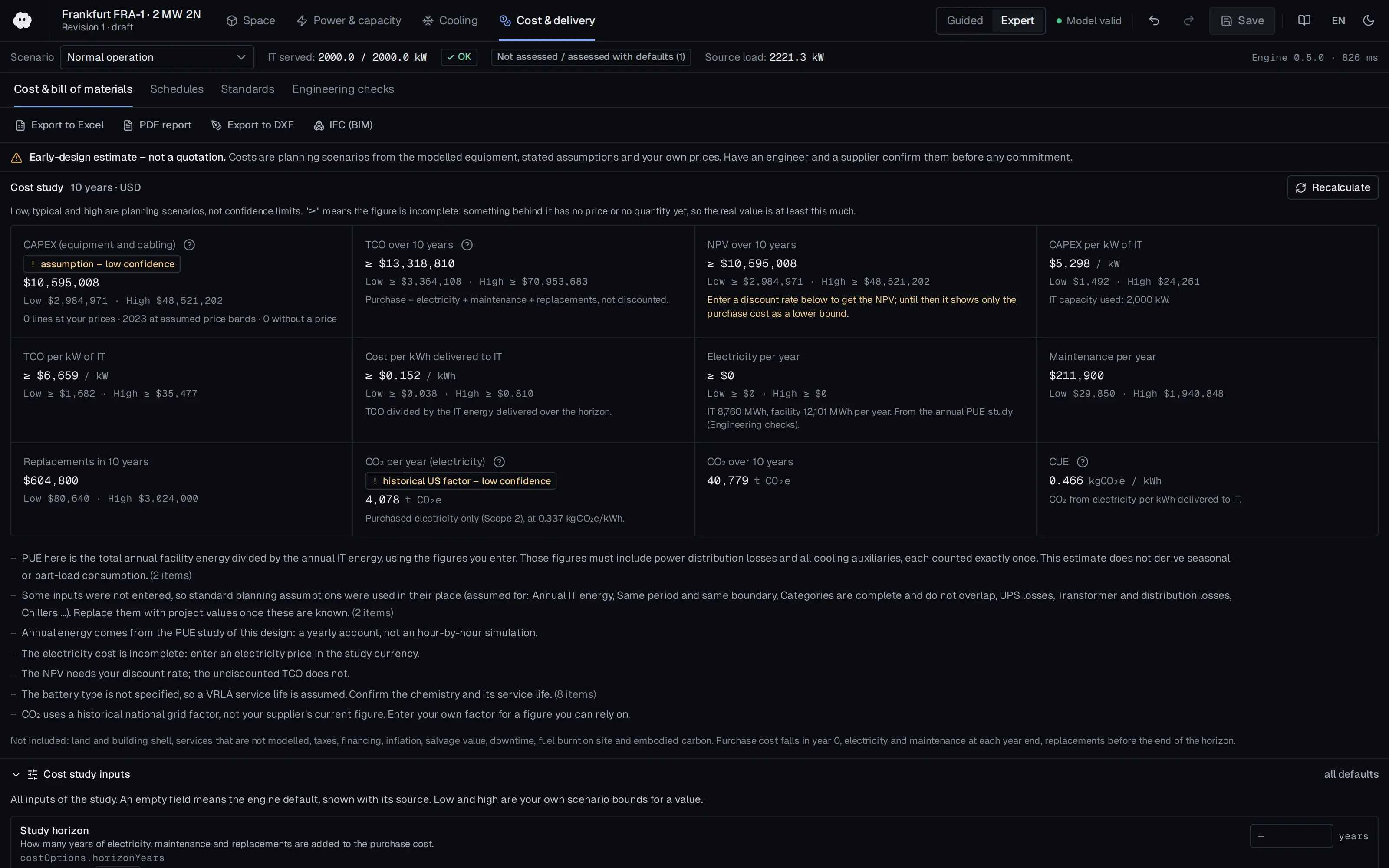
Who should read it
Designers and decision makers planning power, cabling and rack density together in AI data centers.
Related standards
- IEEE 802.3dj
Publication details
- Authors
- Manja Thessin
- Publisher
- BICSI ICT Today
- Year
- 2026
- Document number
- Vol. 47, No. 1 (Jan/Feb/Mar 2026), p. 30
- Document language
- English
- Source type
- Standard
- Access
- Free to read
- Licence
- Copyright retained; citation only — the publisher’s terms apply to the original document
Citation
Manja Thessin (2026). Powering the AI Revolution: Building the Infrastructure That Makes Intelligence Possible (Manja Thessin). BICSI ICT Today. Vol. 47, No. 1 (Jan/Feb/Mar 2026), p. 30. https://online.flippingbook.com/view/793670692/30-31
Events on this subject
- SC26 – International Conference for High Performance Computing, Networking, Storage and Analysis
- BICSI Japan Conference & Exhibition
- Datacloud Asia
All content and rights belong to the respective authors and publishers. SoSo CAD provides only the citation, its own summary and a link to the source, and is not responsible for the sources' content.
Related sources
All sources on this topicBICSI ICT Today 2026
The Impact of AI on Data Center Cabling Requirements (Kenneth Hall)
Catalogue GPU cabinets with depth and 'rearAccess' flags and require front patching zones.
- Fiber counts for many applications have risen by 4x and now 8x.
IEEE Access (Institute of Electrical and Electronics Engineers (IEEE)) 2026
Review of the 800-VDC Power Delivery Architecture and Isolated 800-V to 48-V Converter Solutions for Future AI Data Centers
Define 800 VDC unipolar, ±400 VDC bipolar and 48/54 VDC busbar as separate voltage classes in the single-line diagram, each with its own conductor ampacity, breaker pole count and clearance (IEC 60664-1) checks.
- The OCP Open Rack V3 PSU specification targets above 97.5% peak efficiency and at least 96.5% across 30%-100% load.
IEEE Open Journal of Power Electronics (Institute of Electrical and Electronics Engineers (IEEE)) 2026
State-of-the-Art Power Electronics in AI Data Centers
In rack power templates, model PSU count per shelf and the 33 kW shelf limit for AC distribution, and check busbar, PDU and cooling impact together for racks that exceed 100 kW with several shelves.
- AI rack density is 30-100+ kW against 7-10 kW for traditional racks; an 8-GPU DGX H100 draws around 10,200 W.
arXiv preprint (National Laboratory of the Rockies) 2026
Measurement of Generative AI Workload Power Profiles for Whole-Facility Data Center Infrastructure Planning
Size AI data-centre facility power with measured profiles rather than the rated design: even with all servers utilised, facility power reached only 73-80% of rated design.
- Online inference server power saturated near 2.8 kW at modest request rates.
International Energy Agency 2026
Key Questions on Energy and AI (World Energy Outlook Special Report)
For on-site generation sizing, when users choose islanded or behind-the-meter gas, apply an N+x overbuild check (30-70% above load per IEA) and model BESS for AI power swings.
- AI server power density rose 11 times in 2020-2025 and rises a further four times by 2027.
Energies (MDPI AG) 2026
Research on Design and Optimization of Economic Operation for Indirect Liquid Cooling System in Data Center Servers
In in-cabinet liquid cooling, place high-load servers near the supply side; locating a 1.2 kW server at the bottom cut total power by 34.4%.
- Cooling system energy is cited as accounting for over 30% of data-centre energy consumption.