
Temperature Optimisation in Data Centres (TODC) - Final report
Swiss Federal Office of Energy SFOE (Energy Research and Cleantech); preprint on arXiv · Vlad C. Coroamă
An SFOE-funded study of how raising server inlet temperature changes server (mostly fan) power and whether it saves energy overall.
On this page
Overview
This study examines how raising server inlet temperature changes server power, mostly fan power, and whether it saves energy overall. It is based on primary data from two Swiss colocation data centres that raised their inlet setpoints, together with a literature review and expert interviews. It was funded by the Swiss Federal Office of Energy (SFOE) and is an open-access preprint, arXiv:2509.26163.
Server-room power consistently rose with inlet temperature in the 23-30 C range, at roughly 0.35-0.57% per C depending on the site and analysis. In data centre 1, 65 temperature changes and 325 windowed analyses gave a mean sensitivity of 0.57% per C (95% CI ±0.11%/C), and the sensitivity hardly depended on the starting temperature over 23-29 C. In data centre 2 (1-minute data, 7 temperature changes), the mean sensitivity was 0.34% per C.
The basic limit is that server airflow increases linearly with fan speed while fan power scales with the cube of fan speed. In the cited RISE experiment, relative to a 22 C inlet, raising to 28 C increased total energy by 0.9-1.4% and lowering to 16 C cut it by 0.6-1.2%, depending on load. Reported hyperscale inlet temperatures are Google 26.6 C, Microsoft 27 C and Meta 29.4 C.
Building-level data were too confounded by changing compute load to show whether cooling savings outweigh the extra fan power. The author argues that PUE is the wrong metric for this trade-off because fan power sits in the IT denominator: raising inlet temperature always lowers PUE, since cooling power falls and fan power is counted as IT load, so a lower PUE does not show that total energy fell. The author suggests 25-27 C as the current practical sweet spot for colocation.
Key points
- Between 23 and 30 C, room-wide server power rose by 0.35-0.5 percentage points per degree C.
- In data centre 1, 65 temperature changes and 325 windowed analyses gave a mean sensitivity of 0.57% per C, hardly dependent on the starting temperature over 23-29 C (R2 = 0.005).
- In data centre 2 (1-minute data, 7 changes), the mean sensitivity was 0.34% per C, and every 1-hour and 2-hour window correlation was positive.
- Server airflow increases linearly with fan speed but fan power scales with the cube of fan speed, which sets the basic limit on raising inlet temperature.
- RISE experiment: relative to 22 C inlet, 28 C increased total energy by 0.9-1.4% and 16 C cut it by 0.6-1.2%, depending on load.
- Reported hyperscale inlet temperatures: Google 26.6 C, Microsoft 27 C, Meta 29.4 C.
- Raising inlet temperature always lowers PUE, because fan power is counted as IT load, so a lower PUE does not show that total energy fell.
Using it in design
- Add an IT-side penalty of about 0.3-0.6% of IT power per C of inlet rise above about 23 C (a configurable default) to the setpoint optimiser and energy calculator, and model fan power with the cube of speed.
- Show total facility energy alongside PUE and warn that a lower PUE from higher setpoints may not mean lower total energy.
- Use 25-27 C as the default recommended inlet setpoint band, with an allowable-range warning above 27 C.
- Add a server power versus inlet temperature curve as a catalogue field.
Monthly newsletter · free
Keep your reading list current
Once a month: new library sources, changes to Turkish regulations and upcoming data centre events.
SoSo CAD
Check cooling capacity alongside your design
Review zone heat loads, available capacity and the capacity balance after the largest unit is lost in SoSo CAD.
Request a demo
Who should read it
Cooling and energy engineers who set inlet temperature setpoints in colocation and enterprise data centres.
Related standards
- ASHRAE TC 9.9 Thermal Guidelines for Data Processing Environments
- ISO/IEC 30134-2 (PUE)
Publication details
- Authors
- Vlad C. Coroamă
- Publisher
- Swiss Federal Office of Energy SFOE (Energy Research and Cleantech); preprint on arXiv
- Year
- 2025
- Document number
- arXiv:2509.26163
- Document language
- English
- Source type
- Scientific
- Access
- Free to read
- Licence
- CC BY-NC-ND 4.0 — share unaltered with attribution for noncommercial purposes
Original licence note
arXiv record licensed CC BY-NC-ND 4.0; non-commercial/no-derivatives terms do not meet the library's redistribution policy, so citation only.
Citation
Vlad C. Coroamă (2025). Temperature Optimisation in Data Centres (TODC) - Final report. Swiss Federal Office of Energy SFOE (Energy Research and Cleantech); preprint on arXiv. arXiv:2509.26163. https://doi.org/10.48550/arXiv.2509.26163
Events on this subject
- SC26 – International Conference for High Performance Computing, Networking, Storage and Analysis
- Data Center World Middle East
- Datacenter Forum Stockholm
All content and rights belong to the respective authors and publishers. SoSo CAD provides only the citation, its own summary and a link to the source, and is not responsible for the sources' content.
Related sources
All sources on this topic
European Commission JRC 2025
2025 Best Practice Guidelines for the EU Code of Conduct on Data Centre Energy Efficiency (JRC141521, EUR 40267)
Design the facility to operate within the ASHRAE Class A2 allowable range and require A2 operation within warranty in IT procurement; plan separate environmental zones (practice 5.3.4) for legacy equipment.
- IT equipment AC/DC power converters should be rated at 90% efficiency or better across expected load ranges.
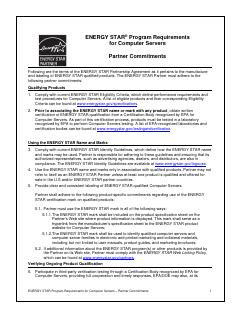
U.S. EPA / ENERGY STAR 2024
ENERGY STAR Program Requirements for Computer Servers, Version 4.0 (Partner Commitments, Eligibility Criteria, and Final Test Method Rev. April 2023)
Write ENERGY STAR Version 4.0 certification and the PSU efficiency steps (at 10% to 100% load points) into the server procurement specification; look especially at 10% and 20% load efficiency for redundant supplies that run lightly loaded.
- EffACTIVE = EXP(0.65 ln EffCPU + 0.30 ln EffMEMORY + 0.05 ln EffSTORAGE).
U.S. DOE FEMP / NREL 2024
Best Practices Guide for Energy-Efficient Data Center Design (Revised July 2024)
Weigh the supply air setpoint against server fan energy: raise it in small steps within the ASHRAE recommended range so the most demanding inlet nears 80 °F, only after air management is in place, and control to IT inlet temperature rather than return temperature.
- Compute racks reached 60 kW in 2013, and recent liquid-cooled racks exceed 125 kW.
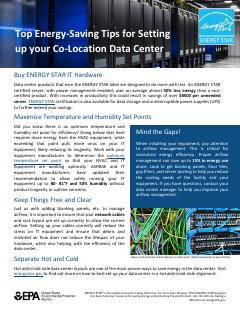
U.S. Environmental Protection Agency (ENERGY STAR) 2023
Top Energy-Saving Tips for Setting up your Co-Location Data Center (ENERGY STAR flyer, 2023)
Make a blanking-panel and gap-filler check a required step in colocation cage and rack layouts, and flag unused rack units.
- Avoiding an unneeded server can save over $8,500.
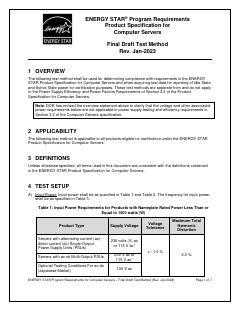
U.S. Environmental Protection Agency (ENERGY STAR) 2023
ENERGY STAR Program Requirements for Computer Servers: Final Draft Test Method (Rev. Jan-2023), Version 4.0
When importing server power data, keep the 25 ± 5 °C test ambient as metadata and warn that fan power rises at higher inlet set points.
- Ambient temperature during testing is 25 ± 5 °C and relative humidity 15% to 80%.
European Commission JRC 2020
Development of the EU Green Public Procurement (GPP) Criteria for Data Centres, Server Rooms and Cloud Services - Final Technical Report (JRC118558, EUR 30251 EN, 2020)
Ask in the specification for a designed PUE (dPUE) at a stated IT load (for example 50%) and conditions, under ISO/IEC 30134-2 or EN 50600-4-2, and write PUE demonstration at handover and the commissioning test into the contract.
- ASHRAE liquid cooling classes cited: W1 2-17 °C, W2 2-27 °C, W3 2-32 °C, W4 2-45 °C, W5 above 45 °C.