
Coordinated Cooling and Compute Management for AI Datacenters
IEEE Transactions on Cloud Computing (Institute of Electrical and Electronics Engineers (IEEE)) · Nardos Belay Abera, Yize Chen
University of Alberta researchers profile GPU servers running LLM inference under different cooling conditions and build joint workload and thermal models for an AI data hall, then design a hierarchical controller setting GPU count, tensor parallelism, GPU frequency (DVFS), supply air temperature and airflow.
CC BY 4.0 — share with attribution
On this page
Overview
AI datacentres are being deployed on a large scale to support the training and deployment of power-intensive large language models (LLMs). Cooling is cited as contributing approximately 45-50% of total energy consumption in AI data centres, and recent studies are cited projecting that 80-90% of total LLM workload and energy in production comes from inference rather than training. Previous work has examined the energy efficiency of LLM inference but explicitly ignored thermal behaviour and cooling systems.
The proposed controller provisions GPU count and tensor parallelism by linear programming, picks per-class GPU frequency (DVFS) by MILP, and sets supply air temperature and airflow by model predictive control (MPC). Cooling control is formulated as an MPC problem (SciPy SLSQP) and the TP and server-allocation problems as MILPs (PuLP), driven by real GPU profiling and a one-week Azure inference trace. Simulation constraints include an upper limit of 70 °C on return-air temperature and 50 °C on GPU inlet temperature, with PID gains Kp 4.5, Ki 0.18 and Kd 0.1.
The controller achieves 24.2% computing-energy savings and 31.2% cooling-energy savings and lowers average GPU temperature by 17.0%, with negligible impact on inference latency. Under the coordinated control, maximum per-GPU temperature stays below 50 °C while service level objectives (SLOs) are maintained.
Limits: the cooling plant modelled is air-based, and the authors list liquid and hybrid cooling as future work. The evaluation is a simulation on a one-week Azure inference trace, not a live system.
Key points
- Cooling is cited as contributing approximately 45-50% of total energy consumption in AI data centres.
- Recent studies are cited projecting that 80-90% of total LLM workload and energy in production comes from inference rather than training.
- The proposed controller achieves 24.2% computing-energy savings and 31.2% cooling-energy savings and lowers average GPU temperature by 17.0%, with negligible impact on inference latency.
- Simulation constraints include an upper limit of 70 °C on return-air temperature and 50 °C on GPU inlet temperature, with PID gains Kp 4.5, Ki 0.18 and Kd 0.1.
- Under the coordinated control, maximum per-GPU temperature stays below 50 °C while SLOs are maintained.
- Cooling control is formulated as an MPC problem (SciPy SLSQP) and the TP and server-allocation problems as MILPs (PuLP), driven by real GPU profiling and a one-week Azure inference trace.
Using it in design
- Design AI-hall cooling control together with workload management: when GPU count and tensor parallelism, DVFS and supply air temperature and airflow were optimised jointly, cooling energy fell by 31.2%.
- Define GPU inlet temperature (50 °C) and return-air (70 °C) upper limits as control constraints and verify them together with SLOs.
- Model the cooling plant as air-based; re-verify results for liquid or hybrid cooling.
Monthly newsletter · free
Keep your reading list current
Once a month: new library sources, changes to Turkish regulations and upcoming data centre events.
SoSo CAD
Check cooling capacity alongside your design
Review zone heat loads, available capacity and the capacity balance after the largest unit is lost in SoSo CAD.
Request a demo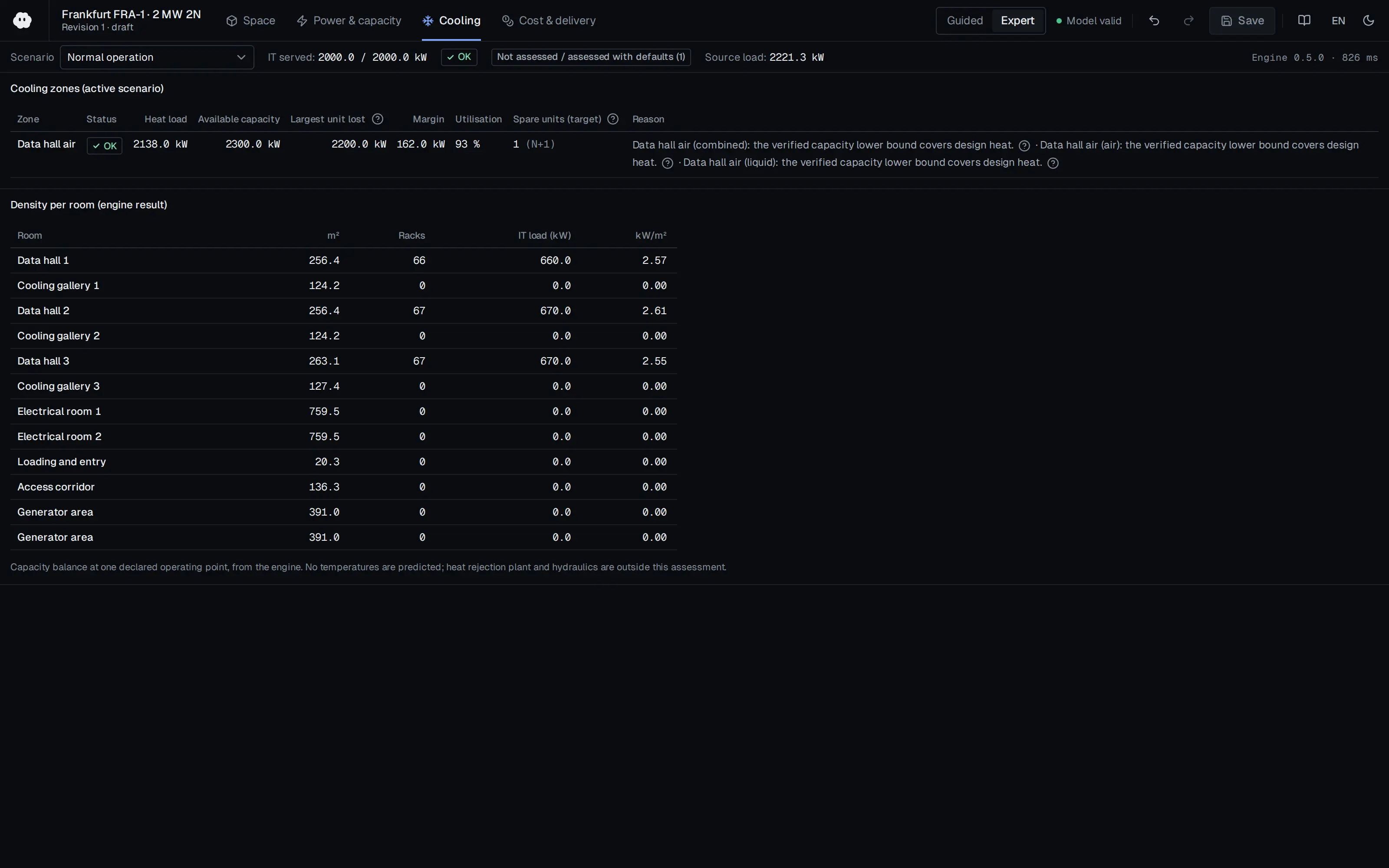
Who should read it
Engineers and researchers developing coordinated compute and cooling control for AI inference clusters.
Document contents
- I. Introduction (A. Main Contribution, B. Article Outline)
- II. Background (A. Datacenters Cooling Systems, B. Tensor Parallelism and Thermal Constraints, C. DVFS and LLM Workload Characteristics)
- III. Modelling (A. General Framework for Rack-Based Air Cooling, B. Temperature Field Model and Power Model Development, C. Workload Forecasting Model, D. Impact of TP and DVFS on LLM Inference Workloads)
- IV. Controller Design (A. Cluster-Level Control, B. Window-Level TP Selection, C. Cooling MPC Formulation, D. Per-Job DVFS with Class-Aware Constraints)
- V. Evaluation (hierarchical control-based provisioning, experimental evaluation, spatial distribution of server exhaust temperature, performance comparison, PID-based datacenter cooling, GPU frequency sensitivity)
Read the document
coordinated-cooling-compute-ai-dc-2026.pdf
CC BY 4.0 — share with attribution
The document is provided unaltered because its licence permits redistribution.
Publication details
- Authors
- Nardos Belay Abera; Yize Chen
- Publisher
- IEEE Transactions on Cloud Computing (Institute of Electrical and Electronics Engineers (IEEE))
- Year
- 2026
- Document number
- arXiv:2601.08113
- Pages
- 1-21
- Document language
- English
- Source type
- Scientific
- Access
- Open licence — downloadable
- Licence
- CC BY 4.0 — share with attribution
- Licence evidence
- arxiv.org
Original licence note
Downloaded PDF is the arXiv version (arXiv:2601.08113), licensed CC BY 4.0 per arXiv OAI metadata; published version in IEEE Transactions on Cloud Computing is also CC BY.
Citation
Nardos Belay Abera; Yize Chen (2026). Coordinated Cooling and Compute Management for AI Datacenters. IEEE Transactions on Cloud Computing (Institute of Electrical and Electronics Engineers (IEEE)). arXiv:2601.08113. 1-21. https://doi.org/10.1109/tcc.2026.3746242
Events on this subject
Browse the events calendarAll content and rights belong to the respective authors and publishers. SoSo CAD provides only the citation, its own summary and a link to the source, and is not responsible for the sources' content.
Related sources
All sources on this topic
Buildings (MDPI AG) 2026
Load-Adaptive Operational Control of an Indirect Evaporative Cooling System for Coordinated Energy and Water Use in a Modular Data Center in a Cold Region
In IEC control, stage airflow to follow load rate and spray to follow room temperature, and prefer a low fresh/return air ratio.
- Going from load rate 0.7 to 1.0 raised annual electricity by 16.2% but water by 74.8% and WUE by 70.6%.
Applied System Innovation (MDPI AG) 2026
Proactive Cooling Control Algorithm for Data Centers Based on LSTM-Driven Predictive Thermal Analysis
For predictive cooling control, plan at least one inlet and one outlet temperature sensor per rack; below that, prediction error rose by about 22%.
- The LSTM uses a 60 min input window and a 30 min prediction horizon, with a reported RMSE of 0.25 and R² of 0.985.
Building Simulation (Springer Science and Business Media LLC) 2024
Energy performance analysis of multi-chiller cooling systems for data centers concerning progressive loading throughout the lifecycle under typical climates
Calculate cooling plant efficiency from the lifecycle-average COP reflecting progressive IT load ramp rather than the design-point COP (in Beijing 2.9 lower than design).
- Free-cooling hours at PLR 1 ranged from 5921 h in Ulanqab to only 158 h in Hong Kong.
European Commission JRC 2018
2018 Best Practice Guidelines for the EU Code of Conduct on Data Centre Energy Efficiency - Version 9.1.0 (JRC110666, EUR 29103 EN)
Keep the 2018 edition practices as a selectable compliance baseline for projects designed in 2018.
- 5.4.1.8 (value 5): investigate free cooling in all new builds and retrofits.
European Commission JRC 2017
2017 Best Practice Guidelines for the EU Code of Conduct on Data Centre Energy Efficiency - Version 8.1.0 (JRC104370, EUR 28426 EN)
Store the best practice edition and version against each design so the compliance checker evaluates practices from the edition in force at design date (8.1.0 for 2017 projects).
- 5.1.6: cabinet doors need at least 66% perforated area, with 80% considered ideal.
U.S. DOE FEMP 2010
Operations & Maintenance Best Practices: A Guide to Achieving Operational Efficiency, Release 3.0 (August 2010)
Choose maintenance strategy by equipment criticality: predictive for critical equipment with random failures, preventive for equipment subject to wear, reactive for small non-critical items; build a master equipment list and priority matrix.
- Boiler combustion tuning and related O&M can yield fuel savings of 2% to 20%.