
ASHRAE's energy standard for data centers turns three
Consulting-Specifying Engineer · Bill Kosik
Bill Kosik's practitioner guide to ASHRAE 90.4-2016 three years after release, explaining its two compliance metrics (MLC and ELC), trade-off provisions and the proposed 2019 addenda.
On this page
Overview
In this 2019 article in Consulting-Specifying Engineer, Bill Kosik looks at ASHRAE Standard 90.4-2016 from a practitioner's view three years after its release. He explains its relationship to 90.1 and its two compliance metrics: the mechanical load component (MLC) and the electrical loss component (ELC).
Design MLC is the sum of cooling, pump, heat-rejection fan and AHU fan design power divided by design ITE power, checked at 100% and 50% ITE load against Table 6.2.1. Annualized MLC requires an hourly energy simulation, also checked at 100% and 50% ITE load. ELC covers incoming service, UPS and ITE distribution: single-feed (N, N+1) UPS is evaluated at 100%/50% load and active dual-feed (2N, 2N+1) at 50%/25%. Separate ELC tables apply for ITE loads under 100 kW and 100 kW and above, and mechanical distribution losses are limited to 2%. Annualized air-system MLC values assume a 20 F supply-air temperature rise and 85 F return air.
The author also describes the trade-off and renewable-offset provisions and the proposed 2019 addenda that would drop design MLC, tighten limits and switch to a four-point annualized MLC. In the proposal, annualized MLC is computed over 25/50/75/100% ITE load, with ITE energy at X% equal to design ITE load x 8,760 h x X%. Kosik cautions that IT power does not scale linearly with computational load. For compliance, consult the standard's edition in force and the edition adopted by the jurisdiction.
Key points
- Design MLC = (cooling + pump + heat-rejection fan + AHU fan design power) / design ITE power, checked at 100% and 50% ITE load against Table 6.2.1.
- Annualized MLC requires an hourly energy simulation, also checked at 100% and 50% ITE load.
- ELC covers incoming service, UPS and ITE distribution; single-feed (N, N+1) UPS is evaluated at 100%/50%, active dual-feed (2N, 2N+1) at 50%/25% load.
- Separate ELC tables apply for ITE loads under 100 kW and 100 kW and above; mechanical distribution losses are limited to 2%.
- Annualized air-system MLC values assume a 20 F supply-air temperature rise and 85 F return air.
- Proposed 2019 addenda: annualized MLC over 25/50/75/100% ITE load, with ITE energy at X% = design ITE load x 8,760 h x X%.
- The proposed addenda would drop design MLC and tighten limits.
- The author cautions that IT power does not scale linearly with computational load.
Using it in design
- Implement the 90.4 MLC and ELC calculators with the correct test load points per UPS redundancy class (N/N+1 vs 2N).
- Expose the 20 F delta-T and 85 F return assumptions as editable inputs and flag when a design deviates.
- Check which edition (2016 or later) the user's jurisdiction adopts.
- Do not scale IT power linearly with computational load; use real equipment data at part-load points.
Monthly newsletter · free
Keep your reading list current
Once a month: new library sources, changes to Turkish regulations and upcoming data centre events.
SoSo CAD
Compare the cost of design decisions
Evaluate equipment costs, energy expenses and total cost of ownership (TCO) using your inputs and assumptions in SoSo CAD.
Request a demo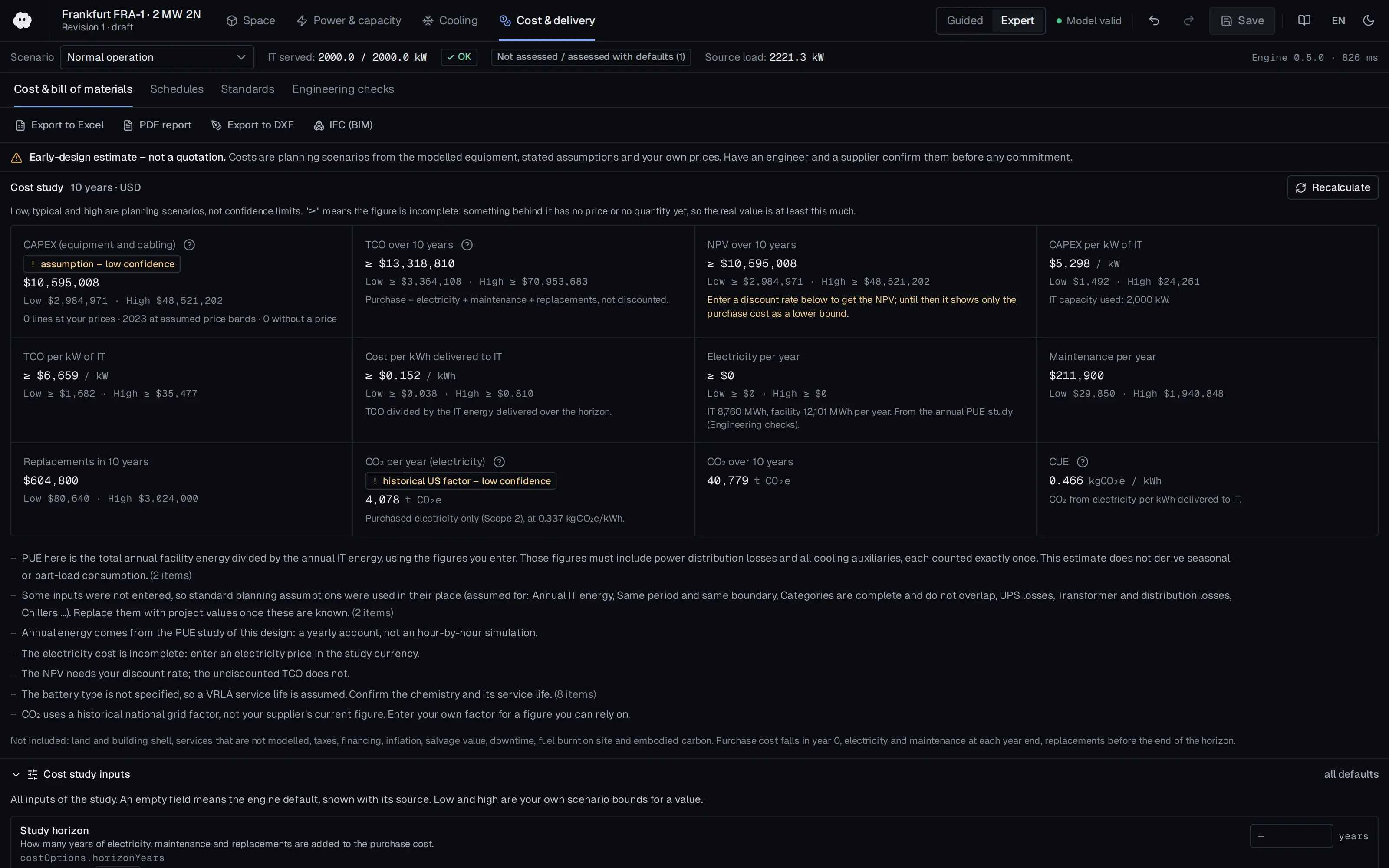
Who should read it
Mechanical and electrical designers calculating data centre energy compliance, and energy modellers.
Related standards
- ASHRAE 90.4-2016
- ASHRAE 90.1-2016
Publication details
- Authors
- Bill Kosik
- Publisher
- Consulting-Specifying Engineer
- Year
- 2019
- Document language
- English
- Source type
- Expert / community
- Access
- Free to read
- Licence
- Copyright retained; citation only — the publisher’s terms apply to the original document
Citation
Bill Kosik (2019). ASHRAE's energy standard for data centers turns three. Consulting-Specifying Engineer. https://www.csemag.com/ashraes-energy-standard-for-data-centers-turns-three/
Events on this subject
Browse the events calendarAll content and rights belong to the respective authors and publishers. SoSo CAD provides only the citation, its own summary and a link to the source, and is not responsible for the sources' content.
Related sources
All sources on this topicConsulting-Specifying Engineer 2015
Driving data center PUE, efficiency
Include economizer control limits, part-load loss curves for each electrical stage and the redundancy topology as energy model inputs.
- Water-cooled IT still rejects roughly 10-30% of cabinet capacity to air; such cabinets typically house 50-80 kW.
International Energy Agency 2025
Energy and AI (World Energy Outlook Special Report)
Use the IEA component split (servers about 60%, storage about 5%, network up to 5%, cooling 7-30%) to sanity-check modelled energy breakdowns.
- The 2035 range across cases is 700-1,700 TWh; the High Efficiency Case is 20% below the Base Case.
U.S. DOE FEMP / NREL 2024
Best Practices Guide for Energy-Efficient Data Center Design (Revised July 2024)
Weigh the supply air setpoint against server fan energy: raise it in small steps within the ASHRAE recommended range so the most demanding inlet nears 80 °F, only after air management is in place, and control to IT inlet temperature rather than return temperature.
- Compute racks reached 60 kW in 2013, and recent liquid-cooled racks exceed 125 kW.
TÜV NORD 2026
EN 50600 — data centre facilities and infrastructures (overview and certification)
In an 'EN 50600' standards profile, offer separate availability-class selectors for power, cooling and cabling (instead of a single Tier), plus a protection-class selector per room or zone
- Protection classes 1-4 for unauthorised access and other hazards; physical-security zoning required
ASHRAE 2023
Using Network Modeling to Test for ASHRAE 90.4 Standard Compliance (2023 ASHRAE Winter Conference paper)
The tool can compute 90.4 MLC and ELC directly from its mechanical and electrical one-lines: segment losses, UPS efficiency at 100/50/25% load and hourly weather by climate zone.
- The authors argue that standardised tools would encourage states to adopt 90.4.
ASHRAE 2022
ANSI/ASHRAE Standard 90.4-2022, Energy Standard for Data Centers - ASHRAE fact sheet
In the compliance calculator, compute annualised MLC and design ELC per segment (UPS, distribution, PDU) and compare them with climate-zone limits.
- The standard applies to data centres with power density above 20 W/ft2 and IT load above 10 kW.