
Using Network Modeling to Test for ASHRAE 90.4 Standard Compliance (2023 ASHRAE Winter Conference paper)
ASHRAE · Aaron P. Wemhoff, Russ Tipton et al.
A paper showing how a network model of cooling and electrical systems can compute the MLC and ELC required by ASHRAE 90.4.
On this page
Overview
The 2023 ASHRAE Winter Conference paper by Aaron P. Wemhoff, Russ Tipton and Mark Seymour shows how a network (component-connection) model of both the cooling and the electrical systems can compute the Mechanical Load Component (MLC) and Electrical Loss Component (ELC) required by ASHRAE Standard 90.4. Compliance is assessed by comparing MLC and ELC (or their sum) with maximum values set by climate zone and by UPS configuration.
The worked example is a 1 MW data centre near Ashburn, Virginia with DX CRAC cooling and a non-redundant UPS chain, evaluated with hourly weather and the Standard's load points. For the 1 MW CRAC design in Climate Zone 4A, annualized MLC = 7,008,000 kWh / 21,900,000 kWh = 0.32 versus an allowed 0.18 (ITE >300 kW). These data show the numerical outputs of the method plainly.
ELC at 100% load = 0.1399 (incoming service) + 0.1365 (UPS) + 0.0026 (ITE distribution) = 0.279, versus an allowed 0.265 for single-feed UPS, IT >=100 kW. ELC at 50% load is 0.2745 versus an allowed 0.189, so the design fails at both load points. In the method, ELC is evaluated at the hour of peak outdoor enthalpy; 2N and 2(N+1) systems use 50%/25% load points instead of 100%/50%.
PSU losses inside IT equipment are excluded from ELC, and the UPS segment is modelled as rectifier efficiency times inverter efficiency. The authors argue that standardised tools would encourage states to adopt 90.4. Since the example is a single facility in one climate zone, the results cannot be generalised; the main contribution is showing how the method exposes non-compliance. These assumptions are stated in line with the Standard's definitions.
Key points
- Compliance is assessed by comparing MLC and ELC (or their sum) with maximum values set by climate zone and UPS configuration.
- For the 1 MW CRAC design in Climate Zone 4A, annualized MLC = 7,008,000 / 21,900,000 kWh = 0.32 versus an allowed 0.18 (ITE >300 kW).
- ELC at 100% load = 0.1399 + 0.1365 + 0.0026 = 0.279 versus an allowed 0.265 for single-feed UPS, IT >=100 kW.
- ELC at 50% load = 0.2745 versus an allowed 0.189, so the design fails at both load points.
- ELC is evaluated at the hour of peak outdoor enthalpy; 2N and 2(N+1) systems use 50%/25% load points.
- PSU losses inside IT equipment are excluded from ELC; the UPS segment is modelled as rectifier x inverter efficiency.
- The example is a 1 MW data centre near Ashburn, Virginia with DX CRAC cooling and a non-redundant UPS chain.
- The authors argue that standardised tools would encourage states to adopt 90.4.
Using it in design
- The tool can compute 90.4 MLC and ELC directly from its mechanical and electrical one-lines: segment losses, UPS efficiency at 100/50/25% load and hourly weather by climate zone.
- Show pass/fail against the table limits as a design-rule warning.
- Apply 50%/25% load points for 2N and 2(N+1) configurations.
- Leave PSU losses inside IT equipment out of the ELC calculation.
Monthly newsletter · free
Keep your reading list current
Once a month: new library sources, changes to Turkish regulations and upcoming data centre events.
SoSo CAD
Compare the cost of design decisions
Evaluate equipment costs, energy expenses and total cost of ownership (TCO) using your inputs and assumptions in SoSo CAD.
Request a demo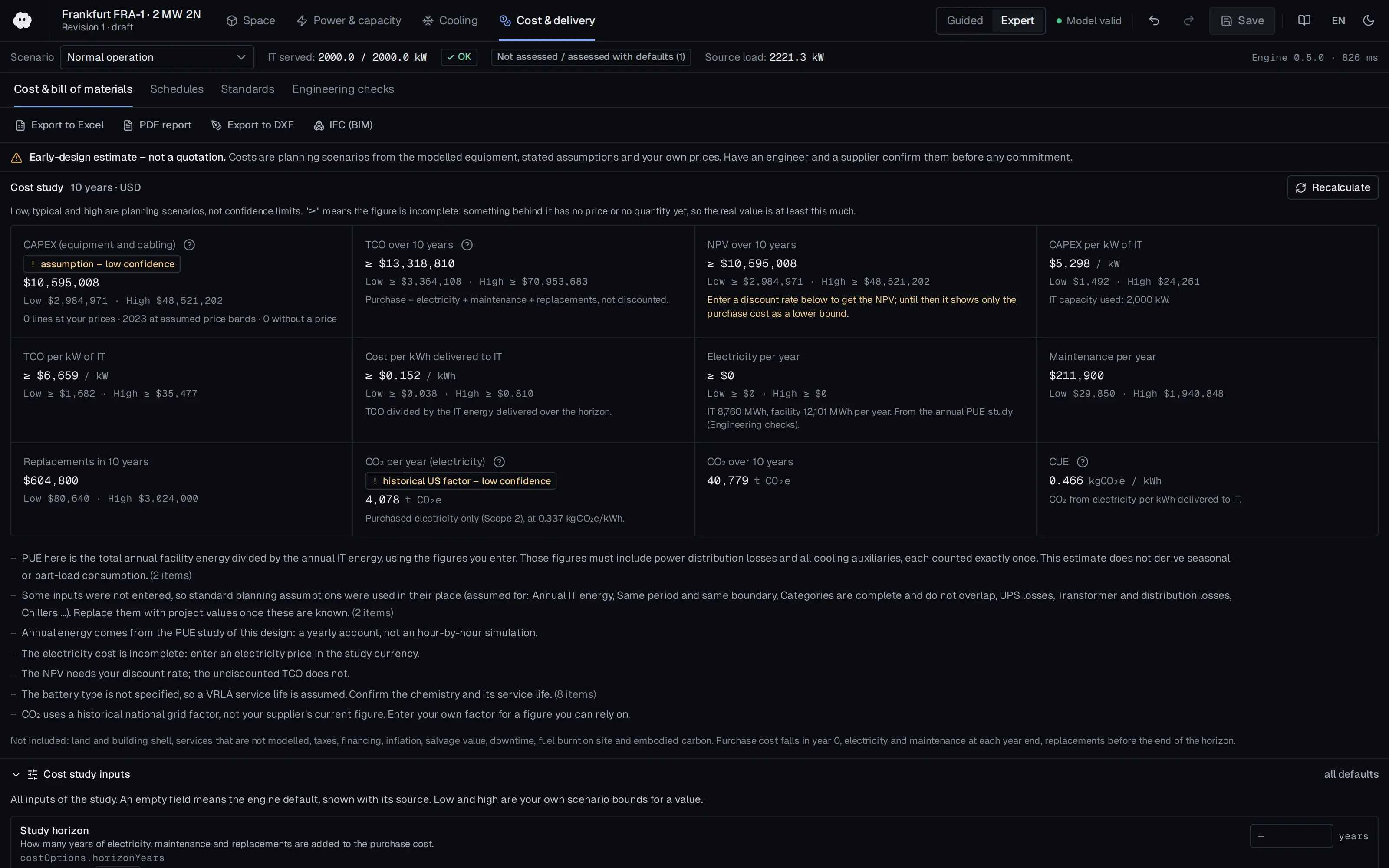
Who should read it
Energy modellers assessing ASHRAE 90.4 compliance, electrical and mechanical designers and compliance consultants.
Related standards
- ASHRAE Standard 90.4-2019
- ASHRAE Standard 90.4-2022
Publication details
- Authors
- Aaron P. Wemhoff; Russ Tipton; Mark Seymour
- Publisher
- ASHRAE
- Year
- 2023
- Document number
- Proceedings of the 2023 ASHRAE Winter Conference; NSF PAR 10435236
- Event
- ASHRAE 2023 Winter Conference
- Document language
- English
- Source type
- Standard
- Access
- Free to read
- Licence
- Copyright retained; citation only — the publisher’s terms apply to the original document
Citation
Aaron P. Wemhoff; Russ Tipton; Mark Seymour (2023). Using Network Modeling to Test for ASHRAE 90.4 Standard Compliance (2023 ASHRAE Winter Conference paper). ASHRAE. Proceedings of the 2023 ASHRAE Winter Conference; NSF PAR 10435236. ASHRAE 2023 Winter Conference. https://par.nsf.gov/biblio/10435236
Events on this subject
Browse the events calendarAll content and rights belong to the respective authors and publishers. SoSo CAD provides only the citation, its own summary and a link to the source, and is not responsible for the sources' content.
Related sources
All sources on this topicASHRAE 2022
ANSI/ASHRAE Standard 90.4-2022, Energy Standard for Data Centers - ASHRAE fact sheet
In the compliance calculator, compute annualised MLC and design ELC per segment (UPS, distribution, PDU) and compare them with climate-zone limits.
- The standard applies to data centres with power density above 20 W/ft2 and IT load above 10 kW.
International Energy Agency 2025
Energy and AI (World Energy Outlook Special Report)
Use the IEA component split (servers about 60%, storage about 5%, network up to 5%, cooling 7-30%) to sanity-check modelled energy breakdowns.
- The 2035 range across cases is 700-1,700 TWh; the High Efficiency Case is 20% below the Base Case.
U.S. DOE FEMP / NREL 2024
Best Practices Guide for Energy-Efficient Data Center Design (Revised July 2024)
Weigh the supply air setpoint against server fan energy: raise it in small steps within the ASHRAE recommended range so the most demanding inlet nears 80 °F, only after air management is in place, and control to IT inlet temperature rather than return temperature.
- Compute racks reached 60 kW in 2013, and recent liquid-cooled racks exceed 125 kW.
TÜV NORD 2026
EN 50600 — data centre facilities and infrastructures (overview and certification)
In an 'EN 50600' standards profile, offer separate availability-class selectors for power, cooling and cabling (instead of a single Tier), plus a protection-class selector per room or zone
- Protection classes 1-4 for unauthorised access and other hazards; physical-security zoning required
Consulting-Specifying Engineer 2019
ASHRAE's energy standard for data centers turns three
Implement the 90.4 MLC and ELC calculators with the correct test load points per UPS redundancy class (N/N+1 vs 2N).
- Annualized MLC requires an hourly energy simulation, also checked at 100% and 50% ITE load.
U.S. DOE Better Buildings / Lawrence Berkeley National Laboratory 2017
Data Center Metering and Resource Guide (February 2017)
At a stand-alone site, design meters that record energy (kWh) at the utility entrance and at the UPS output (or at panels serving only IT if there is no UPS); a UPS display that shows only power (kW) is not enough.
- PUE Level 1 for a stand-alone data center is utility meter reading divided by UPS output energy (M1/M2).