
Stochastic Models for Optimizing Availability, Cost and Sustainability of Data Center Power Architectures through Genetic Algorithm
Revista de Informática Teórica e Aplicada (Universidade Federal do Rio Grande do Sul) · Márcio Sergio Soares Austregésilo, Gustavo Callou
Austregésilo and Callou's 2019 paper couples reliability block diagrams, stochastic Petri nets and an energy flow model with a multi-objective genetic algorithm to optimise equipment selection in a data centre power architecture.
On this page
Overview
The paper was written by Márcio Sergio Soares Austregésilo and Gustavo Callou and published in Revista de Informática Teórica e Aplicada (vol. 26, no. 2, pp. 27-44, 2019), DOI 10.22456/2175-2745.83498.
The method couples reliability block diagrams, stochastic Petri nets and an energy flow model (in the Mercury tool) with a multi-objective genetic algorithm. The algorithm picks equipment for each position in a data centre power architecture to maximise availability while minimising acquisition cost and operational exergy (energy dissipated). It is validated against brute-force search on five reference architectures and then applied to TIA-942 Tier I and Tier II electrical architectures.
Input ranges are given per component (MTTF h; efficiency %; cost USD): UPS 250 kVA [32,787; 72,996], [85; 99], [51,215; 65,513]; STS [36,732; 58,284], [84; 97]; generator [49,654; 64,355], [21; 35], [49,200; 65,433]. MTTR was set to 8 h for all components. For the Tier I architecture, optimisation reduced cost from 122,322.20 to 116,004.52 USD (5.16%) and exergy from 203.39 to 140.13 J (31.10%), and raised availability from 3.3643 to 3.4005 nines.
For the Tier II architecture, cost fell from 292,795.44 to 269,377.66 USD (7.99%), exergy from 283.82 to 175.30 J (38.23%), and availability rose from 3.3478 to 3.4158 nines. The genetic algorithm reached results close to the brute-force optimum while running 6,763,260 times faster than exhaustive enumeration. Limit: the results hold for the stated input ranges and two Tier architectures.
Key points
- A multi-objective genetic algorithm picks equipment for each power architecture position to raise availability while cutting cost and exergy.
- Input ranges: UPS 250 kVA MTTF [32,787; 72,996] h, efficiency [85; 99]%, cost [51,215; 65,513] USD; STS [36,732; 58,284] h, [84; 97]%; generator [49,654; 64,355] h, [21; 35]%, [49,200; 65,433] USD. MTTR 8 h for all components.
- Tier I: cost 122,322.20 to 116,004.52 USD (5.16%), exergy 203.39 to 140.13 J (31.10%), availability 3.3643 to 3.4005 nines.
- Tier II: cost 292,795.44 to 269,377.66 USD (7.99%), exergy 283.82 to 175.30 J (38.23%), availability 3.3478 to 3.4158 nines.
- The genetic algorithm reached results close to the brute-force optimum while running 6,763,260 times faster than exhaustive enumeration.
- The method was validated against brute-force search on five reference architectures.
Using it in design
- Recognise that topology choice is only part of availability; equipment selection within a fixed topology can trade availability, losses and cost.
- In a design optimiser, search catalogue alternatives per single-line-diagram position against a multi-objective score (availability in nines, annual losses, capex) and show a Pareto set instead of a single answer.
- Store MTTF, efficiency and cost per catalogue item so such searches are possible.
- Use heuristic search because exhaustive enumeration explodes combinatorially.
Monthly newsletter · free
Keep your reading list current
Once a month: new library sources, changes to Turkish regulations and upcoming data centre events.
SoSo CAD
Assess redundancy through scenarios
Compare normal operation and equipment failures in SoSo CAD, with supplied loads and capacity shortfalls in one view.
Request a demo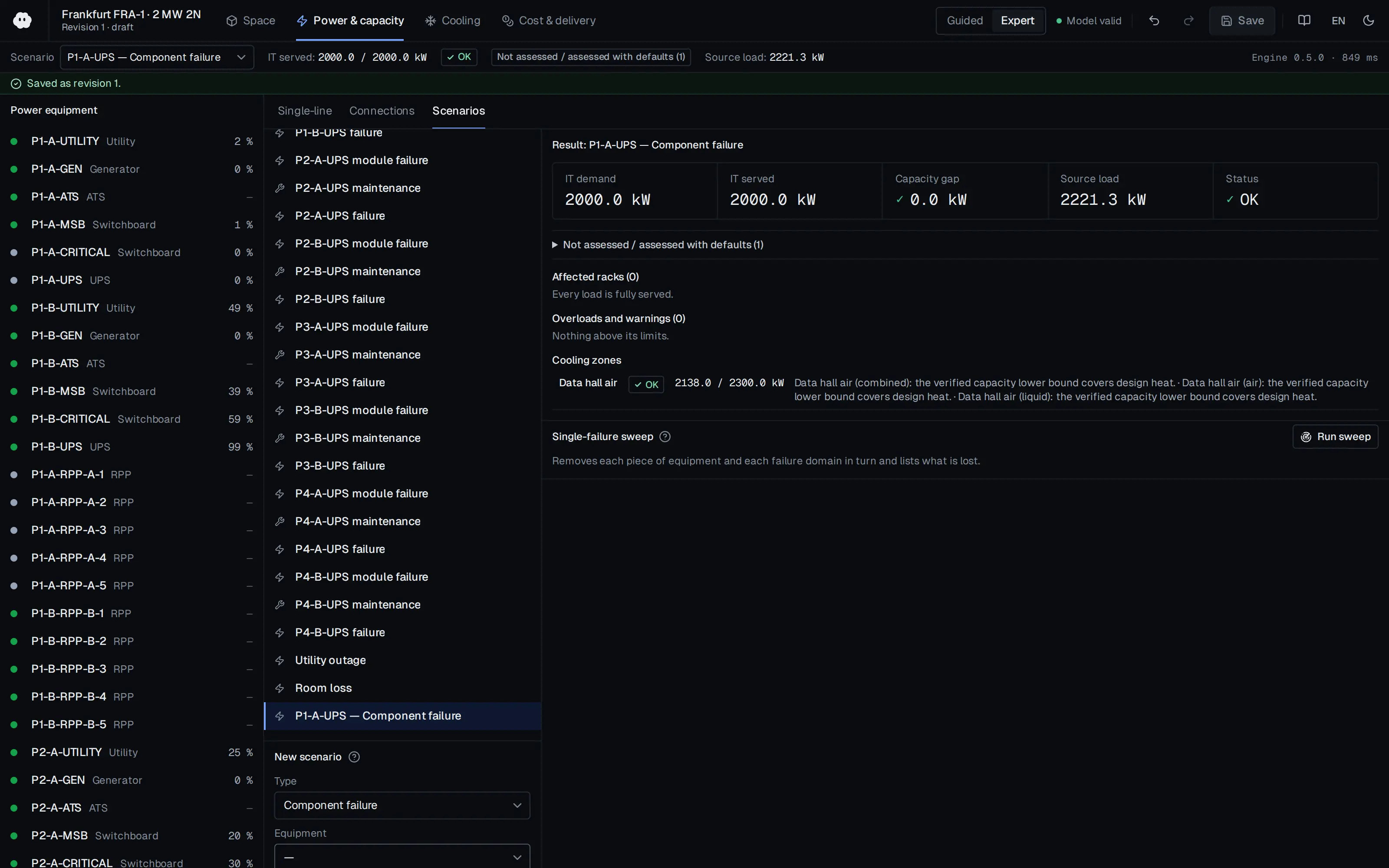
Who should read it
Researchers and design-tool developers working on power architecture optimisation and availability modelling.
Related standards
- ANSI/TIA-942
Publication details
- Authors
- Márcio Sergio Soares Austregésilo; Gustavo Callou
- Publisher
- Revista de Informática Teórica e Aplicada (Universidade Federal do Rio Grande do Sul)
- Year
- 2019
- Volume
- 26
- Issue
- 2
- Pages
- 27-44
- Document language
- English
- Source type
- Scientific
- Access
- Free to read
- Licence
- CC BY-NC-ND 4.0 — share unaltered with attribution for noncommercial purposes
Original licence note
Article states CC BY-NC-ND 4.0; non-commercial/no-derivatives licence, so citation only.
Citation
Márcio Sergio Soares Austregésilo; Gustavo Callou (2019). Stochastic Models for Optimizing Availability, Cost and Sustainability of Data Center Power Architectures through Genetic Algorithm. Revista de Informática Teórica e Aplicada (Universidade Federal do Rio Grande do Sul). 26(2), 27-44. https://doi.org/10.22456/2175-2745.83498
Events on this subject
- Electricity Eurasia 2027
- ELECO 2026 Elektrik-Elektronik ve Biyomedikal Mühendisliği Konferansı
- 7x24 Exchange Spring Conference
All content and rights belong to the respective authors and publishers. SoSo CAD provides only the citation, its own summary and a link to the source, and is not responsible for the sources' content.
Related sources
All sources on this topic
arXiv preprint (University of Michigan) 2026
Grid Integration of AI Data Centers: A Critical Review of Energy Storage Solutions (arXiv preprint)
Layer storage by timescale (chip/server sub-ms to ms, rack ms to seconds, UPS and GiUPS sub-second to 10 s, BESS minutes to hours) and show each layer's duty in the coordination scheme.
- Rapid AI load variations often induce 5-10% voltage swings within milliseconds.
WSEAS TRANSACTIONS ON POWER SYSTEMS (World Scientific and Engineering Academy and Society (WSEAS)) 2026
Design and Prototype of a Microgrid for Enhancing Reliability of Power Supply for Artificial Intelligence Data Centers
Follow the energy-balance chain in a PV/BESS sizing helper (daily load split, conversion losses, usable depth of discharge, power rating against night peak); report usable-energy duration rather than nameplate duration and make DoD an explicit input.
- Covering 60% of demand needs 81,857 kWh/day from PV after 5% DC-AC and 10% battery losses.
arXiv preprint (University of Texas at Austin; formatted for IEEE Transactions on Power Systems) 2025
Wide-Area Power System Oscillations from Large-Scale AI Workloads
Model AI data-centre load as a persistent periodic forcing (0.3-1.5 Hz band, about 20% of peak fluctuating) rather than a ramp, and add oscillation analysis to the grid-interconnection study.
- The fine-tuning model uses a dominant frequency U(0.3, 0.7) Hz and compute fraction 0.7-0.9.
IEEE Access (Institute of Electrical and Electronics Engineers (IEEE)) 2021
A Novel Reliability Index to Assess the Computational Resource Adequacy in Data Centers
Set the number of spare PSUs/servers in a rack with a LOWP-style calculation from target service reliability and the load duration curve, avoiding unnecessary overprovisioning.
- The rack model assumes 10 blade servers rated 800 W each (400 W idle) with 40 local fans.
IEEE Access (Institute of Electrical and Electronics Engineers (IEEE)) 2021
A Review of Data Centers Energy Consumption and Reliability Modeling
Define the failure state (loss of PDU power, loss of a rack, loss of service) explicitly before starting a reliability study and state it in the report.
- Cooling-system operational availability is AO = 1/(λsys/µsys + 1) and functional availability is Af = AO(1 − pus) + (1 − AO)·pt.
ABB 2026
Next-Generation Medium-Voltage Architecture for AI Data Centers
For loads above roughly 30-50 MW add a grid-code compliance checklist (LVRT duration, frequency band, RoCoF, PF) and let users choose LV-UPS versus MV-UPS architecture.
- BESS blocks 0.6-21.6 MW with 1, 2 or 4 h durations