
Guidance on the UPS ENERGY STAR Test Method (December 12, 2013)
U.S. Department of Energy / U.S. EPA (ENERGY STAR) · Bryan Berringer
A one-page US DOE letter answering stakeholder questions on the 2013 ENERGY STAR UPS test method. It clarifies default settings, three-phase versus single-phase input, dc-output test voltage, the steady-state check at 0% load and the measurement period.
U.S. public domain — U.S. Government work; free to reuse
On this page
Overview
The document is a letter from the DOE test-method lead for the ENERGY STAR UPS programme. EPA and DOE published the final UPS test method on 10 May; stakeholders then sent further questions, and DOE decided to add guidance. The text was last updated on 12 December 2013.
A table covers five topics. As a general rule, any setting the test method does not explicitly address stays in its as-shipped (default) configuration. UPSs that accept both three-phase and single-phase input are tested on three-phase power. If a dc-output UPS cannot run at the test voltage given in Table 2, the highest normal operating voltage it supports is used instead.
The steady-state check applies only to the stability of conversion efficiency under active loads, so it is not needed at 0% load; the UPS must nevertheless be thermally stabilised for 125% of the manufacturer-specified time before the power measurement. Measurement may run longer than 15 minutes, in which case the actual period replaces t in Equation 1 for PAVG. DOE data indicate that longer durations do not alter the average efficiency.
Key points
- Settings not covered by the test method remain in as-shipped default configuration.
- UPSs supporting both three-phase and single-phase input are tested on three-phase power.
- A dc-output UPS that cannot run at the Table 2 voltage is tested at its highest normal operating voltage.
- No steady-state check at 0% load, but stabilisation still lasts 125% of the manufacturer time.
- Measurement longer than 15 minutes is allowed; the actual period is used for t in Equation 1.
- DOE data show durations over 15 minutes do not change average efficiency.
Using it in design
- When ingesting vendor UPS efficiency figures, record the input configuration (three-phase) and whether the values follow ENERGY STAR or IEC 62040-3 methods.
- Treat mode settings that are not specified as factory default in the loss model.
- Label the 0% load (no-load loss) point as a value taken after thermal stabilisation only.
Monthly newsletter · free
Keep your reading list current
Once a month: new library sources, changes to Turkish regulations and upcoming data centre events.
SoSo CAD
Review your power design in SoSo CAD
Inspect supply paths, equipment loads and UPS failure scenarios in one model.
Request a demo
Who should read it
Electrical design engineers who use UPS efficiency data in catalogues or loss models, and test laboratories.
Document contents
- General: default settings
- Section 3.B: three-phase and single-phase input power
- Section 3.D: dc-output voltage for test
- Section 5.B: steady-state check at 0% load
- Section 5.C.2: measurement period
Related standards
- IEC 62040-3
- ENERGY STAR UPS Test Method
Read the document
energystar-ups-test-method-guidance-2013.pdf
U.S. public domain — U.S. Government work; free to reuse
The document is provided unaltered because its licence permits redistribution.
Publication details
- Authors
- Bryan Berringer
- Publisher
- U.S. Department of Energy / U.S. EPA (ENERGY STAR)
- Year
- 2013
- Document language
- English
- Source type
- Government / public
- Access
- Open licence — downloadable
- Licence
- U.S. public domain — U.S. Government work; free to reuse
- Licence evidence
- www.copyright.gov
Original licence note
Letter from the DOE test-method lead for the ENERGY STAR UPS program, published by EPA/DOE on energystar.gov; U.S. government work (17 U.S.C. 105).
Citation
Bryan Berringer (2013). Guidance on the UPS ENERGY STAR Test Method (December 12, 2013). U.S. Department of Energy / U.S. EPA (ENERGY STAR). https://www.energystar.gov/sites/default/files/asset/document/Guidance%20on%20the%20UPS%20ENERY%20STAR%20Test%20Method_Dec2013_0.pdf
Events on this subject
Browse the events calendarAll content and rights belong to the respective authors and publishers. SoSo CAD provides only the citation, its own summary and a link to the source, and is not responsible for the sources' content.
Related sources
All sources on this topic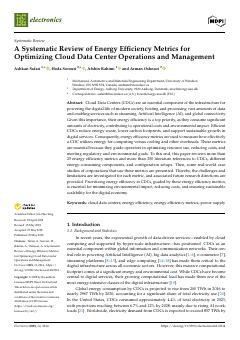
Electronics (MDPI AG) 2025
A Systematic Review of Energy Efficiency Metrics for Optimizing Cloud Data Center Operations and Management
In efficiency reporting do not make PUE the only metric; knowing its weaknesses (manipulation, optimal-condition reporting, ignoring IT utilisation), complement it with WUE, CUE and IT-side metrics (SPUE, PpW, ITEE).
- Google reported a 2023 fleet-average annual PUE of 1.10 against an industry average of 1.58; Microsoft reports PUE and WUE together.
Socomec 2024
Data centre - How to ensure power availability, electrical safety and energy performance? (Expert advice & innovative solutions guide)
In the single-line editor, tag transfer devices as ATSE (IEC 60947-6-1) or STS with a transfer-time field, and suggest STS where the load needs under about 10 ms.
- Human error accounts for 22 % of unplanned outages.
ABB 2022
Data center white paper: 2N low-voltage distribution system design, IEC standards, 0.5 MW IT load (Chinese edition)
Use it as a template for a '2N LV, 0.5 MW' starter project, auto-generating the RPDU, RPP, secondary board, UPS, main board and transformer/generator chain from rack count and kW/rack.
- Transformer: dry type, 10/0.4 kV, 1250 kVA, Z = 6%.
Consulting-Specifying Engineer 2018
Designing power systems for co-location data centers
Support both distributed-redundant and catcher/reserve UPS topologies with automatic post-failure load checks, warning if any unit exceeds 100% after a single failure.
- PDU sizes have grown from 225/300 kVA to 600 kVA or larger.
Siemens 2018
Totally Integrated Power - Planning of Electric Power Distribution: Technical Principles
Offer W/m2 defaults by building type (data centre vs IT room) and redundancy-dependent simultaneity factors in early sizing.
- Harvard Research Group defines AEC-0 to AEC-5; AEC-4 is fault-tolerant 24/7.
U.S. DOE FEMP 2025
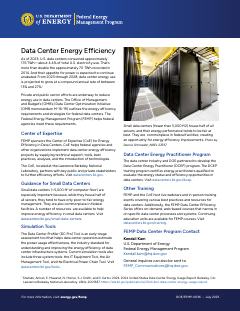
Data Center Energy Efficiency (Fact Sheet DOE/FEMP-0036, July 2025)
For a small data center or server room, write metering, air management and monitoring requirements into the specification from the start, given that energy management in this class tends to be poor.
- Data center energy use is projected to grow 13% to 27% per year (CAGR) from 2023 through 2028.