
NSIDC Data Center: Energy Reduction Strategies - Airside Economization and Unique Indirect Evaporative Cooling (FEMP brochure, 2012)
U.S. DOE Federal Energy Management Program / National Renewable Energy Laboratory · National Renewable Energy Laboratory
This FEMP/NREL case study of the National Snow and Ice Data Center in Boulder describes a retrofit that replaced CRAC units with airside economization and multi-stage indirect evaporative coolers. It is a measured before-and-after example for small-facility retrofits.
On this page
Overview
The study is a FEMP case study documenting the retrofit of the National Snow and Ice Data Center (NSIDC) in Boulder, prepared for DOE FEMP by a national-laboratory contractor. The retrofit replaced CRAC units with airside economization and multi-stage indirect evaporative coolers, reconfigured the room with hot-aisle containment and consolidated servers.
The multi-stage indirect evaporative units were installed in May 2011 and hot aisle containment was added. Three measures were therefore applied together: a change of cooling system, airflow reorganisation and consolidation of the IT load. Part of the results cannot be attributed to a single measure; the document presents the retrofit as a package.
According to the results, cooling energy fell by over 70% in summer months and over 90% in cooler winter months. Annual average PUE for June-October 2011 was 2.01 with the old CRAC system versus 1.55 for the new one. Since September 2011, monthly PUE has stayed below 1.35 thanks to airside economization.
As a limit, the example concerns a small facility in a dry climate. The results should not be transferred directly to humid climates or large facilities, but the case is valuable for validation.
Key points
- Cooling energy fell by over 70% in summer months and over 90% in cooler winter months.
- Annual average PUE, June-October 2011: 2.01 with the old CRAC system versus 1.55 with the new one.
- Since September 2011 monthly PUE stayed below 1.35 due to airside economization.
- Multi-stage indirect evaporative units installed in May 2011; hot aisle containment added.
- CRAC units replaced with airside economization and indirect evaporative coolers; servers consolidated.
- A retrofit of a small facility in a dry climate.
Using it in design
- Offer indirect evaporative cooling and airside economizer options in the cooling selector with climate-driven hours.
- Use the NSIDC PUE before/after as a validation case for small-facility retrofits in dry climates.
- Model hot-aisle containment and server consolidation together with the cooling-system change as a package measure.
Monthly newsletter · free
Keep your reading list current
Once a month: new library sources, changes to Turkish regulations and upcoming data centre events.
SoSo CAD
Check cooling capacity alongside your design
Review zone heat loads, available capacity and the capacity balance after the largest unit is lost in SoSo CAD.
Request a demo
Who should read it
Engineers and energy efficiency consultants working on cooling retrofits and economizer selection.
Publication details
- Authors
- National Renewable Energy Laboratory
- Publisher
- U.S. DOE Federal Energy Management Program / National Renewable Energy Laboratory
- Year
- 2012
- Document language
- English
- Source type
- Government / public
- Access
- Free to read
- Licence
- Copyright retained; citation only — the publisher’s terms apply to the original document
Original licence note
Prepared for DOE FEMP by a national-laboratory contractor (stated on cover); not US-Gov public domain. Cited only.
Citation
National Renewable Energy Laboratory (2012). NSIDC Data Center: Energy Reduction Strategies - Airside Economization and Unique Indirect Evaporative Cooling (FEMP brochure, 2012). U.S. DOE Federal Energy Management Program / National Renewable Energy Laboratory. https://www.energy.gov/cmei/femp/articles/nsidc-data-center-energy-reduction-strategies
Events on this subject
Browse the events calendarAll content and rights belong to the respective authors and publishers. SoSo CAD provides only the citation, its own summary and a link to the source, and is not responsible for the sources' content.
Related sources
All sources on this topic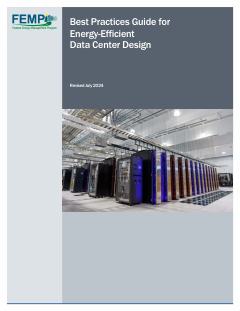
U.S. DOE FEMP / NREL 2024
Best Practices Guide for Energy-Efficient Data Center Design (Revised July 2024)
Weigh the supply air setpoint against server fan energy: raise it in small steps within the ASHRAE recommended range so the most demanding inlet nears 80 °F, only after air management is in place, and control to IT inlet temperature rather than return temperature.
- Compute racks reached 60 kW in 2013, and recent liquid-cooled racks exceed 125 kW.
Buildings (MDPI AG) 2026
Thermal Environment Assessment for Energy-Efficient Cooling in Air-Cooled Data Centers: Measurement, CFD, and Predictive Models
In a design tool, set CFD accuracy expectations from this review's ranges (0.1-4 °C absolute, relative mostly below 20%) and do not limit validation scope to temperature; ask for velocity and pressure too.
- Of the 58 CFD studies, Fluent was used in 24 (41.4%) and 6SigmaDC in 12; standard k-epsilon in 41 (about 70.7%).
Fluids (MDPI AG) 2026
A Review of Thermal Management in Modern Data Centres: Water Usage Effectiveness and Heat Transfer Coefficients
Set WUE targets from the heat-rejection topology (dry, free-cooling, hybrid, evaporative) and not only the server-side cooling technology; WUE depends on the share of heat rejected by evaporation.
- Dry facilities with closed-loop liquid cooling need essentially no water, while evaporative systems typically report WUE up to 2.5 L/kWh.
Applied Sciences (MDPI AG) 2025
Optimization of Airflow Organization in Bidirectional Air Supply Data Centers in China
In retrofitting an existing raised-floor hall, first close unused rack spaces with blanking panels (alone they cut SHI by 42.61%); containment alone gave little benefit.
- Baseline RTI 0.786, SHI 0.230, RCI-HI 0.992. Blanking alone: SHI 0.132, RCI-HI 1. Blanking plus full CAC (Case 7): RTI 1, SHI 0.027.
Scientific Reports (Springer Science and Business Media LLC) 2025
Energy efficiency enhancement in two European data centers through CFD modeling
Set up the retrofit workflow as KPI-guided: with a validated CFD model compute RCI, RHI, RTI and the recirculation index, then test rack repositioning, separators, sealing unused bays and removing badly placed ventilation units in sequence.
- KPI limits: ASHRAE recommended 18-27 °C and allowable 15-32 °C inlet temperatures.
European Commission JRC 2025
2025 Best Practice Guidelines for the EU Code of Conduct on Data Centre Energy Efficiency (JRC141521, EUR 40267)
Design the facility to operate within the ASHRAE Class A2 allowable range and require A2 operation within warranty in IT procurement; plan separate environmental zones (practice 5.3.4) for legacy equipment.
- IT equipment AC/DC power converters should be rated at 90% efficiency or better across expected load ranges.