
Low-voltage electrical installations - Part 4-44: Protection for safety - Protection against voltage disturbances and electromagnetic disturbances
IEC · IEC TC 64
The third edition of IEC 60364-4-44:2024 sets out installation safety against voltage and electromagnetic disturbances, including transient overvoltages and surge protection.
On this page
Overview
The standard is Part 4-44 of the low-voltage electrical installations series prepared by IEC TC 64. It specifies requirements for the safety of installations in the event of voltage disturbances and electromagnetic disturbances. Its scope includes transient overvoltages and surge protective devices (SPDs). It is not intended for public energy distribution or for generation and transmission systems; it addresses the consumer installation only.
The third edition was published on 19 December 2024 and replaces the 2007 edition together with Amendment 1:2015 and Amendment 2:2018. The catalogue lists a 116-page redline version, and Amendment 1 is in preparation. It is a paid standard, and only the publisher's public catalogue abstract and product details were used here.
The edition makes structural changes: terms, definitions and symbols are regrouped in a new 440.3, and Clause 443 is amended to introduce DC SPDs. The change reflects the spread of installations with DC buses such as battery systems and photovoltaics. Related standards recorded include the IEC 61643 series, EN 50310 and IEC 62305. Limits: the full text was not read, so SPD placement rules, voltage classes and thresholds are absent from this record. For a data centre designer, the standard matters as the basis for the protection scheme against overvoltage and electromagnetic effects on critical IT loads.
Key points
- Specifies requirements for installation safety in the event of voltage and electromagnetic disturbances.
- Not intended for public energy distribution or generation and transmission systems.
- Third edition replaces the 2007 edition, Amendment 1:2015 and Amendment 2:2018.
- Terms, definitions and symbols are regrouped in the new 440.3.
- Clause 443 is amended to introduce DC SPDs.
- Published 2024-12-19; 116 pages (redline version); Amendment 1 in preparation.
- Related standards: IEC 61643 series, EN 50310, IEC 62305.
Using it in design
- In surge and EMC design, add an SPD placement rule set: origin of the installation, sub-distribution and sensitive IT boards, with DC SPDs for battery and PV DC buses.
- Run an earthing and bonding topology check for computer rooms (meshed bonding network).
- In specifications citing older editions, check the move to the 2024 edition and the DC SPD change in Clause 443.
- Consult the full text for exact placement distances and values.
Monthly newsletter · free
Keep your reading list current
Once a month: new library sources, changes to Turkish regulations and upcoming data centre events.
SoSo CAD
Review your power design in SoSo CAD
Inspect supply paths, equipment loads and UPS failure scenarios in one model.
Request a demo
Who should read it
Engineers designing electrical systems, surge protection and earthing for data centres.
Related standards
- IEC 61643 series
- EN 50310
- IEC 62305
Publication details
- Authors
- IEC TC 64
- Publisher
- IEC
- Year
- 2024
- Document number
- IEC 60364-4-44:2024
- Document language
- English
- Source type
- Standard
- Access
- Citation only
- Licence
- Copyright retained; citation only — the publisher’s terms apply to the original document
Original licence note
Paid standard. Record built only from the publisher's public catalogue abstract and product metadata; full text not redistributed.
Citation
IEC TC 64 (2024). Low-voltage electrical installations - Part 4-44: Protection for safety - Protection against voltage disturbances and electromagnetic disturbances. IEC. IEC 60364-4-44:2024. https://webstore.iec.ch/en/publication/104438
Events on this subject
Browse the events calendarAll content and rights belong to the respective authors and publishers. SoSo CAD provides only the citation, its own summary and a link to the source, and is not responsible for the sources' content.
Related sources
All sources on this topic
arXiv preprint (University of Michigan) 2026
Grid Integration of AI Data Centers: A Critical Review of Energy Storage Solutions (arXiv preprint)
Layer storage by timescale (chip/server sub-ms to ms, rack ms to seconds, UPS and GiUPS sub-second to 10 s, BESS minutes to hours) and show each layer's duty in the coordination scheme.
- Rapid AI load variations often induce 5-10% voltage swings within milliseconds.
arXiv (Aalborg University) 2026
From Grid to Chip: Power Architecture, Stability, and Flexibility of AI Data Centers
For large sites, capture grid-code inputs per jurisdiction (FRT curve, MW/min ramp limit, power-quality limits) as project inputs and flag UPS settings that transfer to battery or generator on shallow sags.
- NVIDIA reports that 800 V DC instead of 415 V AC cuts copper requirements by 45%.
WSEAS TRANSACTIONS ON POWER SYSTEMS (World Scientific and Engineering Academy and Society (WSEAS)) 2026
Design and Prototype of a Microgrid for Enhancing Reliability of Power Supply for Artificial Intelligence Data Centers
Follow the energy-balance chain in a PV/BESS sizing helper (daily load split, conversion losses, usable depth of discharge, power rating against night peak); report usable-energy duration rather than nameplate duration and make DoD an explicit input.
- Covering 60% of demand needs 81,857 kWh/day from PV after 5% DC-AC and 10% battery losses.
arXiv preprint (Texas Tech University / PNNL; submitted to Renewable and Sustainable Energy Reviews) 2026
A Critical Review of Grid Integration Challenges and Flexibility Opportunities for Large-Scale Data Centers
Base interconnection studies on staged, updatable facility data rather than a single static MW value; requested peak MW and annual energy alone do not establish integration.
- Under IEEE 519-2022, voltage-distortion limits at the PCC are the system owner's responsibility and current-distortion limits are the user's; a scalar THD cannot rule out narrow-band resonance.
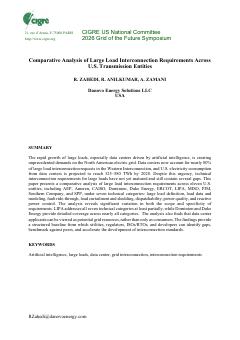
CIGRE US National Committee, 2026 Grid of the Future Symposium (arXiv preprint) 2026
Comparative Analysis of Large Load Interconnection Requirements Across U.S. Transmission Entities
Design data-centre UPS and load control to the most restrictive entity's requirement: 6.0 s ride-through at 0.70-0.90 pu (CAISO), six fault-clearing attempts within 90 s (SPP), six 50-70 ms reclosings (Dominion), and the ban on constant-power control (SPP).
- MISO's proposal requires withstanding three voltage disturbances within 10 s and phase-angle jumps up to 25 degrees.
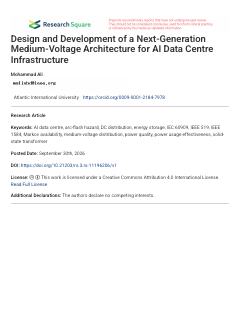
Springer Science and Business Media LLC (preprint) 2026
Design and Development of a Next-Generation Medium-Voltage Architecture for AI Data Centre Infrastructure
Make the 0.1-10 Hz oscillation, 1.40 peak-to-mean ratio and coincidence factor explicit inputs in the AI campus load model, and check storage and buffering against grid ramp limits.
- Conductor mass falls by 97.1%, electrical footprint by 58.1%, annual PUE from 1.42 to 1.11 and 15-year TCO by 32.4%.