
NIST/SEMATECH e-Handbook of Statistical Methods: Chapter 8, Assessing Product Reliability
Original title NIST/SEMATECH e-Handbook of Statistical Methods
NIST / SEMATECH · NIST/SEMATECH
The handbook's reliability chapter explains the exponential lifetime and independent-component series, parallel and r-out-of-n models, and states the assumption behind each probability calculation.
On this page
Overview
The chapter gives four core formulas. For independent components that must all survive, system reliability is the product of the component reliabilities. For independent parallel components where one survivor suffices, system failure probability is the product of the component failure probabilities. For n identical independent components needing at least r survivors, reliability is the sum of the binomial probabilities for r through n survivors.
With a constant failure rate lambda, lifetime reliability is exp(-lambda x time) and mean time to failure (MTTF) is 1/lambda. For instance, two independent components of reliability 0.9 give 0.81 in series and 1 - 0.1 x 0.1 = 0.99 in parallel; these numbers are a simple application of the formulas, not an example from the document. Exponential life means no ageing is modelled.
The limit matters: the chapter supplies no failure data for a particular facility and does not model common-cause failures. The formulas hold only if components are independent; two 'redundant' units fed by the same generator line violate that assumption. Results are therefore an assumption-dependent calculation, not proof of achieved service availability. In short, the formulas are a calculator, not a data source; the failure rates must come from the user and their source.
Key points
- For independent components that must all survive, system reliability is the product of individual reliabilities.
- For independent parallel components where one survivor suffices, system failure probability is the product of component failure probabilities.
- For n identical independent components needing at least r survivors, reliability is the sum of binomial probabilities from r through n.
- With constant failure rate lambda, reliability is exp(-lambda x time) and MTTF is 1/lambda.
- The chapter gives no facility-specific failure data and does not model common-cause failures.
Using it in design
- Make independence and capacity assumptions required inputs of every reliability calculation and keep input provenance.
- Use series, parallel and r-out-of-n blocks as a numeric check of N, N+1 and 2N redundancy schemes.
- Do not present the output as achieved service availability; add a separate note on common-cause failure.
Monthly newsletter · free
Keep your reading list current
Once a month: new library sources, changes to Turkish regulations and upcoming data centre events.
SoSo CAD
Assess redundancy through scenarios
Compare normal operation and equipment failures in SoSo CAD, with supplied loads and capacity shortfalls in one view.
Request a demo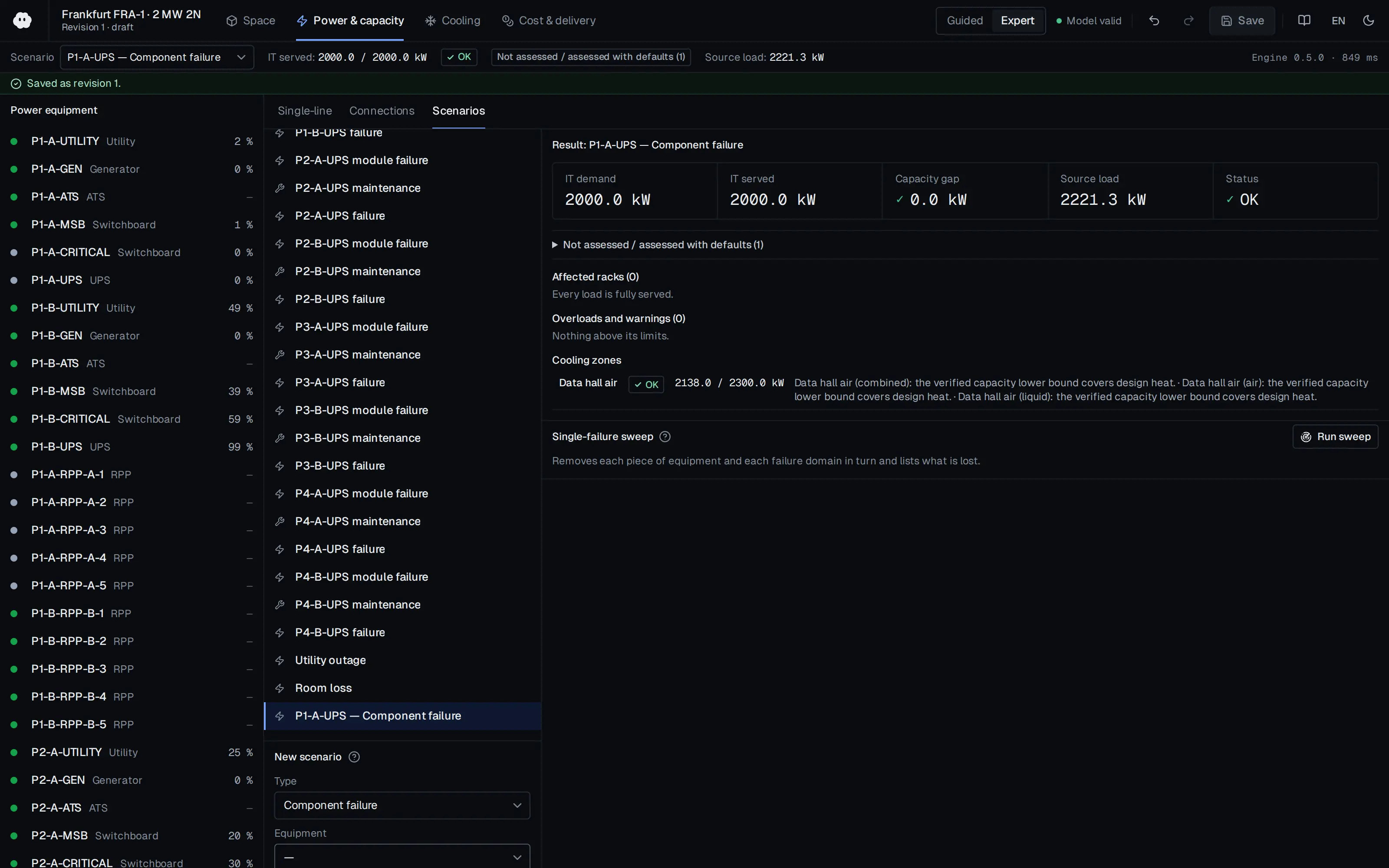
Who should read it
Designers calculating the reliability of redundancy schemes and engineers auditing a calculation's assumptions.
Publication details
- Authors
- NIST/SEMATECH
- Publisher
- NIST / SEMATECH
- Year
- 2012
- Document number
- Chapter 8, Assessing Product Reliability
- Document language
- English
- Source type
- Government / public
- Access
- Free to read
- Licence
- Copyright retained; citation only — the publisher’s terms apply to the original document
Citation
NIST/SEMATECH (2012). NIST/SEMATECH e-Handbook of Statistical Methods. NIST / SEMATECH. Chapter 8, Assessing Product Reliability. https://doi.org/10.18434/M32189
Events on this subject
Browse the events calendarAll content and rights belong to the respective authors and publishers. SoSo CAD provides only the citation, its own summary and a link to the source, and is not responsible for the sources' content.
Related sources
All sources on this topic
arXiv preprint (University of Michigan) 2026
Grid Integration of AI Data Centers: A Critical Review of Energy Storage Solutions (arXiv preprint)
Layer storage by timescale (chip/server sub-ms to ms, rack ms to seconds, UPS and GiUPS sub-second to 10 s, BESS minutes to hours) and show each layer's duty in the coordination scheme.
- Rapid AI load variations often induce 5-10% voltage swings within milliseconds.
arXiv (Aalborg University) 2026
From Grid to Chip: Power Architecture, Stability, and Flexibility of AI Data Centers
For large sites, capture grid-code inputs per jurisdiction (FRT curve, MW/min ramp limit, power-quality limits) as project inputs and flag UPS settings that transfer to battery or generator on shallow sags.
- NVIDIA reports that 800 V DC instead of 415 V AC cuts copper requirements by 45%.
WSEAS TRANSACTIONS ON POWER SYSTEMS (World Scientific and Engineering Academy and Society (WSEAS)) 2026
Design and Prototype of a Microgrid for Enhancing Reliability of Power Supply for Artificial Intelligence Data Centers
Follow the energy-balance chain in a PV/BESS sizing helper (daily load split, conversion losses, usable depth of discharge, power rating against night peak); report usable-energy duration rather than nameplate duration and make DoD an explicit input.
- Covering 60% of demand needs 81,857 kWh/day from PV after 5% DC-AC and 10% battery losses.

Springer Science and Business Media LLC (preprint) 2026
Battery reserve autonomy and diesel generator mission reliability
When presenting UPS battery autonomy as a way to improve generator reliability, compute the reserve threshold against the mission duration and report that autonomy of minutes adds little to long-outage generator reliability.
- For a 72 h mission with Fehr parameters: 0.95617 with one generator, 0.95847 with an ideal 4 h battery reserve, 0.99808 with two independent generators.
Fire (MDPI AG) 2026
Reframing Data Center Fire Safety as a Socio-Technical Reliability System: A Systematic Review
Ask for a fire-safety design file that covers a lifecycle plan (aligned with NFPA 75 and NFPA 76) including emergency response, damage control and post-fire recovery, not only prevention and suppression.
- The search found 806 records (Scopus 330, Web of Science 476); twelve empirical studies were synthesised and benchmarked against NFPA 75 and NFPA 76.
Journal of Engineering Research and Sciences (Journal of Engineering Research and Sciences) 2026
CFD Analysis of Data Center Hall Cooling Performance under Normal and Failure Modes with Control Strategies and Airflow Leakages
Do thermal verification of failure mode (two ACUs offline) with realistic air leakage (cabinet gaps, HAC panel joints); a leak-free model can comply while the leaky model exceeds 32 °C.
- The grid study selected 7,288,454 cells with the standard k-epsilon model and wall functions.