
NIST SP 800-34 Rev. 1: Contingency Planning Guide for Federal Information Systems
National Institute of Standards and Technology · Marianne Swanson, Pauline Bowen et al.
NIST's May 2010 guide that sets out a seven-step contingency planning process for recovering information system services after a disruption. It gives concrete methods for business impact analysis, backup, alternate site selection and testing and exercises.
U.S. public domain — U.S. Government work; free to reuse
On this page
Overview
The guide defines contingency planning as interim measures to recover information system services after a disruption: relocating systems to an alternate site, recovering functions on alternate equipment, or performing functions manually. It gives specific recommendations for client/server, telecommunications and mainframe systems. The seven steps are the policy statement, business impact analysis (BIA), preventive controls, contingency strategies, the information system contingency plan (ISCP), plan testing, training and exercises, and plan maintenance, designed to be integrated into every stage of the system development life cycle.
The BIA section covers determining business processes and recovery criticality, resource requirements and resource recovery priorities. Three time measures are distinguished: Maximum Tolerable Downtime (MTD), the total outage the system owner will accept; Recovery Time Objective (RTO), the longest a system resource can remain unavailable before unacceptable impact, which must normally be shorter than MTD; and Recovery Point Objective (RPO), the point in time to which data can be restored, meaning tolerated data loss, which is not part of MTD. A footnote states that systems supporting mission essential functions must meet an MTD of 12 hours or less.
Strategies are tied to the FIPS 199 availability impact level: low suggests tape backup and a relocate or cold site; moderate, optical backup, WAN/VLAN replication and a cold or warm site; high, mirrored systems, disc replication and a hot site. Alternate site types are cold, warm, hot, mobile and mirrored; the mirrored site is the most expensive and ensures virtually 100 percent availability, while cold sites are cheapest but can take substantial time to equip. A fixed site should lie in an area unlikely to be hit by the same hazard as the primary site. Equipment replacement options are vendor agreements, an equipment inventory and existing compatible equipment.
The plan is presented in three sample formats for low, moderate and high impact, each with Activation/Notification, Recovery and Reconstitution phases. The appendices include sample templates, a BIA template, frequently asked questions, personnel considerations, a summary of SP 800-53 contingency planning controls and the relation to the SDLC.
Key points
- Seven-step process: policy, BIA, preventive controls, strategies, ISCP, testing/training/exercises, plan maintenance.
- RTO must normally be shorter than MTD; reprocessing time is added to the RTO.
- RPO expresses tolerated data loss and is not part of MTD.
- Systems supporting mission essential functions must meet an MTD of 12 hours or less.
- FIPS 199 low: tape backup, relocate or cold site; moderate: optical backup, WAN/VLAN replication, cold or warm site; high: mirrored systems, disc replication, hot site.
- Alternate site types are cold, warm, hot, mobile and mirrored; the mirrored site is the most expensive and gives virtually 100 percent availability.
- Mobile sites can often be delivered within 24 hours, though equipment installation adds time.
- The alternate site should be in an area unlikely to be affected by the same hazard as the primary site.
- The plan has three phases: Activation/Notification, Recovery and Reconstitution.
- The plan is a living document, updated as the system and the organisation change.
Using it in design
- Derive MTD, RTO and RPO from the BIA for the data centre and translate them into UPS and generator runtime, cooling redundancy and replication architecture requirements.
- Choose the secondary site type (cold, warm, hot, mirrored) from the availability impact level and size its power and cooling to meet the RTO.
- Locate the secondary site outside the primary site's hazard area and include travel time in the RTO calculation.
- Define priority-shipment and spare-equipment inventory clauses in supplier SLAs as the equipment replacement strategy.
- Evaluate preventive controls (UPS, RAID, automatic failover, clustering, mirroring) as design requirements together with life-cycle cost.
- Add the testing, training and exercise programme and the plan maintenance cycle to operating procedures.
Monthly newsletter · free
Keep your reading list current
Once a month: new library sources, changes to Turkish regulations and upcoming data centre events.
SoSo CAD
Assess redundancy through scenarios
Compare normal operation and equipment failures in SoSo CAD, with supplied loads and capacity shortfalls in one view.
Request a demo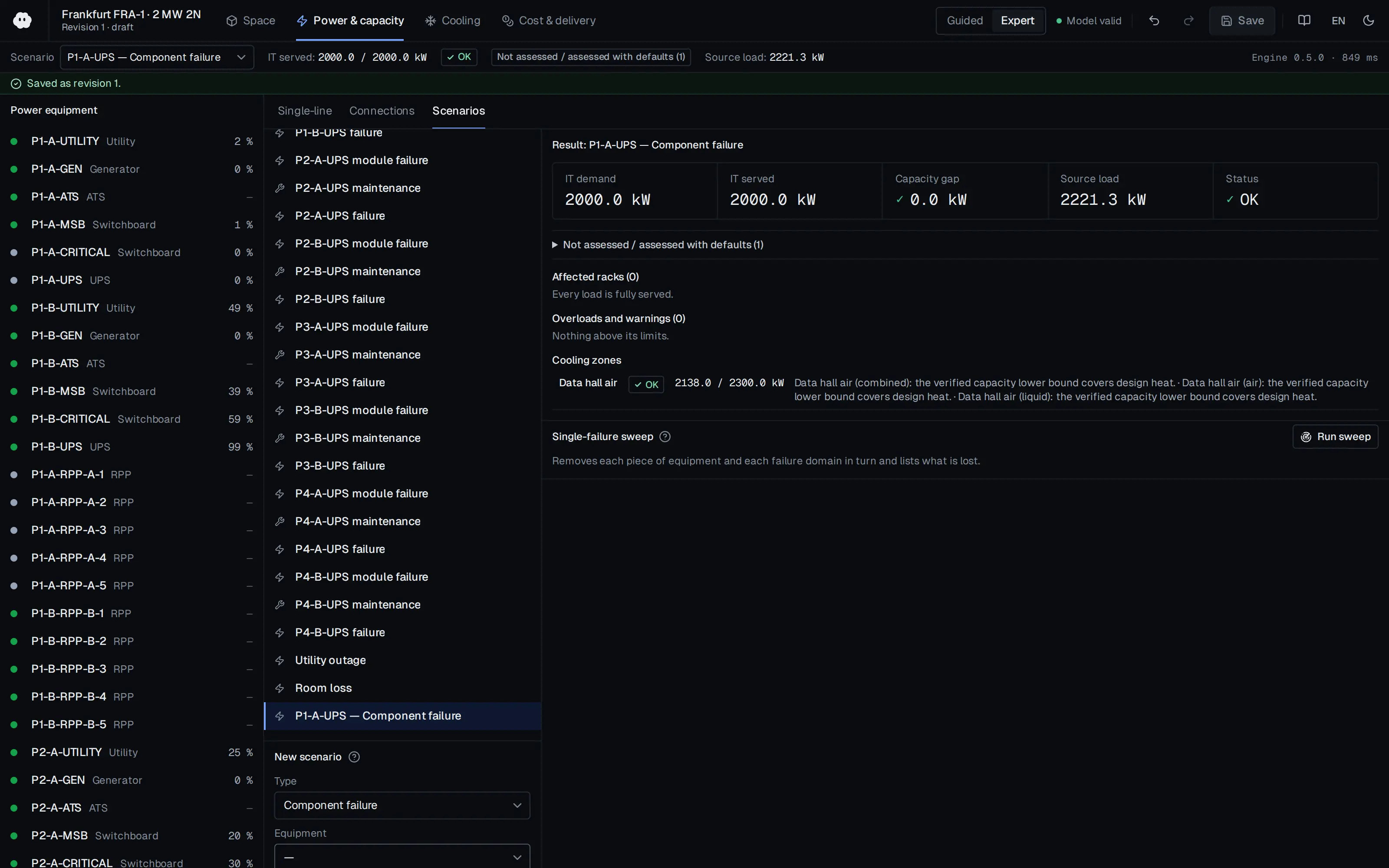
Who should read it
ISCP coordinators, system owners, disaster recovery and continuity planners, and data-centre operations teams.
Document contents
- Executive Summary
- Chapter 1. Introduction
- Chapter 2. Background: Contingency Planning and Resilience; Types of Plans (BCP, COOP, Crisis Communications, CIP, Cyber Incident Response, DRP, ISCP, OEP)
- Chapter 3. Information System Contingency Planning Process
- 3.1 Develop the Contingency Planning Policy Statement
- 3.2 Conduct the Business Impact Analysis (BIA)
- 3.3 Identify Preventive Controls
- 3.4 Create Contingency Strategies (Backup and Recovery; Alternate Sites; Equipment Replacement)
- 3.5 Plan Testing, Training, and Exercises (TT&E)
- 3.6 Plan Maintenance
- Chapter 4. Information System Contingency Plan Development (Activation and Notification, Recovery, Reconstitution)
- Chapter 5. Technical Contingency Planning Considerations (Client/Server, Telecommunications, Mainframe Systems)
- Appendix A. Sample ISCP Templates
- Appendix B. Sample BIA and BIA Template
- Appendix E. Contingency Planning Controls
- Appendix F. Contingency Planning and the SDLC
Related standards
- ISO 22301
- NIST SP 800-53 CP family
Read the document
nist-sp-800-34r1-contingency.pdf
U.S. public domain — U.S. Government work; free to reuse
The document is provided unaltered because its licence permits redistribution.
Publication details
- Authors
- Marianne Swanson; Pauline Bowen; Amy Wohl Phillips; Dean Gallup; David Lynes
- Publisher
- National Institute of Standards and Technology
- Year
- 2010
- Document number
- NIST SP 800-34 Rev. 1
- Document language
- English
- Source type
- Expert / community
- Access
- Open licence — downloadable
- Licence
- U.S. public domain — U.S. Government work; free to reuse
- Licence evidence
- www.copyright.gov
Original licence note
NIST publication available free of charge via doi.org/10.6028; the front-matter authority/copyright statement says it is not subject to copyright in the United States (attribution appreciated); U.S. government work under 17 U.S.C. 105.
Citation
Marianne Swanson; Pauline Bowen; Amy Wohl Phillips; Dean Gallup; David Lynes (2010). NIST SP 800-34 Rev. 1: Contingency Planning Guide for Federal Information Systems. National Institute of Standards and Technology. NIST SP 800-34 Rev. 1. https://doi.org/10.6028/NIST.SP.800-34r1
Events on this subject
Browse the events calendarAll content and rights belong to the respective authors and publishers. SoSo CAD provides only the citation, its own summary and a link to the source, and is not responsible for the sources' content.
Related sources
All sources on this topic
Fire (MDPI AG) 2026
Reframing Data Center Fire Safety as a Socio-Technical Reliability System: A Systematic Review
Ask for a fire-safety design file that covers a lifecycle plan (aligned with NFPA 75 and NFPA 76) including emergency response, damage control and post-fire recovery, not only prevention and suppression.
- The search found 806 records (Scopus 330, Web of Science 476); twelve empirical studies were synthesised and benchmarked against NFPA 75 and NFPA 76.
Journal of Engineering Research and Sciences (Journal of Engineering Research and Sciences) 2026
CFD Analysis of Data Center Hall Cooling Performance under Normal and Failure Modes with Control Strategies and Airflow Leakages
Do thermal verification of failure mode (two ACUs offline) with realistic air leakage (cabinet gaps, HAC panel joints); a leak-free model can comply while the leaky model exceeds 32 °C.
- The grid study selected 7,288,454 cells with the standard k-epsilon model and wall functions.
IEEE Access (Institute of Electrical and Electronics Engineers (IEEE)) 2026
GRAPE-UPS: Direction-Constrained Peer Anomaly Detection for Weak Batteries in Data-Center UPS Strings
Require block-level (per-unit) voltage and resistance monitoring in UPS battery monitoring rather than string totals, citing that one weak unit in a series string limits the whole string's capacity.
- On an independent electrochemical simulation benchmark, directed peer scoring achieved AUPRC 0.848 under nominal conditions and 0.850-0.877 under operating shifts.
Buildings (MDPI AG) 2025
Dynamic Maintenance Cost Optimization in Data Centers: An Availability-Based Approach for K-out-of-N Systems
Plan UPS maintenance from a condition table that maps each unit's state to MTBF and MTTR, then pick the units to maintain that meet target availability at the lowest cost.
- Maintenance service options and costs are based on the APC Symmetra PX 500 kW UPS; the case has ten 500 kW modular UPS units.
World Electric Vehicle Journal (MDPI AG) 2023
Research on Calendar Aging for Lithium-Ion Batteries Used in Uninterruptible Power Supply System Based on Particle Filtering
Plan UPS battery replacement from the RUL of the weakest cell rather than the string average; in a series string one cell sets the replacement date for the whole string even when others have years of life left.
- Per-cell SOH estimation RMSE ranged from 0.15% to 9.07% (MAPE 0.16% to 6.85%).

Open Compute Project Foundation 2022
Leak Detection and Intervention, Revision 1.0 (OCP Advanced Cooling Solutions white paper)
Run a probability-and-impact leak risk analysis at project start, specify BSPP/O-ring joints for serviceable connections and check the O-ring compound against the coolant chemistry using the full wetted-materials list.
- A UQD2 dry-break quick disconnect is specified to drip less than 0.063 cc when disconnected at 200 psi.