
Attributes of an Effective Maintenance Program for Data Center Physical Infrastructure
Schneider Electric · Ken Belanger, Eric Brun et al.
Schneider Electric WP 264 describes the shift from calendar-based to condition-based and eventually risk-informed maintenance of UPS, switchgear and cooling, and names five attributes of a good service provider.
On this page
Overview
The paper places maintenance of UPS, switchgear, cooling and other physical infrastructure on a four-step maturity ladder: reactive, calendar-based (time-based), condition-based and risk-informed. In the calendar-based model that is common today, preventive visits happen quarterly, semi-annually or annually depending on device type; the visit takes place when the date arrives regardless of the device's actual condition. The reactive model acts only after a failure.
Connected equipment and analytics are what make condition-based maintenance possible: because the device reports its own state, work is done when needed and becomes less invasive. The end of the roadmap is risk-informed maintenance, where decisions are driven by risk instead of fixed intervals. The paper names connected equipment as the basis for this move. This cuts unnecessary invasive visits and surfaces a real deviation early through remote monitoring.
Five attributes are listed for choosing a provider: personnel expertise, quality assurance, on-site response time, remote monitoring and thorough inspections during preventive visits. Response time feeds directly into MTTR and therefore availability. The paper dates from 2021 and contains no quantified benefit; the related standards are NFPA 70B, EN 50600-3-1 and the Uptime Tier Standard: Operational Sustainability. Two of the five, remote monitoring and response time, tie directly to the condition-based model and to MTTR.
Key points
- Calendar-based programs schedule preventive visits quarterly, semi-annually or annually per device type.
- Maturity progression: reactive, calendar-based, condition-based, risk-informed maintenance.
- Five provider attributes: expertise, QA, on-site response time, remote monitoring, comprehensive PM inspections.
- Connected equipment and analytics enable less invasive condition-based maintenance.
- Response time feeds directly into MTTR, so it is an input to the availability model.
Using it in design
- In the operations module attach a maintenance strategy and default PM interval (quarterly/semi-annual/annual) to each catalog asset class, with a condition-based monitoring option.
- In the availability model tie MTTR to the response-time SLA and feed opex estimates.
- Add a maintainability check that every redundant component can be isolated for PM (concurrent maintainability).
Monthly newsletter · free
Keep your reading list current
Once a month: new library sources, changes to Turkish regulations and upcoming data centre events.
SoSo CAD
Assess redundancy through scenarios
Compare normal operation and equipment failures in SoSo CAD, with supplied loads and capacity shortfalls in one view.
Request a demo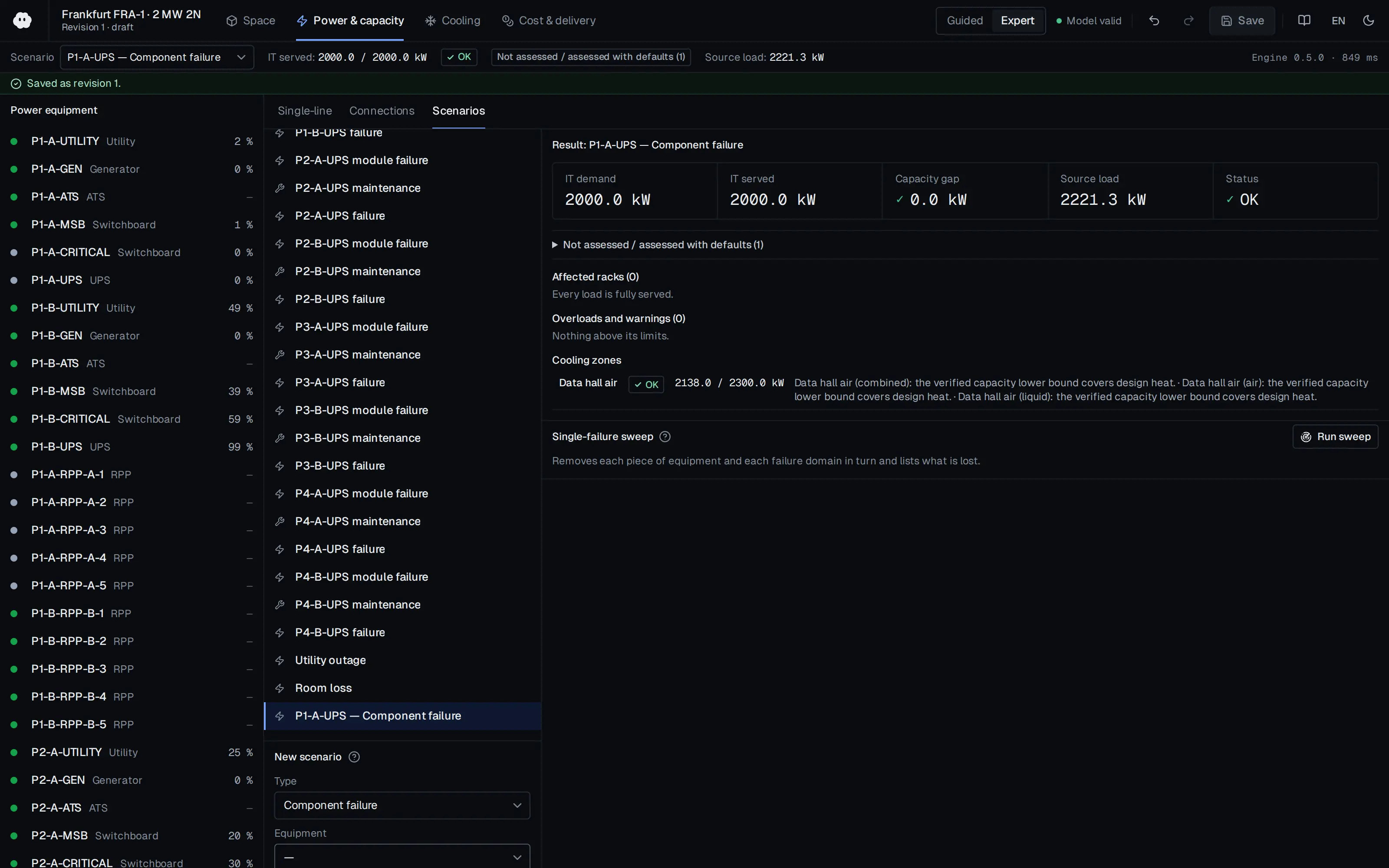
Who should read it
Operations managers selecting service contracts and designers building availability models.
Related standards
- NFPA 70B
- EN 50600-3-1
- Uptime Tier Standard: Operational Sustainability
Publication details
- Authors
- Ken Belanger; Eric Brun; Prasanna Kanchikere; James Martinec; Wendy Torell
- Publisher
- Schneider Electric
- Year
- 2021
- Document number
- WP 264
- Document language
- English
- Source type
- Manufacturer
- Access
- Free to read
- Licence
- Copyright retained; citation only — the publisher’s terms apply to the original document
Citation
Ken Belanger; Eric Brun; Prasanna Kanchikere; James Martinec; Wendy Torell (2021). Attributes of an Effective Maintenance Program for Data Center Physical Infrastructure. Schneider Electric. WP 264. https://download.schneider-electric.com/files?p_Doc_Ref=SPD_WP264_EN
Events on this subject
Browse the events calendarAll content and rights belong to the respective authors and publishers. SoSo CAD provides only the citation, its own summary and a link to the source, and is not responsible for the sources' content.
Related sources
All sources on this topicVertiv 2024
Condition-Based Maintenance Services Address Data Center Challenges
Record telemetry capability (protocols, factory sensors, remote monitoring support) in the equipment catalog.
Schneider Electric 2025
Direct Liquid Cooling System Challenges in Data Centers
Use the eight challenges as a DLC readiness checklist in the commissioning and design-review module.
- Heat capture ratio defines the air share: 80% liquid capture leaves 20% for air cooling.
Schneider Electric 2023
A Quantitative Comparison of UPS Monitoring and Servicing Approaches Across Edge Environments
Add a lifecycle/opex calculator per UPS fleet: site count, UPS VA, battery chemistry, install-year distribution, warranty, truck-roll cost, staff allocation and downtime $/min.
- Typical truck-roll cost is $1000.
Schneider Electric 2012
Data Center Projects: Advantages of Using a Reference Design
Store reference designs as structured objects with required attribute fields (IT kW range, redundancy N/N+1/2N for power and cooling, density kW/rack, annualized PUE, heat rejection type, estimated cost) plus linked one-lines, layouts and BOM lines (part number, qty, supplier).
- Graphics: electrical, mechanical and IT one-lines; layouts with dimensions and clearances of racks, PDUs, CRAC/CRAHs, UPSs, generators, switchboards, ATSs; 3D views.
Journal of Engineering Research and Sciences (Journal of Engineering Research and Sciences) 2026
CFD Analysis of Data Center Hall Cooling Performance under Normal and Failure Modes with Control Strategies and Airflow Leakages
Do thermal verification of failure mode (two ACUs offline) with realistic air leakage (cabinet gaps, HAC panel joints); a leak-free model can comply while the leaky model exceeds 32 °C.
- The grid study selected 7,288,454 cells with the standard k-epsilon model and wall functions.
IEEE Access (Institute of Electrical and Electronics Engineers (IEEE)) 2026
GRAPE-UPS: Direction-Constrained Peer Anomaly Detection for Weak Batteries in Data-Center UPS Strings
Require block-level (per-unit) voltage and resistance monitoring in UPS battery monitoring rather than string totals, citing that one weak unit in a series string limits the whole string's capacity.
- On an independent electrochemical simulation benchmark, directed peer scoring achieved AUPRC 0.848 under nominal conditions and 0.850-0.877 under operating shifts.