
Solving Edge Computing Infrastructure Challenges
Schneider Electric · Patrick Donovan, Wendy Torell
Schneider Electric WP 277 (2019) argues that local edge sites are now business-critical yet differ from central data centres in two ways: little or no on-site staff and large, dispersed fleets.
On this page
Overview
The paper lists recurring mistakes in configuring, deploying and operating edge sites: UPS under- or grossly over-sized, no UPS redundancy or bypass, too few or wrong-type receptacles on the rack PDU or UPS, insufficient U space, missing accessory kits and ignored roll-in space constraints. Its answer is an ecosystem of end user, IT vendor, physical-infrastructure vendor, systems integrator and managed service provider that produces pre-configured, pre-tested micro data centres.
Citing World Wide Technology, pre-configuring platforms before shipment cuts field engineering cost by 25-40%, speeds order processing by 20% and reduces maintenance cost by 7%. Prefabricated modules save on the order of 50% of design and engineering time (per WP 163). Reference designs should contain a design summary, bill of material, rack elevation, electrical one-lines and floor layouts, ideally built into a rule-based configurator.
The infrastructure advice is concrete: a UPS is always recommended for critical edge IT even with a backup generator, a bypass switch allows UPS replacement without downtime, and dual power paths or two UPSs give redundancy. Most small single-rack installations need only passive cooling (enclosure ventilation, exhaust fans to a return plenum); denser installs may need DX CRAC, mini-split or chilled-water units. Rack PDUs may be unnecessary when outlet management is not needed and the UPS has the right outlets and voltage, or when the UPS is hardwired. Management uses cloud-based tools with open APIs.
Key points
- Pre-configuration cuts field engineering 25-40%, maintenance 7% and speeds order processing 20% (WWT).
- Common mistakes: wrong UPS size, no redundancy or bypass, wrong/too few receptacles, insufficient U space, missing accessory kits.
- Prefabricated modules save about 50% of design and engineering time (WP 163).
- A UPS is recommended for critical edge IT even with a generator; bypass allows replacement without downtime.
- Small single racks mostly need passive cooling; dense ones need DX CRAC, mini-split or chilled water.
- Rack PDUs may be unnecessary if outlet management is not needed or the UPS is hardwired.
- Reference design: summary, BOM, rack elevation, one-lines, floor layouts.
Using it in design
- Provide an edge/micro data centre template: single-rack bundle of rack, UPS, rack PDU, cooling (passive default), sensors and cameras.
- Check UPS kVA against IT load, flagging both undersize and gross oversize.
- Check rack PDU input plug against UPS output receptacle type and count, and used U against rack U with a spare-capacity warning.
- Require a maintenance bypass for critical sites, add accessory kits to the BOM, and capture roll-in door width, available power and ducting per deployment.
Monthly newsletter · free
Keep your reading list current
Once a month: new library sources, changes to Turkish regulations and upcoming data centre events.
SoSo CAD
Assess redundancy through scenarios
Compare normal operation and equipment failures in SoSo CAD, with supplied loads and capacity shortfalls in one view.
Request a demo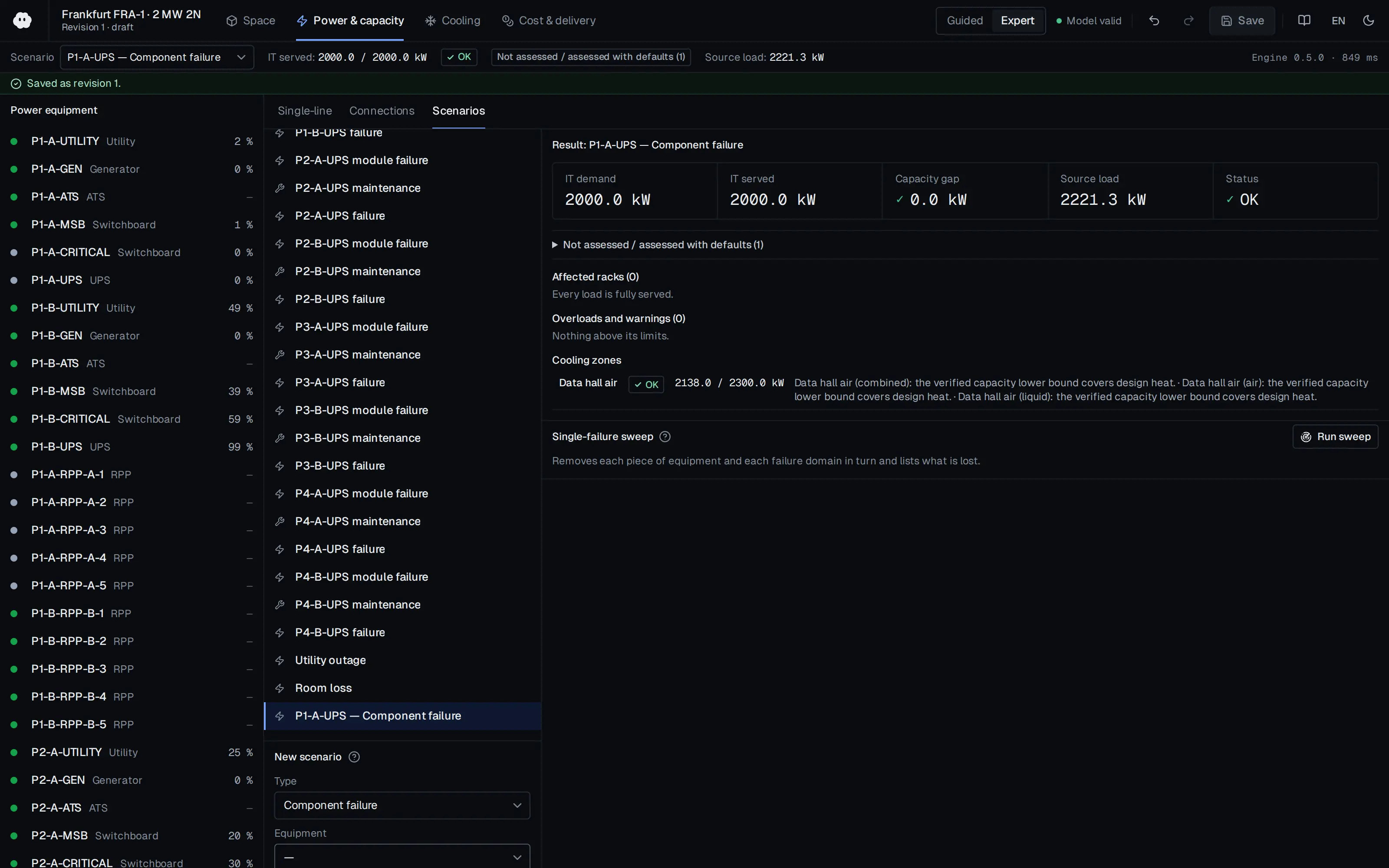
Who should read it
Designers and IT owners standardising micro data centre bundles for many unstaffed edge sites.
Publication details
- Authors
- Patrick Donovan; Wendy Torell
- Publisher
- Schneider Electric
- Year
- 2019
- Document number
- WP 277
- Document language
- English
- Source type
- Manufacturer
- Access
- Free to read
- Licence
- Copyright retained; citation only — the publisher’s terms apply to the original document
Citation
Patrick Donovan; Wendy Torell (2019). Solving Edge Computing Infrastructure Challenges. Schneider Electric. WP 277. https://download.schneider-electric.com/files?p_Doc_Ref=SPD_VAVR-B9AKQA_EN
Events on this subject
Browse the events calendarAll content and rights belong to the respective authors and publishers. SoSo CAD provides only the citation, its own summary and a link to the source, and is not responsible for the sources' content.