
How Monitoring Systems Reduce Human Error in Distributed Server Rooms and Remote Wiring Closets
Schneider Electric · Dennis Bouley
Schneider Electric WP 103 (Dennis Bouley, 2011) blames most downtime in small unattended server rooms on human error and missing real-time information, and proposes four countermeasures.
On this page
Overview
The paper estimates 2.9 million server rooms and wiring closets in the United States and attributes over 70% of reported data centre outages to human error. Real incidents motivate it: racks shrink-wrapped by contractors, leaks from a plumber's work, domestic air conditioners exhausting into the room, and drills and space heaters plugged into UPS outlets.
The four countermeasures are video surveillance with sensors, metered and switched rack PDUs, environmental and door sensors, and central monitoring and automation software. Switched PDUs allow remote reboot and outlet power-on sequencing, avoiding start-up inrush that can overload circuits. Each rack can carry three temperature sensors (bottom, middle, top) because those temperatures often differ substantially.
Outside installation services can usually have a monitoring system running within 1-2 days, with devices found by auto-discovery over a defined IP range. Example alerts are a bottom-of-rack threshold of 62 °F (16 °C) and a rack door open for more than two minutes. Grouped thresholds for device types and mass configuration limit alarm fatigue. One incident sets a concrete limit: a small room cooled by a domestic air conditioner with intake and exhaust in the same room reached about 110 °F (43 °C). The text is light on numbers but works as a persuasive practical guide built from incidents.
Key points
- About 2.9 million US server rooms and wiring closets; over 70% of reported outages attributed to human error.
- Four countermeasures: video surveillance with sensors, metered/switched rack PDUs, environmental and door sensors, central monitoring software.
- Switched PDUs sequence outlet power-on to avoid start-up inrush overload.
- Three temperature sensors per rack (bottom, middle, top) because readings differ.
- Outside services can have monitoring running in 1-2 days; devices found by auto-discovery over an IP range.
- Example alerts: rack bottom 62 °F (16 °C); rack door open over two minutes.
- A domestic air conditioner with intake and exhaust in the same room drove a small room to about 110 °F (43 °C).
Using it in design
- Give edge and closet room templates a default monitoring package: door switch, temperature at 3 heights, leak detector, camera, network management card on UPS and cooling, and metered/switched PDUs with sequencing.
- Warn when a small room's cooling unit rejects heat into the same space.
- Flag unprotected convenience outlets fed from the UPS.
- Report UPS loading per site against a target limit and set thresholds per device group.
Monthly newsletter · free
Keep your reading list current
Once a month: new library sources, changes to Turkish regulations and upcoming data centre events.
SoSo CAD
Assess redundancy through scenarios
Compare normal operation and equipment failures in SoSo CAD, with supplied loads and capacity shortfalls in one view.
Request a demo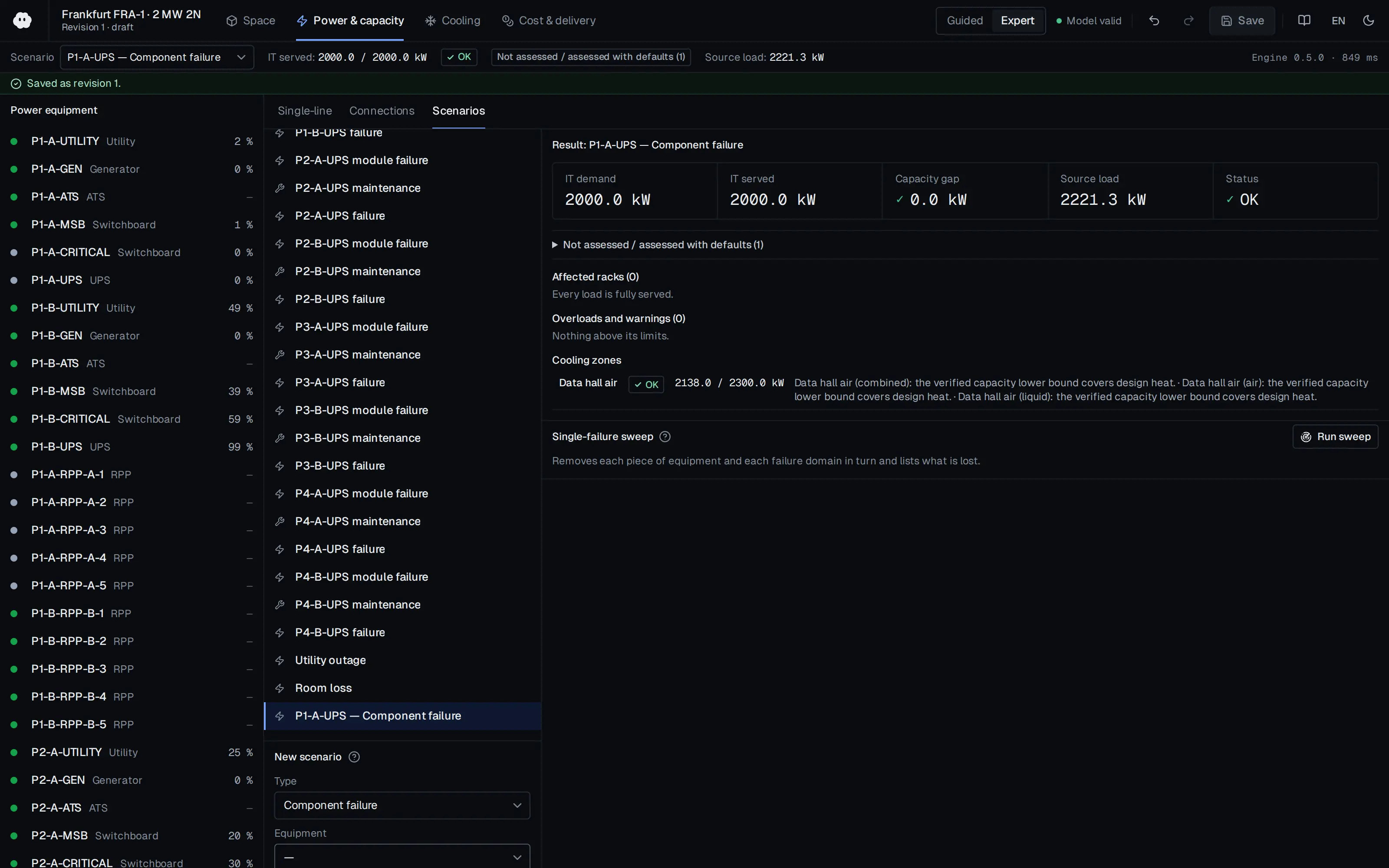
Who should read it
Teams designing and operating small edge, branch and wiring-closet server rooms.
Publication details
- Authors
- Dennis Bouley
- Publisher
- Schneider Electric
- Year
- 2011
- Document number
- WP 103
- Document language
- English
- Source type
- Manufacturer
- Access
- Free to read
- Licence
- Copyright retained; citation only — the publisher’s terms apply to the original document
Citation
Dennis Bouley (2011). How Monitoring Systems Reduce Human Error in Distributed Server Rooms and Remote Wiring Closets. Schneider Electric. WP 103. https://download.schneider-electric.com/files?p_Doc_Ref=SPD_DBOY-7YMKLN_EN
Events on this subject
- SC26 – International Conference for High Performance Computing, Networking, Storage and Analysis
- Data Center World Middle East
- NVIDIA GTC Washington, D.C.
All content and rights belong to the respective authors and publishers. SoSo CAD provides only the citation, its own summary and a link to the source, and is not responsible for the sources' content.