
Calculating ROI of DCIM Monitoring for Distributed IT Sites
Schneider Electric · Wendy Torell, Maria A. Torres Arango
Schneider Electric WP 292 (2026) offers a framework for justifying DCIM monitoring and alarming across distributed and edge IT portfolios where few staff are on site.
On this page
Overview
Value is grouped into three buckets: fewer and shorter downtime events, lower staffing and field-service cost for managing power and cooling devices, and avoided security or environmental incidents. Downtime impact is estimated from four variables: device failures, the share of failures causing IT downtime, average time to restore service (MTTR) and the cost of IT downtime. A cited industry study found 80% of data centres without DCIM reported a major outage versus roughly 29% of those with DCIM, and average outage length was 342 minutes without DCIM against 36 minutes with it, about a 90% reduction.
The staffing bucket covers central IT operations, distracted non-IT site staff and truck rolls. A typical US IT operations technician has a base salary of $58k-$89k, with benefits about 30% of compensation, giving about $100k total per full-time person. A truck roll costs around $1,000 per dispatch (TSIA). For security and environmental incidents the cited breach costs are $2.63M for a business of 500-1,000 employees and $4.35M for the global average data breach.
A companion calculator produces a 5-year NPV cash flow under a subscription model. Three scenarios with 100 power and cooling devices give ROIs of 10.2%, 66.3% and 176.1% over 5 years. The figures rest on cited studies and vendor inputs, and the wide spread from about 10% to over 170% shows how sensitive the result is to fleet age, staff share and incident value.
Key points
- Three value buckets: fewer and shorter downtime events, staffing and field-service cost, avoided security/environmental incidents.
- 80% of data centres without DCIM reported a major outage versus roughly 29% with DCIM.
- Average outage length 342 minutes without DCIM, 36 minutes with; about a 90% reduction.
- Downtime impact: device failures, share causing IT downtime, MTTR, cost of downtime.
- Typical US IT operations technician: $58k-$89k base, benefits about 30%, about $100k per person.
- Truck roll about $1,000 per dispatch (TSIA).
- Cited breach costs: $2.63M for 500-1,000 employee business; $4.35M global average.
- Three 100-device scenarios give 5-year ROI of 10.2%, 66.3% and 176.1%.
Using it in design
- For multi-site designs add a monitoring-coverage check: every UPS, cooling unit, rack PDU and environmental sensor needs a network management interface, otherwise warn unmonitored device.
- Provide an ROI estimator: failure rate x share to downtime x MTTR x $/min, staff share x $100k default, truck rolls x $1,000 default, with 5-year NPV at a user cost of capital.
- Keep defaults editable and labelled as vendor-cited.
- Include leak sensors in liquid-cooled and chilled-water design checklists, since unnoticed leaks are named as a major incident type.
Monthly newsletter · free
Keep your reading list current
Once a month: new library sources, changes to Turkish regulations and upcoming data centre events.
SoSo CAD
Assess redundancy through scenarios
Compare normal operation and equipment failures in SoSo CAD, with supplied loads and capacity shortfalls in one view.
Request a demo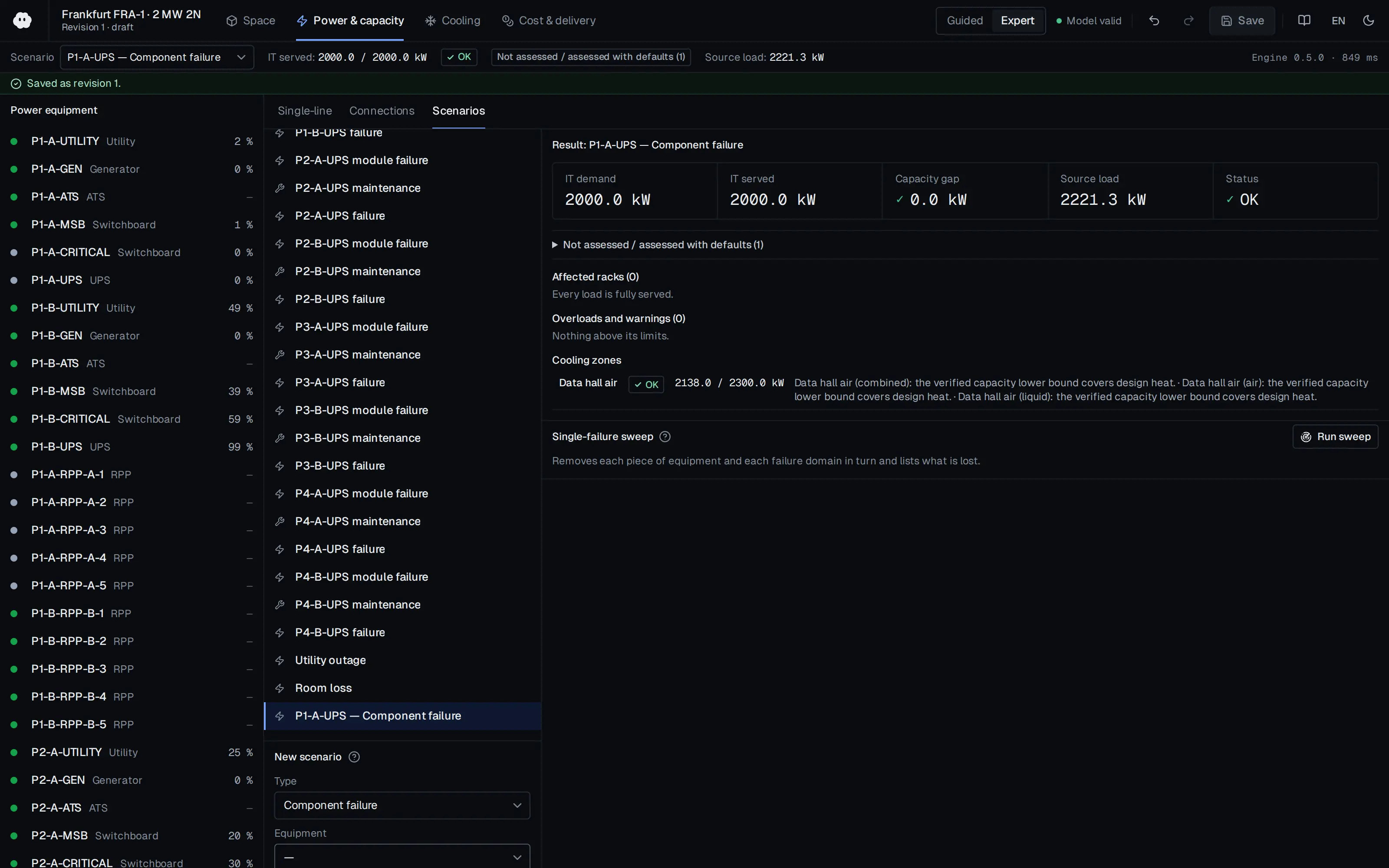
Who should read it
IT and facilities managers who must justify monitoring spend across a distributed or edge portfolio.
Publication details
- Authors
- Wendy Torell; Maria A. Torres Arango
- Publisher
- Schneider Electric
- Year
- 2026
- Document number
- WP 292
- Document language
- English
- Source type
- Manufacturer
- Access
- Free to read
- Licence
- Copyright retained; citation only — the publisher’s terms apply to the original document
Citation
Wendy Torell; Maria A. Torres Arango (2026). Calculating ROI of DCIM Monitoring for Distributed IT Sites. Schneider Electric. WP 292. https://download.schneider-electric.com/files?p_Doc_Ref=SPD_WP292_EN
Events on this subject
Browse the events calendarAll content and rights belong to the respective authors and publishers. SoSo CAD provides only the citation, its own summary and a link to the source, and is not responsible for the sources' content.