
Calculating ROI of Monitoring and Maintenance Service Contracts for New Data Centers
Schneider Electric · Patrick Donovan, Wendy Torell
Schneider Electric WP 152 provides a framework and tool to quantify the return on remote-monitoring and predictive-maintenance contracts against run-to-fail or run-to-alarm operation.
On this page
Overview
The benefits modeled are reduced downtime, lower MTTR, avoided energy penalty from degrading equipment, and lower staff and truck-roll costs. The core contract functions are 24x7 remote monitoring, predictive maintenance and automated dispatch with parts. The energy penalty is given concretely, derived from an Oak Ridge study: unmaintained equipment uses about 119% of baseline energy in year 2, 129% in year 3, 139% in year 4 and 151% in year 5. An average truck roll costs about $1,000 per dispatch.
A cited survey reports about 80% of sites without DCIM had a major outage against about 29% with DCIM, with MTTR reduction up to about 90%. In the sensitivity cases ROI ranges from 11% to 180% for downtime costs of $350/min to $700/min. The 11% case marks the cheap-downtime end and the 180% case the expensive end, a roughly 16-fold spread in return driven only by the downtime-cost input.
The conclusion is that the return depends mostly on the cost of downtime: modest where outages are cheap, very high where they are expensive. The survey data are a cited source, not the paper's own measurement. The 119% to 151% energy penalty is derived from an Oak Ridge study rather than measured by the paper, and the survey figures are likewise cited, so only the downtime-cost input is specific to each site.
Key points
- Energy penalty for unmaintained equipment: about 119% of baseline in year 2, 129% year 3, 139% year 4, 151% year 5.
- Average truck roll costs about $1,000 per dispatch.
- Example ROI ranges from 11% to 180% for downtime costs of $350/min to $700/min.
- Cited survey: about 80% of sites without DCIM had a major outage versus about 29% with DCIM; MTTR reduction up to about 90%.
- Core contract functions: 24x7 remote monitoring, predictive maintenance, automated dispatch with parts.
Using it in design
- Add an efficiency-degradation factor to the opex model for run-to-fail operation (+19%/+29%/+39%/+51% cooling energy in years 2 to 5) against the maintained case.
- Let users enter downtime cost per minute to compute service-contract ROI.
- Add a 'monitoring present' flag to the availability model that lowers MTTR.
Monthly newsletter · free
Keep your reading list current
Once a month: new library sources, changes to Turkish regulations and upcoming data centre events.
SoSo CAD
Assess redundancy through scenarios
Compare normal operation and equipment failures in SoSo CAD, with supplied loads and capacity shortfalls in one view.
Request a demo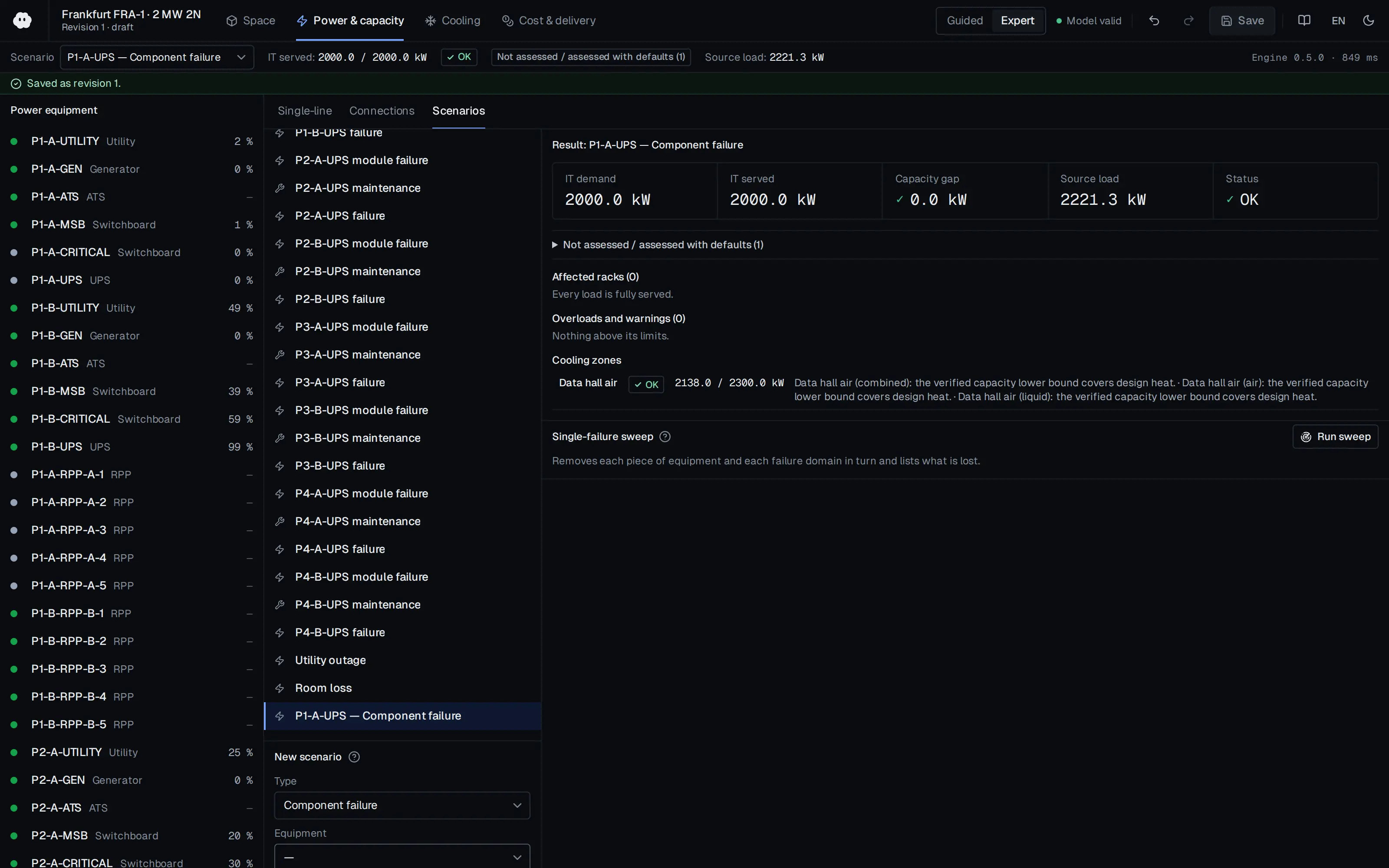
Who should read it
Operations and finance decision makers building the case for a monitoring and maintenance contract.
Related standards
- EN 50600-3-1
Publication details
- Authors
- Patrick Donovan; Wendy Torell
- Publisher
- Schneider Electric
- Year
- 2024
- Document number
- WP 152
- Document language
- English
- Source type
- Manufacturer
- Access
- Free to read
- Licence
- Copyright retained; citation only — the publisher’s terms apply to the original document
Citation
Patrick Donovan; Wendy Torell (2024). Calculating ROI of Monitoring and Maintenance Service Contracts for New Data Centers. Schneider Electric. WP 152. https://download.schneider-electric.com/files?p_Doc_Ref=SPD_WP152_EN
Events on this subject
- Data Center World Middle East
- ELECO 2026 Elektrik-Elektronik ve Biyomedikal Mühendisliği Konferansı
- Datacenter Forum Stockholm
All content and rights belong to the respective authors and publishers. SoSo CAD provides only the citation, its own summary and a link to the source, and is not responsible for the sources' content.
Related sources
All sources on this topic
U.S. DOE FEMP 2010
Operations & Maintenance Best Practices: A Guide to Achieving Operational Efficiency, Release 3.0 (August 2010)
Choose maintenance strategy by equipment criticality: predictive for critical equipment with random failures, preventive for equipment subject to wear, reactive for small non-critical items; build a master equipment list and priority matrix.
- Boiler combustion tuning and related O&M can yield fuel savings of 2% to 20%.
Uptime Institute 2025
Uptime Institute Global Data Center Survey 2025 (15th annual) — press release and public highlights
Use PUE 1.54 as the 'industry average' line on the efficiency dashboard, year-stamped and user-overridable
- Survey run April-May 2025 with 800+ respondents
Huawei Digital Power 2024
Top 10 Trends of Data Center Facility 2024 White Paper
For lithium BESS/UPS rooms, require detection and segregation sized for a 30-60 s runaway escalation.
- Rack power expected to rise from 6-8 kW to 30-40 kW.
Socomec 2024
Data centre - How to ensure power availability, electrical safety and energy performance? (Expert advice & innovative solutions guide)
In the single-line editor, tag transfer devices as ATSE (IEC 60947-6-1) or STS with a transfer-time field, and suggest STS where the load needs under about 10 ms.
- Human error accounts for 22 % of unplanned outages.
Huawei Digital Power 2022
Next-Generation Data Center Facility White Paper
Support CUE, WUE and a heat-reuse fraction next to PUE in reports.
- Above about 20 kW per rack liquid cooling becomes primary, with air as auxiliary.
Eaton 2021
Your Aging Three-Phase UPS: When to Refresh, Replace or Run to Fail
In the asset/lifecycle module store the installation year per UPS and battery, and project replacement dates from the component table defaults.
- New UPSs run at 94-99% efficiency versus 80-92% for most legacy units.