
Industry 4.0: Minimizing Downtime Risk with Resilient Edge Computing
Schneider Electric · Paul Lin, Steven Carlini
Schneider Electric WP 287 (2020) argues that Industry 4.0 technologies push compute to the plant floor, where edge IT in series with production means an IT outage stops the line.
On this page
Overview
IT "in series" with a process (e.g. F&B machines) means any IT outage immediately stops or degrades production, unlike "in parallel" applications with buffer time. Cited downtime costs: automotive average $22,000/min, up to $50,000/min (about $1.3M/h) (ATS 2005); IndustryWeek 2013 average $17,000 per incident; Aberdeen 2016 average $260,000/h, up 60% from $164,000 in 2014.
The paper compares a Tier 1 and a Tier 3 edge installation for an automotive plant: Tier 1 edge IT at 99.67% availability, 28.82 h/yr downtime and a $38.7M loss at $1.3M/h; Tier 3 at 99.98%, 1.58 h/yr and $3.4M, a 95% reduction ($35.3M/yr). Plant-floor challenges are harsh environment, limited space, open access, few IT staff and cyber exposure from IIoT.
Recommendations are purpose-built ruggedized or wall-mount enclosures; Li-ion UPS batteries on plant floors (life normally over 10 years, longer runtime for a given size, embedded monitoring, tolerance of temperatures above 40 °C); and redundant power and cooling for critical loads to achieve concurrent maintainability. Defence-in-depth cybersecurity takes six steps: security plan, network separation, perimeter protection, network segmentation, device hardening, monitoring and update. Pre-integrated edge solutions (WWT) cut field engineering cost 25-40%. Related frameworks are IEC 62443 and the Uptime Institute Tier Standard.
Key points
- Automotive downtime averages $22,000/min, up to $50,000/min (about $1.3M/h).
- Aberdeen 2016: $260,000/h, up 60% from $164,000 in 2014; IndustryWeek 2013: $17,000 per incident.
- Tier 1 edge IT: 99.67%, 28.82 h/yr, $38.7M loss.
- Tier 3 edge IT: 99.98%, 1.58 h/yr, $3.4M; 95% reduction ($35.3M/yr).
- In-series IT stops production immediately; in-parallel applications have buffer time.
- Li-ion UPS: life normally over 10 years, embedded monitoring, tolerance above 40 °C.
- Defence-in-depth in 6 steps: plan, separation, perimeter, segmentation, hardening, monitoring/update.
- Pre-integrated solutions cut field engineering 25-40% and maintenance 7%.
Using it in design
- Add a processCoupling flag (in_series, in_parallel) to edge sites; for in_series default the availability target to Tier III equivalent and require redundant UPS/cooling (N+1 or 2N) plus maintenance bypass.
- Provide a downtime-cost calculator turning availability % into hours/yr x $/h, comparing tier options with the Table 2 method.
- Catalog enclosure ruggedization fields (material, IP, double wall, cable gland) plus UPS battery chemistry and max ambient, and warn when VRLA is specified above 40 °C ambient.
- Checklist: firewall-equipped edge gateway, IT/OT network segmentation, DCIM/remote monitoring connectivity.
Monthly newsletter · free
Keep your reading list current
Once a month: new library sources, changes to Turkish regulations and upcoming data centre events.
SoSo CAD
Assess redundancy through scenarios
Compare normal operation and equipment failures in SoSo CAD, with supplied loads and capacity shortfalls in one view.
Request a demo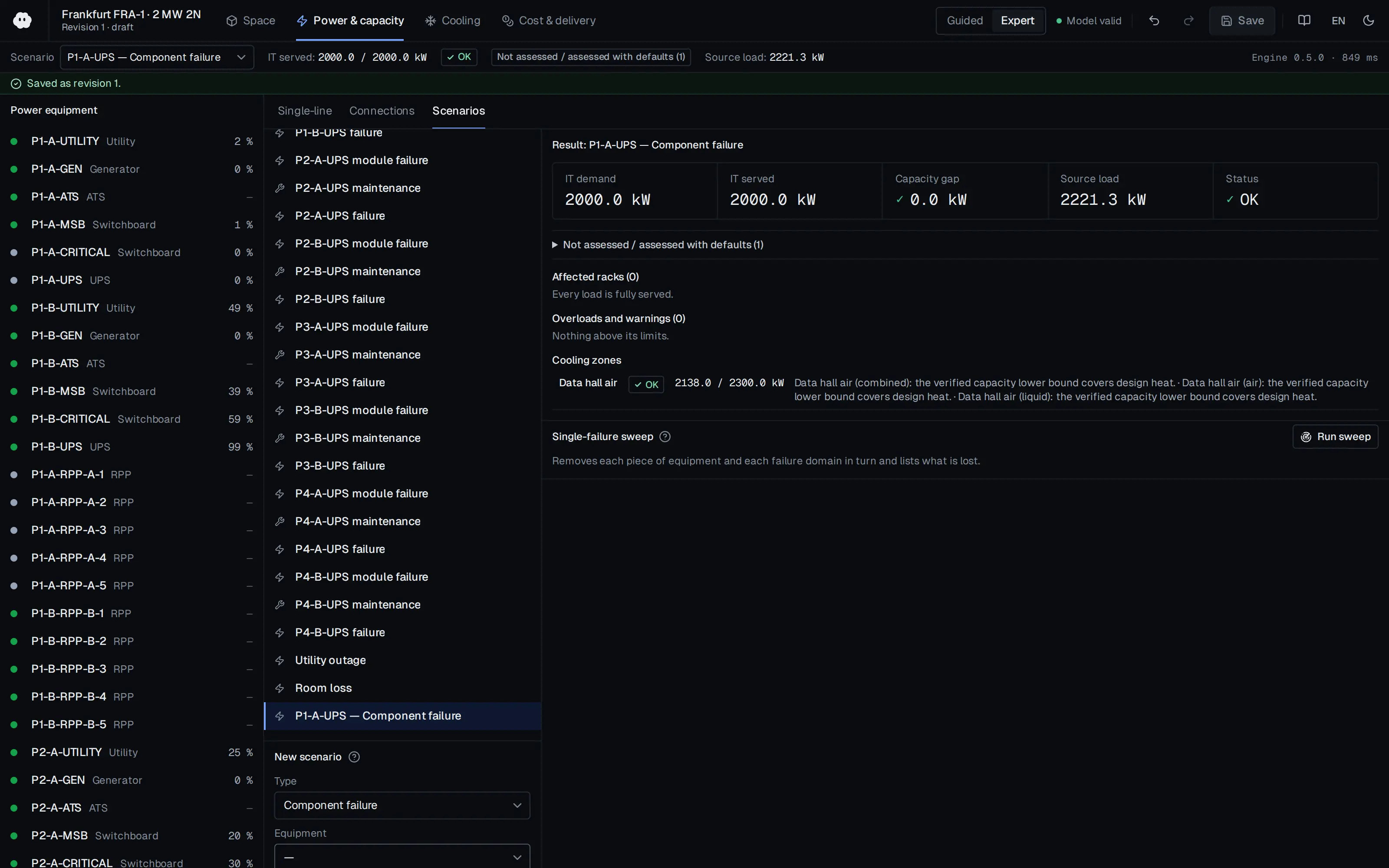
Who should read it
Designers and OT/IT owners putting edge IT on the plant floor and tying downtime cost to availability targets.
Related standards
- IEC 62443
- Uptime Institute Tier Standard: Topology
Publication details
- Authors
- Paul Lin; Steven Carlini
- Publisher
- Schneider Electric
- Year
- 2020
- Document number
- WP 287
- Document language
- English
- Source type
- Manufacturer
- Access
- Free to read
- Licence
- Copyright retained; citation only — the publisher’s terms apply to the original document
Citation
Paul Lin; Steven Carlini (2020). Industry 4.0: Minimizing Downtime Risk with Resilient Edge Computing. Schneider Electric. WP 287. https://download.schneider-electric.com/files?p_Doc_Ref=SPD_WP287_EN
Events on this subject
Browse the events calendarAll content and rights belong to the respective authors and publishers. SoSo CAD provides only the citation, its own summary and a link to the source, and is not responsible for the sources' content.
Related sources
All sources on this topicSchneider Electric 2021
Why Cloud Computing is Requiring us to Rethink Resiliency at the Edge
In a portfolio/edge module let users model multiple sites with availability (or tier), headcount served and severity (1-5), compute series availability for dependent sites and rank sites by downtime x severity.
- Scorecard: annual downtime hours x severity (1-5), an FMECA-style ranking.
Open Compute Project Foundation 2026
Interface Specification Between Hyperscalers and Utility Grid for Disturbance Performance (Version 1.0.0)
For a new site, write the POI LVRT/HVRT envelope and the PFAPR requirement (90% within 2 s) as design criteria, and settle which voltage measurement (line-to-neutral or line-to-line) governs during protection coordination with the utility.
- In ERCOT NOGRR 282, cooling load is subtracted from the pre-fault load used to judge PFAPR.

U.S. DoD (UFC) 2021
UFC 3-600-01, Fire Protection Engineering for Facilities (8 August 2016, Change 6, 6 May 2021)
Build the data hall protection concept in this order: very early warning smoke detection, wet-pipe sprinklers throughout, clean agent only as an addition, and state in the specification that clean agent cannot replace the sprinklers.
- Stand-alone telecommunication facilities over 2,500 ft2 (232 m2) need clean agent or sprinklers; over 7,500 ft2 (696 m2) sprinklers are required and clean agent may only be added.
FEMA 2014
FEMA P-1019, Emergency Power Systems for Critical Facilities: A Best Practices Approach to Improving Reliability (September 2014)
At critical-facility data centers, place generators, ATS, fuel tanks and pumps above the greatest of BFE + 3 ft, DFE + 1 ft and 500-year elevation + 1 ft, and prefer elevation to dry floodproofing.
- Generators over 300 kW are almost exclusively diesel-fueled.
ABB 2026
Next-Generation Medium-Voltage Architecture for AI Data Centers
For loads above roughly 30-50 MW add a grid-code compliance checklist (LVRT duration, frequency band, RoCoF, PF) and let users choose LV-UPS versus MV-UPS architecture.
- BESS blocks 0.6-21.6 MW with 1, 2 or 4 h durations
BICSI 2024
ANSI/BICSI 002-2024, Data Center Design and Implementation Best Practices (overview page)
Offer BICSI classes as an alternate standards profile alongside Uptime/TIA/EN, with an F1~Tier I/Rated-1/Class 1 ... F4~Tier IV/Rated-4/Class 4 table labelled 'conceptual equivalence only'
- A 2010 draft used F0-F5; current editions use F0-F4