
Turkish Building Earthquake Code (TBDY 2018)
Original title Türkiye Bina Deprem Yönetmeliği (TBDY 2018)
Afet ve Acil Durum Yönetimi Başkanlığı (AFAD)
Turkey's seismic building code, in force since 1.1.2019 and replacing the 2007 code; it also requires seismic design of non-structural elements and mechanical and electrical equipment.
On this page
Overview
The Turkish Building Earthquake Code (TBDY 2018) was issued by AFAD and published in Resmî Gazete no. 30364 (repeated issue) on 18.03.2018. It applies to the design and construction of new, altered or enlarged buildings and to the assessment and retrofit of existing ones. It has been in force since 1.1.2019 and repeals the 2007 code. It is essential for data centres in Turkey's high-seismicity regions.
The code defines four ground-motion levels derived from AFAD hazard maps: DD-1 (2% in 50 years; 2475-year return period), DD-2 (10% in 50 years; 475-year), DD-3 (50%; 72-year) and DD-4 (68%; 43-year). Seismic hazard data come from the Türkiye Deprem Tehlike Haritaları (tdth.afad.gov.tr). It also defines building use classes with importance factors, design classes and performance targets. Buildings needed immediately after an earthquake (BKS=1), including communication facilities and energy generation and distribution facilities, have an importance factor of I = 1.5; BKS=2 is 1.2 and others 1.0.
The most relevant provision for data centres is that non-structural elements and mechanical and electrical equipment, with their attachments, must be designed for seismic loads (except in DTS=4 buildings); friction may not be counted in anchor capacity. Equipment heavier than 10% of its floor's weight is treated as part of the structural system. As a limit, this record rests on a summary and key clauses of the code; detailed calculations need the full text and an earthquake engineer's assessment.
Key points
- Applies to new, altered or enlarged buildings and to assessment/retrofit of existing ones; in force 1.1.2019; repeals the 2007 code.
- Ground-motion levels: DD-1 2% in 50 yr (2475-yr), DD-2 10% (475-yr), DD-3 50% (72-yr), DD-4 68% (43-yr).
- Hazard data come from the Türkiye Deprem Tehlike Haritaları (tdth.afad.gov.tr), enacted by decision 2018/11275.
- Importance factor I = 1.5 for BKS=1 buildings needed immediately after an earthquake (incl. communication, energy generation and distribution), 1.2 for BKS=2, 1.0 for others.
- Non-structural elements and mechanical/electrical equipment and attachments must be designed for seismic loads (except DTS=4); friction may not be counted in anchor capacity.
- Equipment heavier than 10% of its floor's weight is treated as part of the structural system.
Using it in design
- In the site/structure module (TR profile), pull DD-2 spectral values from the AFAD map by coordinates.
- Propose BKS=1 (I=1.5) for critical and telecom data centres.
- Generate seismic anchorage demand for racks, UPS, batteries, chillers and generators per Section 6.
- Flag heavy plant above 10% of floor weight for structural modelling.
- Do not add friction to anchor capacity.
Monthly newsletter · free
Keep your reading list current
Once a month: new library sources, changes to Turkish regulations and upcoming data centre events.
SoSo CAD
Assess redundancy through scenarios
Compare normal operation and equipment failures in SoSo CAD, with supplied loads and capacity shortfalls in one view.
Request a demo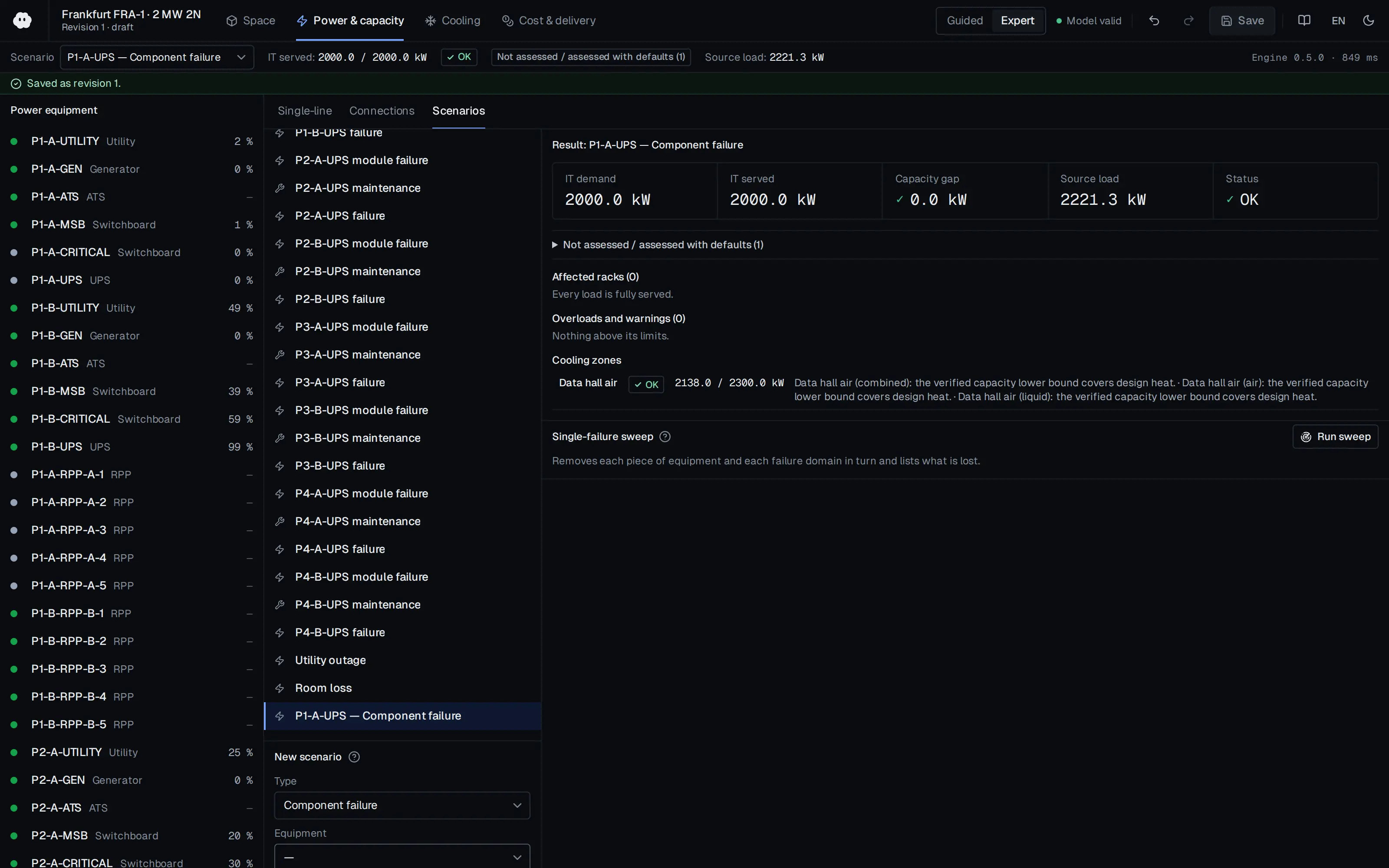
Who should read it
Architects, civil and earthquake engineers and mechanical and electrical designers planning data centre sites and structures in Turkey.
Related standards
- ISO/IEC TS 22237-30
- ASCE 7 Chapter 13
- Eurocode 8
Publication details
- Authors
- Afet ve Acil Durum Yönetimi Başkanlığı (AFAD)
- Publisher
- Afet ve Acil Durum Yönetimi Başkanlığı (AFAD)
- Year
- 2018
- Document number
- RG 30364 mükerrer (18.03.2018)
- Document language
- Turkish
- Source type
- Turkish regulation
- Access
- Free to read
- Licence
- Bibliographic reference only — the document is not redistributed here; confirm reuse terms at the original source
Original licence note
Official Turkish legislation published in the Resmî Gazete; FSEK (Law 5846) Art. 31 makes laws and regulations freely reproducible, but this library keeps it citation-only by policy. Text read from mevzuat.gov.tr (consolidated version as of 2026-11).
Citation
Afet ve Acil Durum Yönetimi Başkanlığı (AFAD) (2018). Türkiye Bina Deprem Yönetmeliği (TBDY 2018). Afet ve Acil Durum Yönetimi Başkanlığı (AFAD). RG 30364 mükerrer (18.03.2018). https://www.mevzuat.gov.tr/mevzuat?MevzuatNo=24468&MevzuatTur=7&MevzuatTertip=5
Events on this subject
Browse the events calendarAll content and rights belong to the respective authors and publishers. SoSo CAD provides only the citation, its own summary and a link to the source, and is not responsible for the sources' content.
Related sources
All sources on this topic
International Energy Agency 2026
Energy and AI in East Asia
In a site module for Korea and Japan, flag grid-congested metro regions and suggest renewable-rich regions.
- Data centres use 1.5% of global electricity and are projected to reach about 945 TWh (about 3%) by 2030.
CIGRE US National Committee, 2026 Grid of the Future Symposium (arXiv preprint) 2026
Comparative Analysis of Large Load Interconnection Requirements Across U.S. Transmission Entities
Design data-centre UPS and load control to the most restrictive entity's requirement: 6.0 s ride-through at 0.70-0.90 pu (CAISO), six fault-clearing attempts within 90 s (SPP), six 50-70 ms reclosings (Dominion), and the ban on constant-power control (SPP).
- MISO's proposal requires withstanding three voltage disturbances within 10 s and phase-angle jumps up to 25 degrees.
Open Compute Project Foundation 2026
Data Center Facility - Low Voltage Direct Current Power Distribution, Version 1.1.0
Choose the voltage class with LV limited to 1500 VDC; check that sources stay below it in steady state (for example 750 V per pole) and that device voltage windows fit; 800 V devices with only a +/-5% range cannot operate below 750 V and are unusable there.
- Moving backup energy storage out of the rack frees 12-16 OU, 27-36% more space in a 44 OU rack.
Open Compute Project Foundation 2026
Interface Specification Between Hyperscalers and Utility Grid for Disturbance Performance (Version 1.0.0)
For a new site, write the POI LVRT/HVRT envelope and the PFAPR requirement (90% within 2 s) as design criteria, and settle which voltage measurement (line-to-neutral or line-to-line) governs during protection coordination with the utility.
- In ERCOT NOGRR 282, cooling load is subtracted from the pre-fault load used to judge PFAPR.
U.S. Department of Energy / Federal Register 2025
Request for Information on Artificial Intelligence Infrastructure on DOE Lands (Federal Register, April 7, 2025)
For federal-site scenarios, keep water (million gal/day), grid market (MISO, PJM) and area (acres) as separate fields in site records.
- Responses were due 7 May 2025; the RFI is not a solicitation.
U.S. Department of Energy / Federal Register 2025
Accelerating Speed to Power/Winning the Artificial Intelligence Race: Federal Action To Rapidly Expand Grid Capacity and Enable Electricity Demand Growth (Request for Information, September 18, 2025)
When planning a large load connection, query the interconnection queue, transmission congestion and reconductoring potential for the relevant grid region early.
- The RFI cites Executive Orders 14154, 14179, 14262 and 14302.