
Energy and AI in East Asia
International Energy Agency · International Energy Agency, Korea Energy Economics Institute
A joint IEA and Korea Energy Economics Institute (KEEI) study (27 March 2026) extending Energy and AI to East Asia. It covers data-centre demand and grid planning, the determinants of AI data-centre energy use (PUE, coolants, power conversion), regional grid isolation and Korea's concentration of data centres around Seoul.
CC BY 4.0 — share with attribution
On this page
Overview
The report extends the 2025 Energy and AI study with three aims: to examine how AI can be applied in the energy system, to analyse how AI energy consumption affects grid planning and operation, and to offer policy recommendations. East Asia is central both to the global energy transition and to the AI industry: about 90% of the world's ten largest semiconductor companies are headquartered there (Chinese Taipei 73%, China 10%, Korea 8%) and almost six in ten chips are made in the region. Data centres use 1.5% of global electricity, projected to reach about 945 TWh (about 3%) by 2030.
Regional context: Korea aims for 29.2% renewable electricity by 2030 and Japan has a similar 2030 target, with Japan's 2024 variable-renewable share nearly twice Korea's. China met its 1,200 GW renewable target for 2030 in 2024, six years early. Lack of cross-border interconnection limits grid flexibility; Korea behaves like an island or quasi-island and needs transmission from renewables-rich Jeolla to the Seoul Metropolitan Area, which has the lowest electricity self-sufficiency.
Chapter 2 (Energy for AI) lists three determinants of data-centre energy use: PUE, coolants and current conversion. Cooling ranges from 7% to 30% of total electricity; high-density racks produce higher-temperature waste heat, and waste-heat use for local heating can be considered at early siting. In the 2024 Uptime Institute survey about 30% of data centres ran at 20 kW per rack or higher; densities above 50 kW remain a minority but have grown for six years. Air cooling can become impractical and less efficient above some density; liquid cooling (cold plate, immersion) can be combined with rear-door heat exchangers but is harder to deploy in existing facilities.
On PUE: the annual average fell from 2.5 in 2007 to 1.41 in 2024 but has plateaued since 2020. Hyperscale data centres were at 1.14 in 2024 and are expected at 1.09 by 2035; Google reported a trailing twelve-month fleet PUE of 1.09 in 2024. In the Base Case global weighted PUE falls to 1.29 in 2030, saving about 90 TWh. Asia Pacific's hot and humid climate raises cooling needs and makes free cooling less feasible. On regulation, China was first to adopt a nationwide efficiency standard (GB 40879-2021) and set a PUE of 1.5 target for 2025; the Netherlands targets 1.16, Singapore 1.3 and Japan 1.4, while the EU and Germany set no specific PUE value.
On demand and grids: in the Base Case Asia Pacific excluding China uses about 100 TWh in 2030 (11% of the global total) and Europe about 115 TWh (12%). China used 25% of the global 415 TWh in 2024 and reaches about 280 TWh, almost 30%, in 2030. At least 150 GW of data-centre projects are in advanced stages of grid-connection queues globally, some possibly placeholders. About 60% of Korea's data centres are in the Seoul Metropolitan Area, 14% in Chungcheong and only 8% in Jeolla, which has the highest renewables share. Major Korean transmission projects have been delayed about 70 months (nearly six years) on average over the past decade, mainly by local opposition.
Key points
- Data centres use 1.5% of global electricity and are projected to reach about 945 TWh (about 3%) by 2030.
- About 90% of the ten largest semiconductor companies are headquartered in East Asia and almost 60% of chips are made there.
- Three determinants of AI data-centre energy use are PUE, coolants and current conversion; cooling ranges from 7% to 30% of total electricity.
- In 2024 about 30% of surveyed data centres ran at 20 kW per rack or higher; densities over 50 kW are a minority but growing.
- Annual average PUE fell from 2.5 (2007) to 1.41 (2024) but has plateaued since 2020; the Base Case reaches 1.29 in 2030, saving about 90 TWh.
- Hyperscale PUE was 1.14 in 2024 and is expected at 1.09 by 2035; Google reported a fleet trailing-twelve-month PUE of 1.09.
- China targets an average PUE of 1.5 for 2025; the Netherlands 1.16, Singapore 1.3, Japan 1.4; the EU and Germany set no specific PUE.
- Asia Pacific excluding China uses about 100 TWh in 2030 (11%), China about 280 TWh (almost 30%) and Europe about 115 TWh.
- About 60% of Korea's data centres are in the Seoul Metropolitan Area; Jeolla, with the highest renewables share, hosts about 8%.
- At least 150 GW of data-centre projects are in advanced grid-connection queues globally; major Korean transmission projects were delayed about 70 months on average.
Using it in design
- In a site module for Korea and Japan, flag grid-congested metro regions and suggest renewable-rich regions.
- Include waste-heat reuse (local heating) at the early siting stage.
- Use national PUE targets in country profiles: China 1.5 (2025), Japan 1.4, Singapore 1.3, Netherlands 1.16.
- Limit free-cooling assumptions in hot, humid climates; use a higher cooling share and PUE for Asia Pacific sites.
- Compare the practical limit of air cooling with liquid options (cold plate, immersion, rear-door heat exchanger) for high-density racks.
- Add the risk of transmission delay (about 70 months on average in Korea) to the grid-connection schedule.
Monthly newsletter · free
Keep your reading list current
Once a month: new library sources, changes to Turkish regulations and upcoming data centre events.
SoSo CAD
Compare the cost of design decisions
Evaluate equipment costs, energy expenses and total cost of ownership (TCO) using your inputs and assumptions in SoSo CAD.
Request a demo
Who should read it
Investors, engineers and policy makers planning data-centre siting, power supply and grid connection in East Asia (Korea, Japan, China, Chinese Taipei).
Document contents
- Introduction
- What is AI?
- AI in East Asia
- How are energy and AI connected?
- Regional context and challenges
- Chapter 1. AI for energy
- AI for renewable energy
- AI for the power grid
- AI for end users
- AI for energy innovation
- Chapter 2. Energy for AI
- Energy use in data centres
- Outlook for electricity consumption for AI in East Asia and beyond
- Providing low-emissions electricity for data centres
- Connecting data centres to the grid
- Chapter 3. High-level policy recommendations
Read the document
iea-energy-and-ai-east-asia-2026.pdf
CC BY 4.0 — share with attribution
The document is provided unaltered because its licence permits redistribution.
Publication details
- Authors
- International Energy Agency; Korea Energy Economics Institute
- Publisher
- International Energy Agency
- Year
- 2026
- Document language
- English
- Source type
- Government / public
- Access
- Open licence — downloadable
- Licence
- CC BY 4.0 — share with attribution
- Licence evidence
- www.iea.org
Original licence note
Landing page states 'Licence CC BY 4.0'; PDF pages carry 'IEA. CC BY 4.0'. Licence text: https://creativecommons.org/licenses/by/4.0/
Citation
International Energy Agency; Korea Energy Economics Institute (2026). Energy and AI in East Asia. International Energy Agency. https://www.iea.org/files/431d7d22-039e-46d3-9832-090a8b4075fc/EnergyandAIinEastAsia.pdf
Events on this subject
Browse the events calendarAll content and rights belong to the respective authors and publishers. SoSo CAD provides only the citation, its own summary and a link to the source, and is not responsible for the sources' content.
Related sources
All sources on this topicEPRI (Electric Power Research Institute) 2024
Powering Intelligence: Analyzing Artificial Intelligence and Data Center Energy Consumption (2024 White Paper)
When a user picks a US state, show regional data-centre load share and growth scenarios as context for utility interconnection lead times.
- Average US PUE has stabilised around 1.6 (2007-2023 trend).
International Energy Agency 2026
Powering Artificial Intelligence: Strategies for Integrating Data Centres into Electricity Systems
In the grid-connection module, support firm and non-firm (curtailable, phased, dynamic-limit) options and size the BESS or genset capacity needed to ride through curtailment hours.
- Operators signed 45 TWh of PPAs in H1 2026 (up nearly 20%), about 70% in the United States.
International Energy Agency 2025
Electricity 2025 - Analysis and Forecast to 2027
Add a China profile to regulatory rules: show the average PUE below 1.5 and on-load rate of at least 60% targets as a compliance warning (possibly stricter for national hub regions).
- China's data centres used over 100 TWh in 2024 and could double by 2027.
International Energy Agency 2024
Electricity 2024 - Analysis and Forecast to 2026
Use this document as benchmark and context only, not as a source of default values.
- Data centres, cryptocurrencies and AI used about 460 TWh in 2022, almost 2% of global demand.
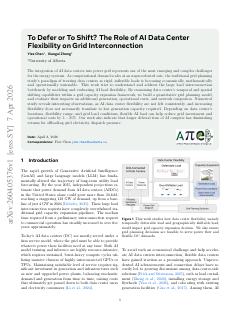
arXiv preprint (University of Alberta) 2026
To Defer or To Shift? The Role of AI Data Center Flexibility on Grid Interconnection
In large-load interconnection negotiation, present AI load flexibility (a deferral window of up to about 3 hours) as a lever for interconnection capacity and timing; returns diminish beyond 3 hours.
- In the IEEE 14-bus study, data centres on buses connected to congested lines benefit most from geographic load shifting.
Frontiers in Environmental Science (Frontiers Media SA) 2026
Net sustainability assessment of AI-driven data centers in the GCC: an MCDA approach framework
In AI data-centre investment assessment in hot, arid regions, weigh carbon, water, social and governance criteria together with explicit weights (0.40/0.25/0.20/0.15); indirect water (desalination energy) was about 0.68 times direct cooling water.
- In the extended boundary, embodied carbon adds 15-25% to the operational footprint.