
Powering Artificial Intelligence: Strategies for Integrating Data Centres into Electricity Systems
International Energy Agency
An IEA report requested by France's G7 Presidency (14 October 2026) surveying data-centre grid-integration policy across more than 34 jurisdictions covering about 90% of global capacity. It catalogues 134 policies and covers queue reform, bring-your-own-power (BYOP) requirements and non-firm connections.
CC BY 4.0 — share with attribution
On this page
Overview
The report takes stock of evolving practice in integrating data centres into electricity systems. The largest operators (hyperscalers) will spend more than USD 700 billion in 2026, and data-centre investment grew 17% in 2025 to exceed USD 550 billion, more than global oil and gas production investment. Electricity demand in advanced economies grew 2.1% in 2025, with data centres more than 20% of the increase. The report highlights public concern over electricity prices, emissions and water, and pressure on local grids. More than 34 jurisdictions are covered, about 90% of global data-centre capacity.
The policy inventory finds 134 policies and regulations guiding data-centre integration, nearly 40% announced or implemented in the last 12 months. The most common policy area is improving visibility of data-centre demand in scale, timing and location. In several jurisdictions connection queues exceed today's peak demand (Texas, Virginia, Finland, the United Kingdom), and they contain duplicate or speculative projects. Overestimating demand risks stranded grid investment, underestimating it risks bottlenecks and delay. Queue reform aims to reflect credible projects, prioritise using maturity and financial commitment, and speed up connection studies.
On connection models: because periods of system stress last relatively few hours a year, IEA analysis finds non-firm connections could enable an additional 750-900 GW of grid hosting capacity globally. Norway, South Australia, Spain and the Southwest Power Pool in the United States are testing conditional or curtailable access, time-dependent phased access, and dynamic consumption limits tied to real-time or forecast network conditions. Active management of compute load is rare; AI-optimised capacity can cost USD 20-30 billion per GW to rent for a year, about 100 times the equivalent battery capacity, making curtailment very expensive. A US event in which a data-centre load of over 3 GW abruptly disconnected and switched to backup has led some system operators to consider technical performance requirements.
On procurement and sustainability: operators signed 45 TWh of PPAs in the first half of 2026 (up nearly 20%), about 70% in the United States, with a small but growing number for advanced geothermal, SMRs, long-duration storage and virtual power plants. Ireland requires certain new data centres to build or contract new dispatchable capacity, while China and Spain have placed or are considering renewable purchase obligations. Data centres are associated with about 150 Mt of CO2 from electricity today, growing to about 350 Mt in 2035 in the central scenario (about 1.5% of global energy-related emissions). Nearly 40% of identified AI-dedicated capacity is in areas of high or extremely high water stress, and water efficiency trades off against energy efficiency.
On cost allocation and principles: the effect on bills is not clear-cut. A new large load needing network or generation investment recovered from all users can raise others' bills, while a load that fills existing capacity and pays its share can spread fixed costs and ease pressure. Large-load tariffs usually charge for reserved capacity rather than energy; minimum-payment commitments, long-term contracts matched to asset life, exit fees, collateral and phased connections address three risks: a load using less than it reserved, leaving before assets are paid off, and never connecting. The report offers six principles: transparency on location and consumption, predictable connection processes, holistic energy and water efficiency, coordinated fair tariffs, frameworks for flexibility and stability, and dialogue and experience sharing.
Key points
- The survey covers more than 34 jurisdictions (about 90% of global data-centre capacity) and identifies 134 policies and regulations, nearly 40% in the last 12 months.
- Hyperscalers will spend over USD 700 billion in 2026; data-centre investment grew 17% in 2025 to over USD 550 billion.
- The most common policy area is visibility of data-centre demand in scale, timing and location; queues in some places exceed today's peak demand.
- Queue reform: stricter entry requirements, maturity assessments, financial commitments and milestone-based capacity release.
- Non-firm connections could enable an extra 750-900 GW of grid hosting capacity globally; models are curtailable access, phased access and dynamic consumption limits.
- AI-optimised capacity can cost USD 20-30 billion per GW per year to rent, about 100 times the equivalent battery capacity, so compute curtailment is very costly.
- A US disconnection of a data-centre load of over 3 GW to backup supply led operators to consider technical performance requirements.
- BYOP is spreading: Ireland requires new dispatchable capacity; China and Spain have or consider renewable purchase obligations.
- Operators signed 45 TWh of PPAs in H1 2026 (up nearly 20%), about 70% in the United States.
- Data-centre CO2 from electricity rises from about 150 Mt to about 350 Mt in 2035 (about 1.5%); nearly 40% of AI capacity is in high water-stress areas.
Using it in design
- In the grid-connection module, support firm and non-firm (curtailable, phased, dynamic-limit) options and size the BESS or genset capacity needed to ride through curtailment hours.
- Capture jurisdiction BYOP rules (new dispatchable capacity, renewable purchase obligations) in the regulatory profile.
- Show in the project schedule that connection applications need maturity and financial-commitment evidence under queue reform.
- Add technical performance requirements to the electrical design checklist given the risk of abrupt large-load disconnection.
- In water-stressed regions assess the water versus energy efficiency trade-off together.
- Adjust the cost model for tariff terms (minimum payment, long-term contract, exit fee, collateral) by jurisdiction.
Monthly newsletter · free
Keep your reading list current
Once a month: new library sources, changes to Turkish regulations and upcoming data centre events.
SoSo CAD
Bring standards pre-checks into your project
Review model-based TS EN 50600 and Tier pre-checks, missing inputs and items requiring engineering review in SoSo CAD.
Request a demo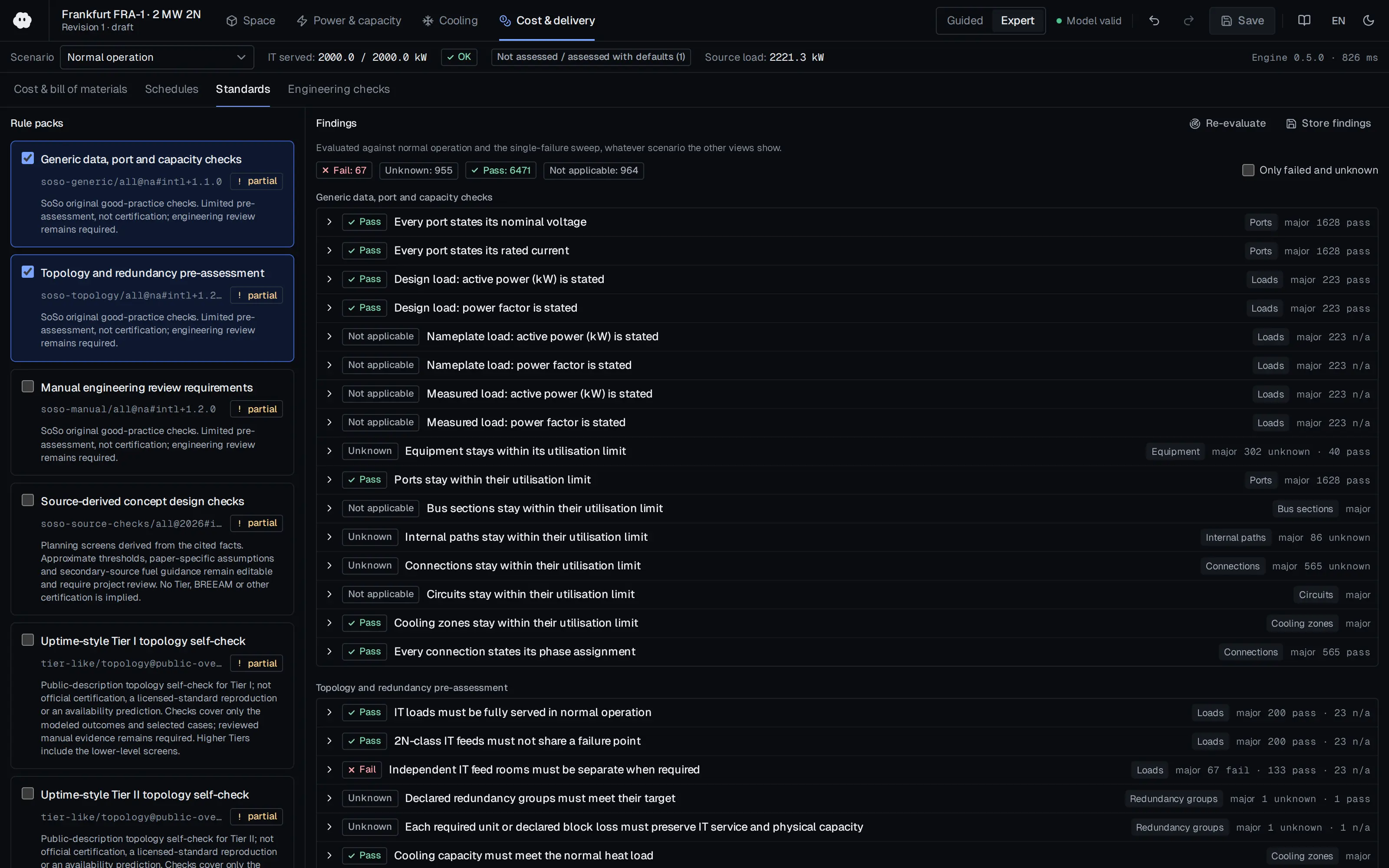
Who should read it
Policy makers, regulators, grid operators, developers and investors working on data-centre grid connection, tariffs and power-supply strategy.
Document contents
- Executive summary
- Introduction
- Understanding where and when data centres will consume electricity
- Load projections
- Spatial planning
- Enhancing the energy efficiency and sustainability of data centres
- Where efficiency is measured
- Reporting and facility performance
- Long-term resilience of data centre infrastructure
- Better management of grid connection requests by data centres
- Permitting
- Queue management and connection arrangements
- Allocating costs related to grid and infrastructure upgrades for data centres
- Securing electricity supply for data centres
- Integrating data centres securely into the grid
- Flexibility
- Stability
- Annex: Data centre and large-load policies by jurisdiction
Read the document
iea-powering-artificial-intelligence-2026.pdf
CC BY 4.0 — share with attribution
The document is provided unaltered because its licence permits redistribution.
Publication details
- Authors
- International Energy Agency
- Publisher
- International Energy Agency
- Year
- 2026
- Document language
- English
- Source type
- Government / public
- Access
- Open licence — downloadable
- Licence
- CC BY 4.0 — share with attribution
- Licence evidence
- www.iea.org
Original licence note
Landing page states 'Licence CC BY 4.0'; PDF pages carry 'IEA. CC BY 4.0'. Licence text: https://creativecommons.org/licenses/by/4.0/
Citation
International Energy Agency (2026). Powering Artificial Intelligence: Strategies for Integrating Data Centres into Electricity Systems. International Energy Agency. https://www.iea.org/files/cd360a30-aaef-43cd-84e6-a125c3a0bc67/PoweringArtificialIntelligence.pdf
Events on this subject
- Electricity Eurasia 2027
- The smarter E Europe (Intersolar Europe, ees Europe, Power2Drive, EM-Power)
- ELECO 2026 Elektrik-Elektronik ve Biyomedikal Mühendisliği Konferansı
All content and rights belong to the respective authors and publishers. SoSo CAD provides only the citation, its own summary and a link to the source, and is not responsible for the sources' content.
Related sources
All sources on this topic
European Commission 2019
Commission Regulation (EU) 2019/424 of 15 March 2019 laying down ecodesign requirements for servers and data storage products - consolidated text 01.03.2021 (incl. Regulation (EU) 2021/341)
In the IT equipment catalogue store PSU efficiency at 10/20/50/100% load, power factor, active state efficiency (SERT/EN 303470) and declared operating class A1-A4, and validate new models against the 2023 tier.
- Secure data deletion applies from 1 March 2020; latest firmware and security updates must be made available from 1 March 2021.
EPRI (Electric Power Research Institute) 2026
EPRI DCFlex - Data Center Flexibility Initiative (programme site)
In the electrical/grid module, let users declare a flexible-load capability (curtailable MW, duration, ride-through via BESS) for interconnection studies.
- Workstream 5: distribution-connected data centres (DxDCs).
U.S. Department of Energy, Secretary of Energy Advisory Board (SEAB) 2024
Recommendations on Powering Artificial Intelligence and Data Center Infrastructure (SEAB, July 30, 2024)
Offer alternatives to diesel (gas, BESS, fuel cells) in backup-power design.
- Presented to the Secretary of Energy on 30 July 2024.
The Green Grid 2022
WP#85 - 230V Enterprise PSU Market-Ready Efficiency Study
For EU sites, default server PSU efficiency to the Lot 9 (Regulation (EU) 2019/424) minimum.
- Scope is 230 V enterprise power supply units.
International Energy Agency 2026
Energy and AI in East Asia
In a site module for Korea and Japan, flag grid-congested metro regions and suggest renewable-rich regions.
- Data centres use 1.5% of global electricity and are projected to reach about 945 TWh (about 3%) by 2030.
International Energy Agency 2026
Key Questions on Energy and AI (World Energy Outlook Special Report)
For on-site generation sizing, when users choose islanded or behind-the-meter gas, apply an N+x overbuild check (30-70% above load per IEA) and model BESS for AI power swings.
- AI server power density rose 11 times in 2020-2025 and rises a further four times by 2027.