
Electricity 2025 - Analysis and Forecast to 2027
International Energy Agency
The IEA's 2025 electricity market report forecasts global demand to 2027, with data-centre analysis focused on China and the United States. China's 2024 target of an average PUE below 1.5 and US data-centre growth as a driver of upward demand revisions stand out.
CC BY 4.0 — share with attribution
On this page
Overview
The report is a general outlook for electricity markets in 2025-2027, with data centres as one part. Global demand rose 4.3% in 2024 and is forecast to keep growing close to 4% to 2027, an unprecedented 3,500 TWh over three years, more than a Japan added each year. Emerging economies provide 85% of the growth. Advanced economies were almost unchanged in 2024 versus 2021 but account for about 15% of global growth to 2027, reversing a 15-year decline trend; drivers are electric vehicles, air conditioning, data centres and heat pumps.
On China: data centres used over 100 TWh in 2024 and could double by 2027, though projections from Chinese institutions show wide uncertainty. Estimates for 2022 ran from 77 to 270 TWh, the upper end probably including data networks such as 5G. From telecom operator and large ICT company data, the IEA estimates data-centre consumption excluding networks at 70-130 TWh in 2023, and adjusting Chinese projections for networks gives 180-340 TWh in 2027 and 260-470 TWh in 2030. Data centres were about 3% of China's demand growth in 2022-2024 and could reach 6% over the next three years.
China's policies: about USD 6 billion has been invested under the Eastern Data and Western Computing (EDWC) strategy, with 1.95 million server racks installed by June 2024 and 63% reported in use (against over 8.1 million racks in operation nationally at end-2023). Western and northern regions with abundant renewables host latency-tolerant services such as AI training and storage, while eastern and central regions host low-latency services such as AI inference. The 2024 Special Action Plan for Green and Low-Carbon Development of Data Centres aims to cut average PUE below 1.5, improve WUE and CUE and raise the on-load rate to at least 60% by end-2025, with EDWC data centres sourcing at least 80% of electricity from renewables.
On the United States: demand rose 2% in 2024 to a record and is expected to grow about 2% a year in 2025-2027, an upward revision from January 2024 mostly due to data centres. A US Department of Energy-commissioned study shows data-centre consumption rising from about 60 TWh in 2014 to 176 TWh in 2023, over 4% of national electricity, and scenarios add 150-400 TWh by 2028, reaching about 325-580 TWh or 6.7-12% of demand. Projects announced in the first half of 2024 needed nearly 24 GW, triple the same period of 2023.
The report also gives wide non-data-centre background: renewables dominating supply as coal's share contracts, clean energy limiting power-sector CO2 in 2025-2027, diverging wholesale prices with more negative pricing, and extreme-weather reliability, with spotlights on China's demand drivers, Dunkelflaute stress tests and negative prices. For data centres the only regulatory takeaway is China's PUE and on-load targets; the document gives no design-level data.
Key points
- Global demand rose 4.3% in 2024 and is forecast to grow close to 4% a year to 2027, adding 3,500 TWh over three years.
- Emerging economies provide 85% of additional demand; advanced economies rise to about 15%.
- China's data centres used over 100 TWh in 2024 and could double by 2027.
- Network-adjusted Chinese projections are 180-340 TWh in 2027 and 260-470 TWh in 2030; the IEA's own 2023 estimate is 70-130 TWh.
- Data centres were about 3% of China's demand growth in 2022-2024 and could reach 6% over the next three years.
- Under EDWC, 1.95 million racks were installed by June 2024 and 63% were in use; China had over 8.1 million racks at end-2023.
- China's 2024 action plan targets average PUE below 1.5 and an on-load rate of at least 60% by end-2025, and at least 80% renewables for EDWC data centres.
- US data-centre consumption rose from about 60 TWh (2014) to 176 TWh (2023), over 4% of US electricity; a DOE study sees 325-580 TWh (6.7-12%) in 2028.
- Projects announced in the first half of 2024 need nearly 24 GW, triple the same period of 2023.
- The US demand forecast (about 2% a year in 2025-2027) was revised up from January 2024, largely due to data centres.
Using it in design
- Add a China profile to regulatory rules: show the average PUE below 1.5 and on-load rate of at least 60% targets as a compliance warning (possibly stricter for national hub regions).
- For Chinese projects, reflect the renewable-share targets (at least 80% for EDWC data centres) in power-procurement planning.
- When using Chinese data-centre demand figures, check whether the scope includes networks; the report notes many estimates include 5G networks.
- For US sites, use demand growth and announced-project volumes (24 GW) as context for grid-connection risk.
- Use the document as market and policy context rather than a source of design values.
Monthly newsletter · free
Keep your reading list current
Once a month: new library sources, changes to Turkish regulations and upcoming data centre events.
SoSo CAD
Compare the cost of design decisions
Evaluate equipment costs, energy expenses and total cost of ownership (TCO) using your inputs and assumptions in SoSo CAD.
Request a demo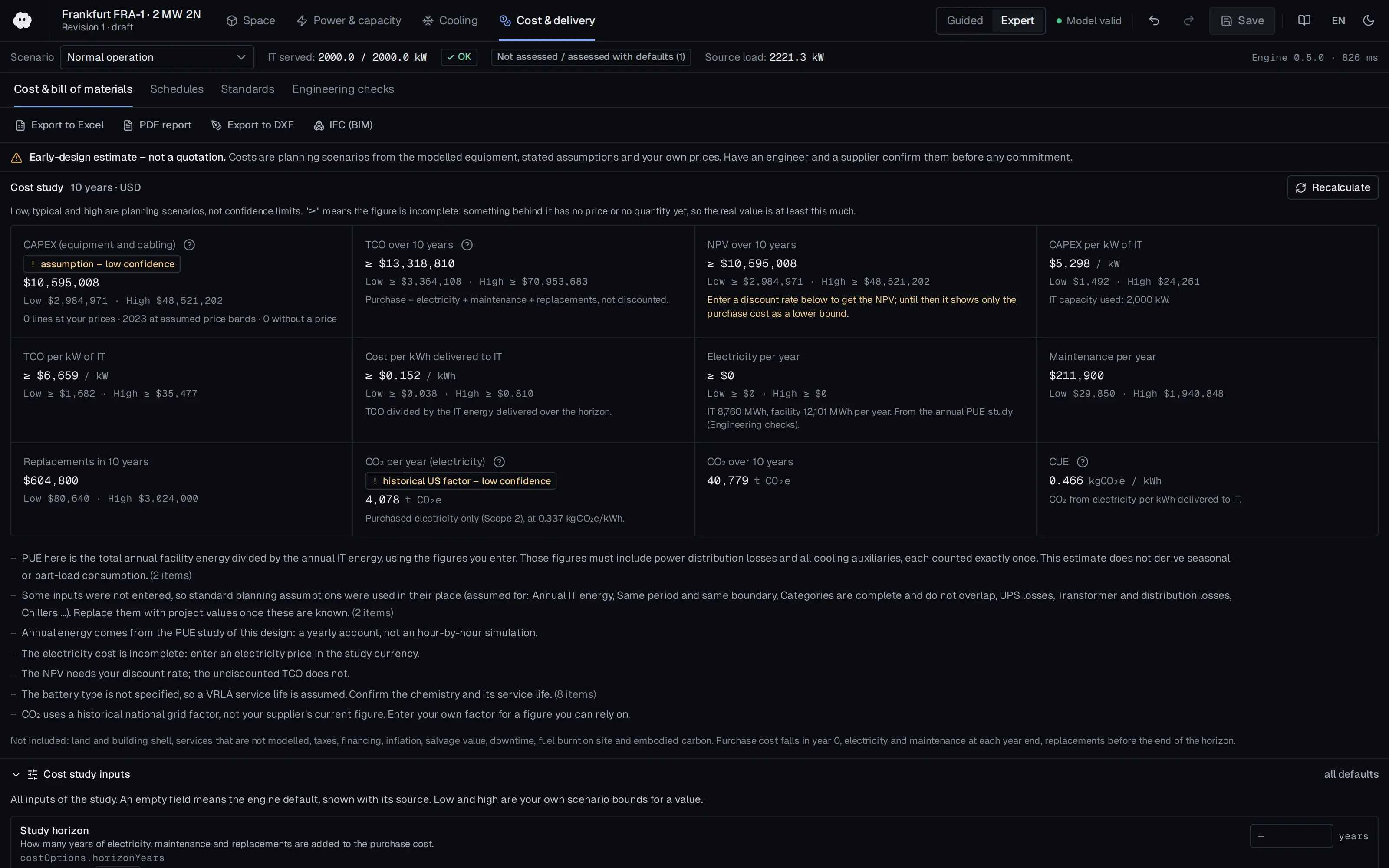
Who should read it
Investors, planners and policy makers assessing data-centre investment and grid connection in the Chinese and US markets.
Document contents
- Executive Summary
- Demand: Entering the Age of Electricity
- Spotlight: What is driving China's electricity demand growth?
- Understanding China's data centre and 5G electricity consumption projections
- China's Eastern Data and Western Computing initiative
- Action plans to improve computational power, efficiency and clean energy share
- Data centres are a key driver of electricity demand growth in the United States
- Supply: Renewables dominate as coal's share continues to contract
- Spotlight: Dunkelflaute events as potential stress tests
- Emissions: Clean energy mitigates CO2 power emissions in 2025-2027
- Prices: Wholesale trends diverge, while negative pricing increases
- Reliability: Extreme weather events make improved security imperative
- Regional Focus
- Annexes
Related standards
- GB 40879
Read the document
iea-electricity-2025.pdf
CC BY 4.0 — share with attribution
The document is provided unaltered because its licence permits redistribution.
Publication details
- Authors
- International Energy Agency
- Publisher
- International Energy Agency
- Year
- 2025
- Document language
- English
- Source type
- Government / public
- Access
- Open licence — downloadable
- Licence
- CC BY 4.0 — share with attribution
- Licence evidence
- www.iea.org
Original licence note
Landing page states 'Licence CC BY 4.0'; PDF pages carry 'IEA. CC BY 4.0'. Licence text: https://creativecommons.org/licenses/by/4.0/
Citation
International Energy Agency (2025). Electricity 2025 - Analysis and Forecast to 2027. International Energy Agency. https://www.iea.org/files/7c671ef6-2947-4e87-beea-af0e1288e1d7/Electricity2025.pdf
Events on this subject
- iMasons Climate Accord Summit
- ICCI 2027 – Uluslararası Enerji ve Çevre Fuarı ve Konferansı
- The smarter E Europe (Intersolar Europe, ees Europe, Power2Drive, EM-Power)
All content and rights belong to the respective authors and publishers. SoSo CAD provides only the citation, its own summary and a link to the source, and is not responsible for the sources' content.
Related sources
All sources on this topic
International Energy Agency 2026
Energy and AI in East Asia
In a site module for Korea and Japan, flag grid-congested metro regions and suggest renewable-rich regions.
- Data centres use 1.5% of global electricity and are projected to reach about 945 TWh (about 3%) by 2030.

International Energy Agency 2026
Powering Artificial Intelligence: Strategies for Integrating Data Centres into Electricity Systems
In the grid-connection module, support firm and non-firm (curtailable, phased, dynamic-limit) options and size the BESS or genset capacity needed to ride through curtailment hours.
- Operators signed 45 TWh of PPAs in H1 2026 (up nearly 20%), about 70% in the United States.
International Energy Agency 2024
Electricity 2024 - Analysis and Forecast to 2026
Use this document as benchmark and context only, not as a source of default values.
- Data centres, cryptocurrencies and AI used about 460 TWh in 2022, almost 2% of global demand.
European Commission 2026
Report from the Commission to the European Parliament and the Council on the energy efficiency of data centres in the EU - COM(2026) 500 final
Set the PUE target for new designs against the bands in the report (below 1.2 excellent, above 1.5 needs improvement) and possible future minimum-standard thresholds, noting that the 500-1000 kW class averaged 1.64.
- EU data centres consumed 68 TWh of electricity in 2024, expected to reach 114 TWh by 2030 (3.2% of EU electricity).
European Commission 2026
Annexes 1 to 3 to Commission Delegated Regulation C(2026) 3472 - EU data centre energy (PUE) and water (WUE) efficiency classes, data centre label, and amendments to Delegated Regulation (EU) 2024/1364
Translate PUE and WUE targets into A-G classes: class A needs a design PUE of 1.15 or below and WUE of 0.1 or below; the class D boundary is 1.5 and 0.6. Write the class target into the design specification.
- WUE classes: A <= 0.1; B 0.1-0.2; C 0.2-0.4; D 0.4-0.6; E 0.6-0.8; F 0.8-1.0; G > 1.0.
European Commission 2026
Commission Delegated Regulation C(2026) 3472 of 21.9.2026 supplementing Directive (EU) 2023/1791 and amending Delegated Regulation (EU) 2024/1364 as regards the establishment of a common Union rating scheme for data centres (main act)
As labels will be issued every year from 15 August 2027, set PUE and WUE class targets (Annex I) at design stage for new and existing sites and build the metering infrastructure to the reporting requirements.
- Labels are generated automatically by the European database every year from 15 August 2027 and are publicly available electronically in all official Union languages.