
Directional protection and directional zone selectivity
ABB
ABB application paper on the directional (D) protection and directional zone selectivity functions of the PR123/PR333 trip units for LV systems with more than one source.
On this page
Overview
Directional protection D works like a definite-time S function but with two delays, t7FW (forward) and t7BW (backward), applied once threshold I7 is exceeded; it needs no auxiliary supply or dedicated wiring. Direction is decided from reactive power: the phase reactive power must exceed 2% of nominal phase power, otherwise the relay uses the shorter of t7FW and t7BW.
Directional zone selectivity requires zone selectivity S and G to be off and a 24 V DC auxiliary supply; each relay has DFin/DBin inputs and DFout/DBout block outputs. Breakers bounding the faulted section trip at t7s, and if one fails to open the next upstream breaker opens after about a further 100 ms. Without auxiliary power, directional zone selectivity degrades to plain directional protection with t7FW/t7BW times, which the designer must allow for.
The paper shows how lock signals between relays isolate a faulted section in ring or meshed networks. Worked examples cover two generators on a common busbar, a double-transformer substation with bus tie, and a board fed by LV generators in parallel with transformers, followed by a practical commissioning guide.
Key points
- D works like a definite-time S with two delays (t7FW forward, t7BW backward) above threshold I7; no auxiliary supply or dedicated wiring needed.
- Direction comes from reactive power; phase reactive power must exceed 2% of nominal phase power, otherwise the shorter of t7FW and t7BW is used.
- Directional zone selectivity needs S and G zone selectivity off and a 24 V DC auxiliary supply; DFin/DBin inputs and DFout/DBout outputs.
- Breakers bounding the faulted section trip at t7s; if one fails, the next upstream opens about 100 ms later.
- Without auxiliary power it degrades to plain directional protection with t7FW/t7BW times.
- Examples: two generators on one busbar, MV/LV substation with bus tie, LV generators in parallel with transformers.
Using it in design
- For main switchboards with two transformers plus bus tie, or generator paralleling boards, flag that conventional time selectivity cannot discriminate fault direction and propose directional or directional-zone selectivity on incomers and bus tie.
- Capture per breaker whether it supports D/ZSI-D and whether auxiliary supply is present.
- Warn that loss of 24 V DC auxiliary reverts to slower directional times and include that in the selectivity study.
Monthly newsletter · free
Keep your reading list current
Once a month: new library sources, changes to Turkish regulations and upcoming data centre events.
SoSo CAD
Review your power design in SoSo CAD
Inspect supply paths, equipment loads and UPS failure scenarios in one model.
Request a demo
Who should read it
Electrical engineers designing selectivity for multi-source LV boards with parallel transformers or generators.
Related standards
- IEC 60947-2
- IEC 60947-1
Publication details
- Authors
- ABB
- Publisher
- ABB
- Year
- 2008
- Document number
- 1SDC007401G0201
- Document language
- English
- Source type
- Manufacturer
- Access
- Free to read
- Licence
- Copyright retained; citation only — the publisher’s terms apply to the original document
Citation
ABB (2008). Directional protection and directional zone selectivity. ABB. 1SDC007401G0201. https://library.e.abb.com/public/c1a005fc597b0df7c1257ac5003d1c59/1SDC007401G0201.pdf
Events on this subject
- Electricity Eurasia 2027
- ELECO 2026 Elektrik-Elektronik ve Biyomedikal Mühendisliği Konferansı
- ICCI 2027 – Uluslararası Enerji ve Çevre Fuarı ve Konferansı
All content and rights belong to the respective authors and publishers. SoSo CAD provides only the citation, its own summary and a link to the source, and is not responsible for the sources' content.
Related sources
All sources on this topicABB 2022
Data center white paper: 2N low-voltage distribution system design, IEC standards, 0.5 MW IT load (Chinese edition)
Use it as a template for a '2N LV, 0.5 MW' starter project, auto-generating the RPDU, RPP, secondary board, UPS, main board and transformer/generator chain from rack count and kW/rack.
- Transformer: dry type, 10/0.4 kV, 1250 kVA, Z = 6%.
Open Compute Project Foundation 2026
Clean Backup Power Technology Requirements, Base Specification Version 0.3 (effective Apr 22, 2026)
Extend the generator catalogue with technology type (diesel, HVO, gas, H2 ICE, PEM fuel cell), emissions factor relative to the 1742 lb/MWh baseline, start time, block-load capability and NFPA 110 level.
- Overload 110% for 60 s and 150% for 3 s; transient voltage response to ISO 8528-5 G3; steady-state frequency within +/-0.5%.
Energies (MDPI AG) 2023
Reliability Assessment of the Configuration of Dynamic Uninterruptible Power Sources: A Case of Data Centers
When choosing among DRUPS or UPS configurations, first screen with the graph-based method to identify the best candidates, then do the detailed RBD calculation for that candidate only.
- Single system: λ = 3.10 × 10^-6 1/h, A = 0.999949, MTBF 306,600 h (35 years).
U.S. DoD (UFC) 2023
UFC 3-540-01 Engine-Driven Generator Systems for Prime and Standby Power Applications (1 August 2014, Change 3, 26 January 2023)
Include transient and steady-state loads, transformer inrush, motor starting and UPS load in the generator sizing study, and calculate UPS charging load using the minimum charging current allowed while on generator.
- Harmonic analysis is required when switching power supplies make up 25% or more of the system load.
FEMA 2014
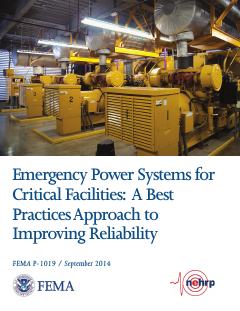
FEMA P-1019, Emergency Power Systems for Critical Facilities: A Best Practices Approach to Improving Reliability (September 2014)
At critical-facility data centers, place generators, ATS, fuel tanks and pumps above the greatest of BFE + 3 ft, DFE + 1 ft and 500-year elevation + 1 ft, and prefer elevation to dry floodproofing.
- Generators over 300 kW are almost exclusively diesel-fueled.
FEMA 2007
FEMA 543, Design Guide for Improving Critical Facility Safety from Flooding and High Winds (Risk Management Series, January 2007)
For site selection, look beyond the 100-year flood to the 500-year (0.2%) flood and the facility's occupancy category, and avoid flood hazard areas where possible.
- A freeboard of 1 to 3 feet above the flood elevation is often applied to critical facilities.