
Commissioning on-site electrical systems
Consulting-Specifying Engineer · Kenneth Kutsmeda
Kutsmeda adapts ASHRAE Guideline 0's four-phase commissioning process to on-site electrical systems in critical facilities and argues that commissioning must begin in pre-design.
On this page
Overview
Kutsmeda's article adapts ASHRAE Guideline 0's four-phase commissioning process to on-site electrical systems in critical facilities. His central argument is that commissioning must begin in pre-design so that the design supports testing. The article lays out the equipment scope and three test levels: individual equipment, discrete system and integrated system (black-start).
The discrete system level means, for example, testing PDU, UPS and switchgear together under load and on generator. The integrated level covers site-wide black-start with partial failures. The design phase should provide load-bank connections or isolation breakers for phased construction, and control sequences with timer presets for every mode.
In the construction phase, the article notes that factory tests often miss interfaces with controls, mechanical and life-safety systems, so the commissioning authority (CxA) may add witnessed procedures. In a North Carolina data centre case study, a manufacturer-built simulator and phased testing uncovered defective breakers, failure-mode interaction problems and inrush coordination issues.
The commissioned system later rode through a 25 kV utility switch fault without losing critical load; the owner estimated a recovery cost of $5 million had it dropped. The limits of the article are that it rests on a single 2008 case study and that the cost figure is the owner's own estimate. Related documents named are ASHRAE Guideline 0-2005, NETA ATS, IEEE 450, IEEE 1188, NFPA 70E, NFPA 110 and NFPA 111.
Key points
- Three test levels: individual equipment, discrete system (e.g., PDU+UPS+switchgear under load and on generator) and integrated site-wide black-start with partial failures.
- The design phase must provide load-bank connections or isolation breakers for phased construction, and control sequences with timer presets for every mode.
- Factory tests often miss interfaces with controls, mechanical and life-safety systems; the CxA may add witnessed procedures.
- Case study testing found defective breakers, failure-mode interaction problems and inrush coordination issues.
- A post-commissioning 25 kV utility switch fault was ridden through without losing critical load.
- The owner estimated a $5 million recovery cost had the load dropped.
Using it in design
- For phased builds, the tool should place load-bank connection points and isolation breakers and output a Cx test list with individual, discrete and integrated levels.
- Include sequence-of-operations timer presets as fields on transfer and paralleling equipment.
- Involve the commissioning authority from the earliest design stage.
- Define witnessed site tests for interfaces that factory tests do not cover.
Monthly newsletter · free
Keep your reading list current
Once a month: new library sources, changes to Turkish regulations and upcoming data centre events.
SoSo CAD
Bring standards pre-checks into your project
Review model-based TS EN 50600 and Tier pre-checks, missing inputs and items requiring engineering review in SoSo CAD.
Request a demo
Who should read it
Engineers and commissioning authorities who design, commission and test electrical systems for critical facilities.
Related standards
- ASHRAE Guideline 0-2005
- NETA ATS
- IEEE 450
- IEEE 1188
- NFPA 70E
- NFPA 110
- NFPA 111
Publication details
- Authors
- Kenneth Kutsmeda
- Publisher
- Consulting-Specifying Engineer
- Year
- 2008
- Document language
- English
- Source type
- Expert / community
- Access
- Free to read
- Licence
- Copyright retained; citation only — the publisher’s terms apply to the original document
Citation
Kenneth Kutsmeda (2008). Commissioning on-site electrical systems. Consulting-Specifying Engineer. https://www.csemag.com/articles/commissioning-on-site-electrical-systems/
Events on this subject
Browse the events calendarAll content and rights belong to the respective authors and publishers. SoSo CAD provides only the citation, its own summary and a link to the source, and is not responsible for the sources' content.
Related sources
All sources on this topic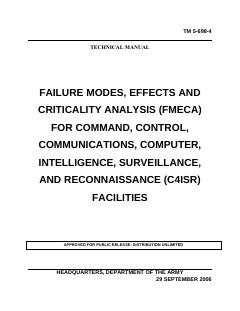
U.S. Army Corps of Engineers (Headquarters, Department of the Army) 2006
TM 5-698-4 Failure Modes, Effects and Criticality Analyses (FMECA) for Command, Control, Communications, Computer, Intelligence, Surveillance, and Reconnaissance (C4ISR) Facilities (29 September 2006)
At design stage run a functional FMEA of each critical system (power, generators, cooling); do not start without schematics, bill of materials, block diagram and the mission requirement.
- The Risk Priority Number is Severity (1-10) x Occurrence (1-10), optionally multiplied by Detection: RPN = S x O x D.
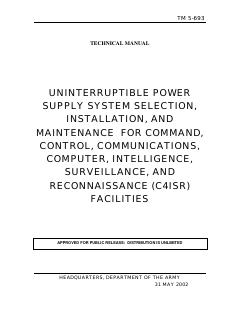
U.S. Army Corps of Engineers (Headquarters, Department of the Army) 2002
TM 5-693 Uninterruptible Power Supply System Selection, Installation, and Maintenance for Command, Control, Communications, Computer, Intelligence, Surveillance, and Reconnaissance (C4ISR) Facilities (31 May 2002)
Calculate availability from MTBF and MTTR before choosing a UPS configuration; apply the same method to single-unit, N+1 and dual-redundant layouts to compare the gain from redundancy with the cost of the added components.
- C4ISR facilities require a reliability level of 99.9999 percent (the six-nine rule), which may call for greater redundancy.
Huawei Digital Power 2022
Data Center PowerPOD 3.0 Technology White Paper
Add a 'prefabricated power train' block type (transformer, LV, UPS, feeders) carrying footprint, weight and a clearance envelope.
- Average rack power rose from 4 kW to 6-8 kW and is heading to 12-16 kW.
Schneider Electric 2021
Comparing IEC 61850 vs. Traditional Monitoring, Protection and Control Solutions in Large Data Centers
Add a protectionControlScheme attribute to the MV module: hardwired_plc_modbus, iec61850_station_bus, iec61850_process_bus.
- GOOSE: under 4 or 10 ms, self-monitored multicast.
Eaton 2016
Best Practices for Modernizing Vintage Data Centers
Add a designLifeYears catalog parameter per equipment type, default to the range midpoint, and drive a TCO/refresh timeline from it.
- Rack PDU 8-12 yr; power cables 8-20 yr; busway 8-20 yr
Consulting-Specifying Engineer 2026
Know the electrical, power components in a data center
Seed facility-type templates with default UPS/generator redundancy and fuel autonomy from Table 1.
- Generators should be loaded to at least 30% to avoid wet stacking.