
Considerations when Paralleling Generating Sets
Cummins · Robert Patrick
Cummins Power Topic #5410679 (Robert Patrick, 2017) condenses the company's paralleling guidance from Power Topics 9015-9017 and manual T-016 into one technical precis. It gives concrete thresholds for synchronising, load sharing and neutral currents in data-centre standby plants.
On this page
Overview
The paper explains how groups of like or unlike generator sets synchronise and share load, either in island mode or in parallel with the utility. Its first conclusion is that with dissimilar sets, the first-priority load is capped by the smallest set that may close first: a 1500 kW plus 500 kW system can accept only 500 kW as first-priority load.
A manageable system keeps the smallest set at no less than 30% of the largest set's capacity. For synchronising, the transient current into the incoming set at breaker closure should stay below 50% of its rated full-load current. The suggested close window is frequency within 0.1 Hz, rate of change of 0.1 Hz/s, voltage within less than 1% and phase angle below 10 degrees, as the record lists it.
For first-start arbitration, random access uses random 1-8 ms bursts over 800 ms and retries after 2.5 s, and a set must be at 90% voltage and frequency before it is ready to load. Dead-bus (dead-field) paralleling is not supported by standard PowerCommand controls, needs a third-party module, and is considered less robust than random access.
The most reusable section covers circulating neutral currents. 2/3-pitch alternators produce no third-order harmonics, so paralleling 2/3-pitch machines with connected neutrals avoids triplen circulating currents, while mixing them with 5/6-pitch machines needs care. Alternator voltage waveform guidance is no more than 5% THD line-to-line and line-to-neutral and no more than 3% in any single harmonic.
Key points
- With dissimilar sets, first-priority load is limited by the smallest set that may close first (500 kW in a 1500 kW + 500 kW system).
- Manageability guideline: smallest set at least 30% of the largest set's capacity.
- Transient current into the incoming set at closure should not exceed 50% of its rated current.
- Suggested sync window: 0.1 Hz frequency, 0.1 Hz/s rate of change, voltage within under 1%, phase angle under 10 degrees.
- Random-access arbitration: 1-8 ms bursts over 800 ms, retry after 2.5 s, set ready at 90% voltage and frequency.
- Dead-bus paralleling needs a third-party module with PowerCommand and is judged less robust.
- 2/3-pitch alternators give no triplen harmonics; mixing with 5/6 pitch requires mitigation of neutral circulating current.
- Waveform guidance: THD up to 5%, any single harmonic up to 3%.
Using it in design
- Check smallest-to-largest set ratio against the 30% guideline and flag designs below it.
- Compute the first-priority load limit from the smallest set's rating whenever set sizes differ.
- Before interconnecting neutrals in a 4-wire system, require identical alternator pitch or specify neutral reactors or switching.
- In a paralleling switchgear template, make the first-start scheme and tie-breaker options explicit choices.
Monthly newsletter · free
Keep your reading list current
Once a month: new library sources, changes to Turkish regulations and upcoming data centre events.
SoSo CAD
Review your power design in SoSo CAD
Inspect supply paths, equipment loads and UPS failure scenarios in one model.
Request a demo
Who should read it
Electrical engineers and controls integrators designing low- or medium-voltage paralleled standby generator plants.
Related standards
- ISO 8528-5
- IEC 60034-1
Publication details
- Authors
- Robert Patrick
- Publisher
- Cummins
- Year
- 2017
- Document number
- Power Topic #5410679
- Document language
- English
- Source type
- Manufacturer
- Access
- Free to read
- Licence
- Copyright retained; citation only — the publisher’s terms apply to the original document
Citation
Robert Patrick (2017). Considerations when Paralleling Generating Sets. Cummins. Power Topic #5410679. https://mart.cummins.com/imagelibrary/data/assetfiles/0056622.pdf
Events on this subject
- Electricity Eurasia 2027
- ELECO 2026 Elektrik-Elektronik ve Biyomedikal Mühendisliği Konferansı
- ICCI 2027 – Uluslararası Enerji ve Çevre Fuarı ve Konferansı
All content and rights belong to the respective authors and publishers. SoSo CAD provides only the citation, its own summary and a link to the source, and is not responsible for the sources' content.
Related sources
All sources on this topicCummins 2025
Data Center Continuous (DCC) Ratings: A comparison of DCC ratings, ISO definitions and Uptime requirements
Give generator catalogue entries a rating table keyed by class {ESP, PRP, COP, DCP, DCC/manufacturer-unlimited} rather than a single kW value.
- QSK95-based sets offer ratings up to 3.5 MW (ISO 8528-1).

Open Compute Project Foundation 2026
Clean Backup Power Technology Requirements, Base Specification Version 0.3 (effective Apr 22, 2026)
Extend the generator catalogue with technology type (diesel, HVO, gas, H2 ICE, PEM fuel cell), emissions factor relative to the 1742 lb/MWh baseline, start time, block-load capability and NFPA 110 level.
- Overload 110% for 60 s and 150% for 3 s; transient voltage response to ISO 8528-5 G3; steady-state frequency within +/-0.5%.
Energies (MDPI AG) 2023
Reliability Assessment of the Configuration of Dynamic Uninterruptible Power Sources: A Case of Data Centers
When choosing among DRUPS or UPS configurations, first screen with the graph-based method to identify the best candidates, then do the detailed RBD calculation for that candidate only.
- Single system: λ = 3.10 × 10^-6 1/h, A = 0.999949, MTBF 306,600 h (35 years).
U.S. DoD (UFC) 2023
UFC 3-540-01 Engine-Driven Generator Systems for Prime and Standby Power Applications (1 August 2014, Change 3, 26 January 2023)
Include transient and steady-state loads, transformer inrush, motor starting and UPS load in the generator sizing study, and calculate UPS charging load using the minimum charging current allowed while on generator.
- Harmonic analysis is required when switching power supplies make up 25% or more of the system load.
FEMA 2014
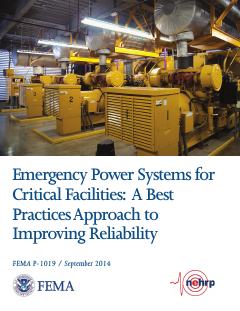
FEMA P-1019, Emergency Power Systems for Critical Facilities: A Best Practices Approach to Improving Reliability (September 2014)
At critical-facility data centers, place generators, ATS, fuel tanks and pumps above the greatest of BFE + 3 ft, DFE + 1 ft and 500-year elevation + 1 ft, and prefer elevation to dry floodproofing.
- Generators over 300 kW are almost exclusively diesel-fueled.

FEMA 2007
FEMA 543, Design Guide for Improving Critical Facility Safety from Flooding and High Winds (Risk Management Series, January 2007)
For site selection, look beyond the 100-year flood to the 500-year (0.2%) flood and the facility's occupancy category, and avoid flood hazard areas where possible.
- A freeboard of 1 to 3 feet above the flood elevation is often applied to critical facilities.