
AI Deployments are Reshaping Intra-Data Center Fiber and Communications (Melissa Farney)
Data Center Frontier · Melissa Farney
An article explaining the split of AI data centre networks into a conventional Ethernet front-end and a dedicated GPU back-end fabric, and what that means for fiber infrastructure.
On this page
Overview
The article explains how AI data centre networks split into a conventional Ethernet front-end and a dedicated GPU back-end fabric, and what that means for fiber infrastructure. Back-end fabrics need 400-800 Gbps per GPU with sub-microsecond latency in fat-tree or similar topologies, which pushes single-mode fiber and high-power optics. The article also discusses prefabricated cabling to speed up deployment.
In front-end networks, server-to-leaf links run at 25-50 Gbps and spine links at about 100 Gbps, with mostly north-south traffic. Back-end AI fabrics, by contrast, run at 400 or 800 Gbps per GPU with sub-microsecond latency and east-west traffic in fat-tree or hypercube topologies.
Dedicated back-end networks keep GPU utilisation often above 95 percent; on a large cluster each point of idle time can cost hundreds of thousands of dollars per year. Back-end bandwidth has largely eliminated copper, making single-mode fiber the standard for intra-data centre AI links.
800G optical transceivers add significant power and heat, so cooling must be considered. IEEE 802.3 is the related standard. The article is an industry piece offering no method or measurement detail, and its figures are general. The message for designers is that in AI halls the network should be planned as two separate fabrics, each with its own pathways and fiber counts.
Key points
- Front-end networks: server-to-leaf 25-50 Gbps and spine links about 100 Gbps, mostly north-south traffic.
- Back-end AI fabrics: 400 or 800 Gbps per GPU, sub-microsecond latency, east-west traffic in fat-tree or hypercube topologies.
- Dedicated back-end networks keep GPU utilisation often above 95 percent; each point of idle time can cost hundreds of thousands of dollars per year on a large cluster.
- Back-end bandwidth has largely eliminated copper, making single-mode fiber the standard for intra-data centre AI links.
- 800G optical transceivers add significant power and heat, requiring cooling consideration.
- The article also covers how prefabricated cabling speeds deployment.
Using it in design
- Model two separate network fabrics (front-end and back-end) in AI hall templates with separate pathways and fiber counts.
- Include optics power per port in the rack heat load.
- Size cable pathways and fiber counts on a single-mode fiber assumption.
- Offer prefabricated cabling as an option that shortens deployment time.
Monthly newsletter · free
Keep your reading list current
Once a month: new library sources, changes to Turkish regulations and upcoming data centre events.
SoSo CAD
From technical references to data centre design
Review rack layouts, power supplies and cooling zones in a shared SoSo CAD project model.
Request a demo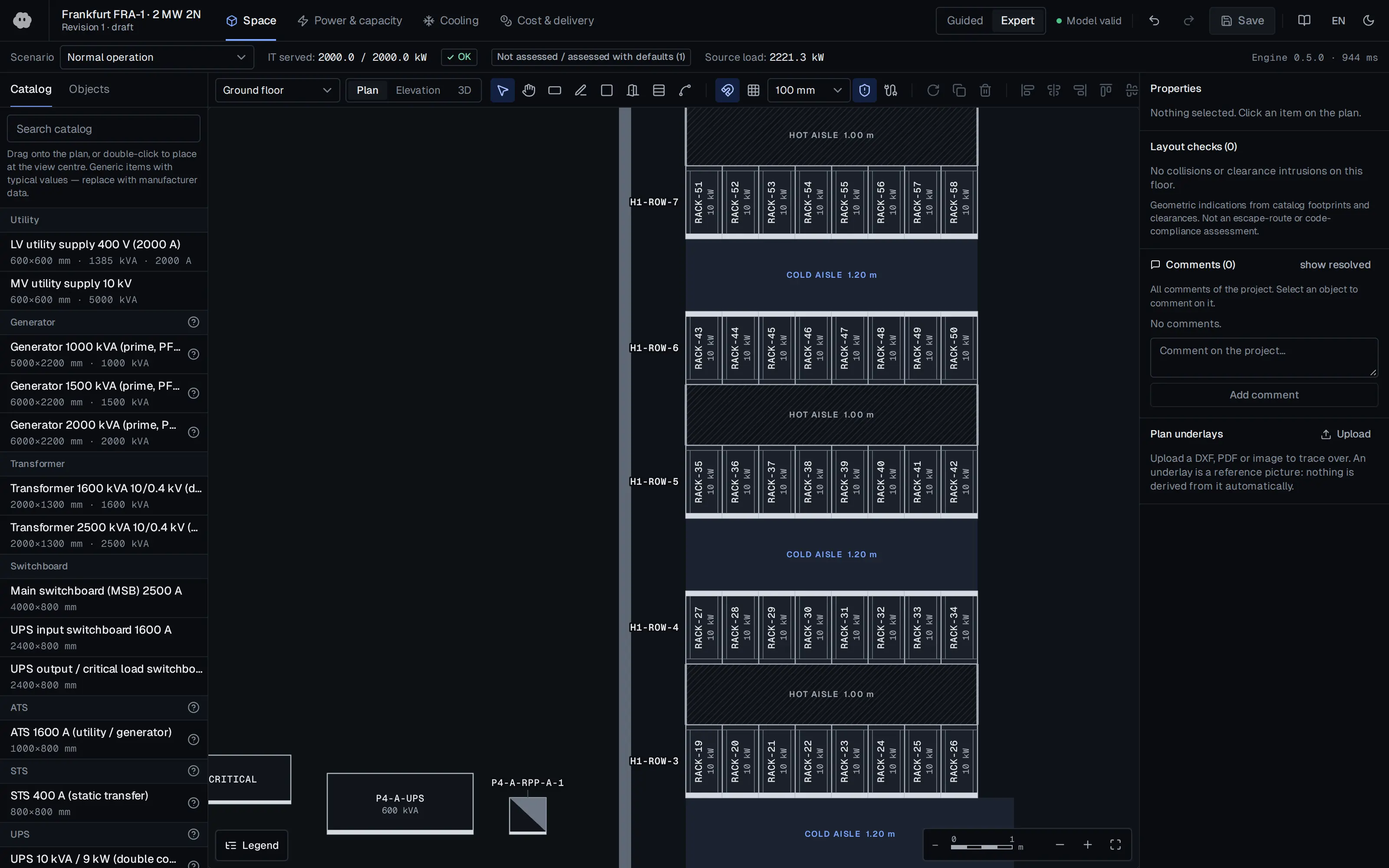
Who should read it
Designers and network engineers planning network and cabling infrastructure for AI halls.
Related standards
- IEEE 802.3
Publication details
- Authors
- Melissa Farney
- Publisher
- Data Center Frontier
- Year
- 2025
- Document language
- English
- Source type
- Expert / community
- Access
- Free to read
- Licence
- Copyright retained; citation only — the publisher’s terms apply to the original document
Citation
Melissa Farney (2025). AI Deployments are Reshaping Intra-Data Center Fiber and Communications (Melissa Farney). Data Center Frontier. https://www.datacenterfrontier.com/machine-learning/article/55300534/ai-deployments-are-reshaping-intra-data-center-fiber-and-communications
Events on this subject
- SC26 – International Conference for High Performance Computing, Networking, Storage and Analysis
- BICSI Japan Conference & Exhibition
- Datacloud Asia
All content and rights belong to the respective authors and publishers. SoSo CAD provides only the citation, its own summary and a link to the source, and is not responsible for the sources' content.