
Information technology - Data centre facilities and infrastructures - Part 5: Telecommunications cabling infrastructure
ISO/IEC · ISO/IEC JTC 1
The cabling part of the ISO/IEC 22237 series, covering data centre telecommunications cabling infrastructure and its pathways, spaces and enclosures against the availability classes.
On this page
Overview
ISO/IEC TS 22237-5:2018 is the fifth part of the ISO/IEC 22237 series on data centre facilities and infrastructures, published as a Technical Specification (TS). Its subject is the telecommunications cabling infrastructure of data centres, treated against the availability classes. Because it is a paid standard, this record rests only on the publisher's public catalogue abstract and product details; the full text has not been read.
According to the catalogue abstract, the document covers IT and network cabling, with SAN and LAN given as examples. It also addresses the cabling used to monitor and control power distribution, environmental control and physical security. So not only server and network connections but also the cabling that observes the facility's operating infrastructure falls within the standard's field. Other building automation cabling is also in scope.
Besides the cables themselves, the standard covers the pathways, spaces and enclosures that this cabling infrastructure needs. This indicates that cable trays, underfloor routes and distribution areas should be treated as part of the design. The document is a first edition published on 27 April 2018 and runs to 30 pages. Related standards include EN 50600-2-4, ISO/IEC 11801-5 and TIA-942.
The limit of this record is that it offers nothing beyond the catalogue abstract: no class-specific requirements, distances or cable type values appear here. The source should therefore be read as a guide to which subjects fall within the standard and which related documents to consult; for application decisions the full text of the standard must be consulted.
Key points
- The document is a Technical Specification, part 5 of the ISO/IEC 22237 series.
- It covers IT and network telecommunications cabling (for example SAN and LAN).
- It covers cabling to monitor and control power distribution, environmental control and physical security.
- It also covers other building automation cabling.
- It covers pathways, spaces and enclosures for the cabling infrastructure.
- Edition 1 was published 2018-04-27 and has 30 pages.
- Related standards: EN 50600-2-4, ISO/IEC 11801-5, TIA-942.
Using it in design
- Model cable pathways (overhead trays, underfloor) and distribution areas as layout objects.
- Apply class-driven redundancy for higher classes, for example diverse entrance paths.
- Include BMS and EPMS monitoring cabling in the take-off.
Monthly newsletter · free
Keep your reading list current
Once a month: new library sources, changes to Turkish regulations and upcoming data centre events.
SoSo CAD
Assess redundancy through scenarios
Compare normal operation and equipment failures in SoSo CAD, with supplied loads and capacity shortfalls in one view.
Request a demo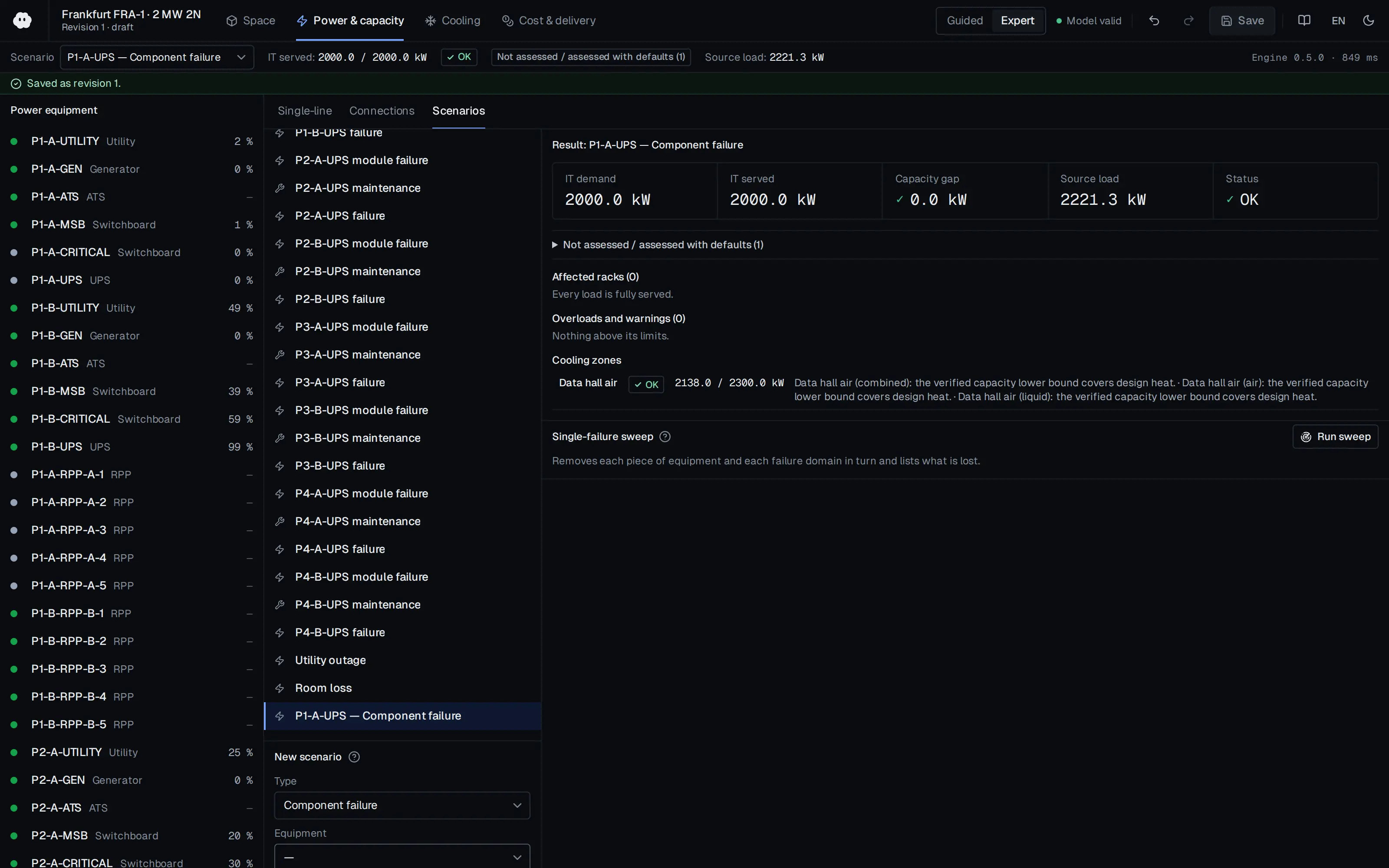
Who should read it
Engineers responsible for data center network, cabling and layout design.
Related standards
- EN 50600-2-4
- ISO/IEC 11801-5
- TIA-942
Publication details
- Authors
- ISO/IEC JTC 1
- Publisher
- ISO/IEC
- Year
- 2018
- Document number
- ISO/IEC TS 22237-5:2018
- Document language
- English
- Source type
- Standard
- Access
- Citation only
- Licence
- Copyright retained; citation only — the publisher’s terms apply to the original document
Original licence note
Paid standard. Record built only from the publisher's public catalogue abstract and product metadata; full text not redistributed.
Citation
ISO/IEC JTC 1 (2018). Information technology - Data centre facilities and infrastructures - Part 5: Telecommunications cabling infrastructure. ISO/IEC. ISO/IEC TS 22237-5:2018. https://webstore.iec.ch/en/publication/63077
All content and rights belong to the respective authors and publishers. SoSo CAD provides only the citation, its own summary and a link to the source, and is not responsible for the sources' content.
Related sources
All sources on this topicNVIDIA 2025
NVIDIA DGX SuperPOD: Next Generation Scalable Infrastructure for AI Leadership - Reference Architecture featuring NVIDIA DGX GB200
Define the cluster template with SU = 8 NVL72 racks at 1.2 MW IT; auto-place SUs in rows following the reference rack layout, allocating ~150 kW per compute rack plus network racks.
- Each SU (8 DGX GB200 NVL72 racks) requires 1.2 MW TDP.

Springer Science and Business Media LLC (preprint) 2026
Design and Development of a Next-Generation Medium-Voltage Architecture for AI Data Centre Infrastructure
Make the 0.1-10 Hz oscillation, 1.40 peak-to-mean ratio and coincidence factor explicit inputs in the AI campus load model, and check storage and buffering against grid ramp limits.
- Conductor mass falls by 97.1%, electrical footprint by 58.1%, annual PUE from 1.42 to 1.11 and 15-year TCO by 32.4%.

Open Compute Project Foundation 2026
Diablo 400 Project: Rack and Power, Base Specification Version 0.7.0 (effective March 1, 2026)
Check that the facility's AC feed (480, 415 or 400 V, single or dual) and the rack power range match the planned IT block, including up to 1.1 MW per sidecar and the parallel option.
- AC input is 3-phase at 480, 415 or 400 Vrms +/-10%, single feed or dual N+N, 50/60 Hz +/-3 Hz.

Open Compute Project Foundation 2026
Open Rack V3 HPR V2 72kW Power Shelf, Rev 1.0.0 (June 12, 2026)
Size rack feeds by option: two independent 60 A NEC or 63 A IEC circuits, protection suited to 40 kA available short-circuit current at the tap-box, and no PDU in between.
- Shelf envelope is 537 mm W x 46.2 mm H x 867.5 mm D (1 OU).
Open Compute Project Foundation 2026
Whitepaper: Thermal Boundaries in AI Infrastructure - Matching cooling technologies to compute through the power inflection, Version 1.00 (October 2026)
Choose cooling architecture against target rack power and each method's usable envelope: a 45 kW air ceiling (60-80 kW with rear doors), 120-250 kW class cold-plate racks, and the paper's anchor values for announced 600 kW-class racks.
- Practical air-cooled rack ceiling is taken as 45 kW, extendable to about 60-80 kW with rear-door heat exchangers.

Applied Thermal Engineering (Elsevier BV) 2025
Immersion cooling fluid comparison using a single-phase immersion/liquid technique for data centers
In hybrid immersion/direct liquid cooling design, rank dielectric fluids by FOM1, but remember a high-FOM1 fluid can infiltrate the TIM of cold-plated CPUs and raise their temperature.
- A near doubling of FOM1 lowered average fluid temperature by approximately 7.7 °C.