
Grid Accommodation of Dynamic HPC Demand (EE HPC State of the Practice Workshop, 2019)
Energy Efficient HPC Working Group · Grant L. Stewart, Gregory A. Koenig et al.
A workshop paper from the EE HPC WG explaining why rapid power swings from large supercomputers can disturb voltage on the local grid and what can mitigate them.
On this page
Overview
This document is a paper from the Energy Efficient HPC Working Group (EE HPC WG) for its State of the Practice Workshop in Kyoto in 2019; the authors are Grant L. Stewart, Gregory A. Koenig, Jingjing Liu, Anders Clausen, Sonja Klingert and Natalie Bates. It explains why rapid power swings from large supercomputers can disturb voltage on the local grid and what can mitigate them.
The paper reviews the basics of voltage fluctuation, reactance and grid stiffness, lists stabilising devices, and presents four anonymised HPC site case studies built from questionnaires and interviews. The sites differ in transmission voltage, nearby generation and VAR support. Stabilising devices include generators with automatic voltage regulation, capacitor banks, SVCs and STATCOMs. The scale is notable: exascale systems are expected to have 30-40 MW peak demand and up to 20 MW load swings in 15 ms (one 60 Hz cycle) to several seconds. One cited deployment saw 1.9 MW fluctuations causing 9% voltage fluctuation during initial testing; another study measured about 0.4% for 1.5 MW, anticipating up to 4%. ORNL's Summit has a 13 MW peak demand.
The case-study sites range from a developing site (1.3 MW peak with 1.0 MW swings, planning 14 MW) to sites on 345 kV and 500 kV networks with heavy VAR support. The authors conclude that dynamic-load modelling with the utility is needed early in planning, because mitigation measures can be comparable in cost to the computing system itself. These figures show that the effect depends on the grid's strength at the point of connection as much as on the size of the swing.
Key points
- Exascale systems are expected to have 30-40 MW peak demand and up to 20 MW load swings in 15 ms (one 60 Hz cycle) to several seconds.
- One deployment saw 1.9 MW fluctuations causing 9% voltage fluctuation during initial testing; another study measured about 0.4% for 1.5 MW, anticipating up to 4%.
- ORNL's Summit has a 13 MW peak demand.
- Mitigating devices: generators with automatic voltage regulation, capacitor banks, SVCs and STATCOMs.
- Case-study sites range from a developing site (1.3 MW peak, 1.0 MW swings, planning 14 MW) to sites on 345 kV and 500 kV networks with heavy VAR support.
- Mitigation can be comparable in cost to the computing system itself, so early planning with the utility is needed.
- Related standard: IEEE 1453 (voltage fluctuations/flicker).
Using it in design
- Site/grid-connection screens should capture expected load-step magnitude and ramp time and short-circuit strength at the point of connection.
- Warn when large fast load swings are planned on a weak grid without VAR compensation or energy-storage buffering.
- Do dynamic-load modelling with the utility at the start of planning.
- Add the cost of stabilising devices (SVC, STATCOM, capacitor banks) to the project budget early.
Monthly newsletter · free
Keep your reading list current
Once a month: new library sources, changes to Turkish regulations and upcoming data centre events.
SoSo CAD
Review your power design in SoSo CAD
Inspect supply paths, equipment loads and UPS failure scenarios in one model.
Request a demo
Who should read it
Electrical designers and grid-connection engineers planning sites with large, fast-changing HPC and AI loads.
Related standards
- IEEE 1453 (voltage fluctuations/flicker)
Publication details
- Authors
- Grant L. Stewart; Gregory A. Koenig; Jingjing Liu; Anders Clausen; Sonja Klingert; Natalie Bates
- Publisher
- Energy Efficient HPC Working Group
- Year
- 2019
- Document number
- EE HPC SOP Workshop, Kyoto, 2019
- Event
- EE HPC State of the Practice Workshop 2019, Kyoto
- Document language
- English
- Source type
- Industry body
- Access
- Free to read
- Licence
- Copyright retained; citation only — the publisher’s terms apply to the original document
Citation
Grant L. Stewart; Gregory A. Koenig; Jingjing Liu; Anders Clausen; Sonja Klingert; Natalie Bates (2019). Grid Accommodation of Dynamic HPC Demand (EE HPC State of the Practice Workshop, 2019). Energy Efficient HPC Working Group. EE HPC SOP Workshop, Kyoto, 2019. EE HPC State of the Practice Workshop 2019, Kyoto. https://datacenters.lbl.gov/sites/default/files/Grid%20Accommodation%20of%20Dynamic%20HPC%20Demand%20%281%29.pdf
Events on this subject
Browse the events calendarAll content and rights belong to the respective authors and publishers. SoSo CAD provides only the citation, its own summary and a link to the source, and is not responsible for the sources' content.
Related sources
All sources on this topic
CIGRE US National Committee, 2026 Grid of the Future Symposium (arXiv preprint) 2026
Comparative Analysis of Large Load Interconnection Requirements Across U.S. Transmission Entities
Design data-centre UPS and load control to the most restrictive entity's requirement: 6.0 s ride-through at 0.70-0.90 pu (CAISO), six fault-clearing attempts within 90 s (SPP), six 50-70 ms reclosings (Dominion), and the ban on constant-power control (SPP).
- MISO's proposal requires withstanding three voltage disturbances within 10 s and phase-angle jumps up to 25 degrees.
Open Compute Project Foundation 2026
Interface Specification Between Hyperscalers and Utility Grid for Disturbance Performance (Version 1.0.0)
For a new site, write the POI LVRT/HVRT envelope and the PFAPR requirement (90% within 2 s) as design criteria, and settle which voltage measurement (line-to-neutral or line-to-line) governs during protection coordination with the utility.
- In ERCOT NOGRR 282, cooling load is subtracted from the pre-fault load used to judge PFAPR.
arXiv preprint (Black & Veatch / University of Central Missouri) 2025
Enhancing Grid Resilience for Giga-Watt Scale Data Centers Using High Voltage Circuit Breaker Operated Braking Resistors
In gigawatt-scale data-centre interconnection studies, add the load-loss scenario from IT load transferring to UPS in a voltage dip (for example 5 × 200 MW with a 1:1 split giving 500 MW) to the grid frequency and voltage analysis.
- Data-centre plant sizes are cited as ranging between 500 MW and 2 GW.
CIGRE US National Committee, 2025 Grid of the Future Symposium (arXiv preprint) 2025
Best Practices for Large Load Interconnections: A North American Perspective on Data Centers
In a large-load interconnection application, verify the relevant entity's large-load threshold (10-75 MW) and ramp limit (Southern ≤20 MW/min) early; definitions differ widely between entities.
- Southern Company is the only entity in this review with a numeric ramp cap: ≤20 MW/min under normal operation.
U.S. DoD (UFC) 2019
UFC 3-550-01 Exterior Electrical Power Distribution (1 September 2016, Change 3, 01 November 2019)
Settle the loop or alternate-feed arrangement and the maintenance isolation points for the MV run from utility entry to the building early; the text treats shortening maintenance outages as a direct design driver.
- Elbow-type arresters go at the ends of all radials and at normally open loop points, for all voltages above 5 kV.
FEMA 2014
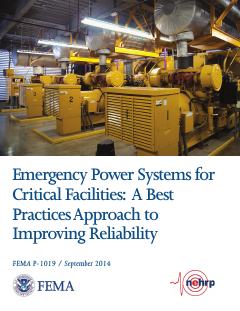
FEMA P-1019, Emergency Power Systems for Critical Facilities: A Best Practices Approach to Improving Reliability (September 2014)
At critical-facility data centers, place generators, ATS, fuel tanks and pumps above the greatest of BFE + 3 ft, DFE + 1 ft and 500-year elevation + 1 ft, and prefer elevation to dry floodproofing.
- Generators over 300 kW are almost exclusively diesel-fueled.