
Performance and Applicability Analysis of Indirect Evaporative Cooling Units in Data Centers Across Various Humidity Regions
Buildings (MDPI AG) · Qian Wei, Jun Lu et al.
A TRNSYS model of a packaged indirect evaporative cooling (IEC) air handler, validated against operating data, compares dry (Urumqi), medium-humidity (Beijing) and humid (Shanghai) Chinese sites.
CC BY 4.0 — share with attribution
On this page
Overview
IEC, which uses natural cooling sources, is a promising technology for cutting data-centre cooling energy; the study asks how adaptable IEC units are in regions of different humidity. The modelled machine room uses 24 °C supply air and 36 °C return air; the heat-transfer core is 60% efficient in dry (FAIHT) mode and 70% in IEC mode. Mode switching is: dry heat exchange when outdoor T ≤ 16 °C; IEC (spray on) when T > 16 °C and wet-bulb ≤ 19 °C; hybrid with compressors when wet-bulb > 19 °C. Annual mode hours, COP, energy and mechanical-cooling demand were compared against packaged air-cooled DX units and a water-cooled chiller system.
Natural cooling (dry plus IEC modes) covered about 97.29% of the year in Urumqi, about 79% in Beijing and about 43% in Shanghai; average annual COP was 7.34, 6.33 and 5.42. In Urumqi the unit's total annual energy consumption was 279,498.77 kWh with 7253.52 kWh of mechanical cooling; in Beijing 339,930.91 kWh with 116,011.34 kWh of mechanical cooling.
Against packaged air-cooled DX units, IEC energy savings were 57.46% (Urumqi), 48.26% (Beijing) and 39.41% (Shanghai). Against a water-cooled chiller system, IEC saved 41.11%, 35.96% and 29.95% of power and 78.26%, 75.01% and 68.75% of water in the three cities. Average annual PUE with the IEC unit was below 1.3 in all three cities, compared with 1.42 for the packaged air-cooled DX system.
Limits: simulation results depend on a specific unit model and the 24/36 °C supply-return assumption; the benefit shrinks as humidity rises. IEC wins on energy everywhere and on water against the water-cooled chiller system, but the advantage narrows in humid regions.
Key points
- The modelled machine room uses 24 °C supply air and 36 °C return air; the heat-transfer core is 60% efficient in dry (FAIHT) mode and 70% in IEC mode.
- Mode switching: dry heat exchange when outdoor T ≤ 16 °C; IEC (spray on) when T > 16 °C and wet-bulb ≤ 19 °C; hybrid with compressors when wet-bulb > 19 °C.
- Natural cooling (dry plus IEC modes) covered about 97.29% of the year in Urumqi, about 79% in Beijing and about 43% in Shanghai; average annual COP was 7.34, 6.33 and 5.42.
- Against packaged air-cooled DX units, IEC energy savings were 57.46% (Urumqi), 48.26% (Beijing) and 39.41% (Shanghai).
- Against a water-cooled chiller system, IEC saved 41.11%, 35.96% and 29.95% of power and 78.26%, 75.01% and 68.75% of water in the three cities.
- Average annual PUE with the IEC unit was below 1.3 in all three cities, compared with 1.42 for the packaged air-cooled DX system.
Using it in design
- Assess an IEC unit by climate: natural cooling covered 97% of the year in a dry climate and 43% in a humid one; check the wet-bulb distribution (19 °C threshold) against project climate data.
- When comparing IEC with water-cooled chillers, report energy savings (30-41%) and water savings (69-78%) together; the benefit narrows in humid regions.
- Define the mode-switching thresholds (16 °C dry, 19 °C wet-bulb) as setpoints in the control logic and include annual mode hours in the design report.
Monthly newsletter · free
Keep your reading list current
Once a month: new library sources, changes to Turkish regulations and upcoming data centre events.
SoSo CAD
Check cooling capacity alongside your design
Review zone heat loads, available capacity and the capacity balance after the largest unit is lost in SoSo CAD.
Request a demo
Who should read it
Cooling designers assessing the suitability of indirect evaporative cooling units across humidity regions.
Document contents
- 1. Introduction
- 2. Material and Methods (2.2 Location Selection for DC Model, 2.3 Calculation and Analysis of Operating-Mode-Switching Set Values, 2.4 Unit Model Establishment, 2.5 Verification of Unit Model)
- 3. Results and Discussion (3.1 Analysis of Operating-Mode Hours of IEC Units in Typical Cities: dry Urumqi, moderate-humidity Beijing, high-humidity Shanghai; 3.2 Performance Analysis of a Typical Urban IEC Unit: the same three cities)
- 4. Comparative Analysis of Different Air-Conditioning Systems in DC (4.1 Comparative Analysis of Energy Consumption of Air-Conditioning Systems)
- 5. Conclusions
Related standards
- ASHRAE TC9.9 Thermal Guidelines
- GB 50174
Read the document
iec-units-humidity-regions-2024.pdf
CC BY 4.0 — share with attribution
The document is provided unaltered because its licence permits redistribution.
Publication details
- Authors
- Qian Wei; Jun Lu; Xiaoping Xia; Bin Zhang; Xiang Ying; Leihong Li
- Publisher
- Buildings (MDPI AG)
- Year
- 2024
- Volume
- 14
- Issue
- 11
- Pages
- 3623
- Document language
- English
- Source type
- Scientific
- Access
- Open licence — downloadable
- Licence
- CC BY 4.0 — share with attribution
- Licence evidence
- www.mdpi.com
Original licence note
p.1 states the article is open access under the Creative Commons Attribution (CC BY) licence.
Citation
Qian Wei; Jun Lu; Xiaoping Xia; Bin Zhang; Xiang Ying; Leihong Li (2024). Performance and Applicability Analysis of Indirect Evaporative Cooling Units in Data Centers Across Various Humidity Regions. Buildings (MDPI AG). 14(11), 3623. https://doi.org/10.3390/buildings14113623
Events on this subject
Browse the events calendarAll content and rights belong to the respective authors and publishers. SoSo CAD provides only the citation, its own summary and a link to the source, and is not responsible for the sources' content.
Related sources
All sources on this topic
Buildings (MDPI AG) 2026
Load-Adaptive Operational Control of an Indirect Evaporative Cooling System for Coordinated Energy and Water Use in a Modular Data Center in a Cold Region
In IEC control, stage airflow to follow load rate and spray to follow room temperature, and prefer a low fresh/return air ratio.
- Going from load rate 0.7 to 1.0 raised annual electricity by 16.2% but water by 74.8% and WUE by 70.6%.
Energies (MDPI AG) 2023
Free Cooling for Saving Energy: Technical Market Analysis of Dry, Wet, and Hybrid Cooling Based on Manufacturer Data
Check free-cooling feasibility from the required coolant outlet temperature, the tower approach (dry 10 K, open wet 5 K, closed wet 6.5 K) and the at-least-5 K coolant range.
- Minimum outlet temperatures with evaporative cooling are up to 16 K lower than with dry cooling.
arXiv (University of Michigan preprint) 2026
Data Center Cooling Choices Shift Water Impacts Across the Grid: An Integrated Water-Energy Model for Sustainable Data Center Development
In cooling selection, calculate direct and indirect water together: an air-cooled chiller cut direct water 97% but raised the indirect share to 96.6% and electricity by 32%.
- Indirect water intensity varied by about 50% across months, depending on which generators supplied the added load.
Open Compute Project Foundation 2026
Guidelines: Impact of Strategies on Data Center Energy Consumption, Carbon Footprint, and Water Consumption (March 2026)
Evaluate cooling and siting options on energy, carbon, site water and water scarcity together, not on PUE or WUE alone.
- Same example: emissions fall from 3,500 to 2,700 t CO2/yr with the carbon factor of 0.26 kg CO2/kWh.
Open Compute Project Foundation 2023
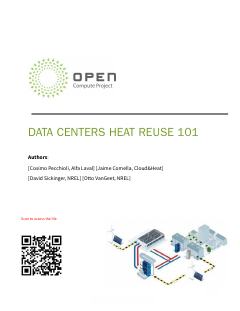
Data Centers Heat Reuse 101
A heat-reuse module should report recoverable heat (kW) and its temperature band by cooling technology (air, RDHx, DLC/immersion) and suggest compatible heat-host categories.
- Containerised/modular data centres can exceed 0.5 MW, a significant heat quantity for many local applications.
Resources, Conservation and Recycling (Elsevier BV) 2022
Climate- and technology-specific PUE and WUE estimations for U.S. data centers using a hybrid statistical and thermodynamics-based approach
In early data-centre design, set PUE and WUE targets by size class, cooling system and climate zone using this study's ranges (for example 1.71-2.22 for small rooms, 1.12-1.25 for large scale).
- Airside economisers with adiabatic cooling (case 1) use less water than airside economisers alone (case 3).