
Information technology - Data centres - Key performance indicators - Part 4: IT Equipment Energy Efficiency for servers (ITEEsv)
ISO/IEC · ISO/IEC JTC 1
The standard defining the ITEEsv indicator for the energy efficiency characteristics of a data centre's server fleet; it addresses IT equipment efficiency, not facility overhead.
On this page
Overview
ISO/IEC 30134-4:2017 is the fourth part of the key performance indicator (KPI) series for data centres and defines IT Equipment Energy Efficiency for servers, ITEEsv. The indicator quantifies the energy efficiency characteristics of the servers in a data centre. The first edition was published on 18 October 2017 and runs to 12 pages. This page rests on the publisher's public abstract and product metadata, not on the full text of the standard.
According to the publisher's abstract, ITEEsv can be calculated using pre-existing or context-specific server performance benchmarks. The standard defines the indicator's purpose, how to use it and how to report it. Its goal is to help raise the aggregate energy effectiveness of the server fleet. In other words, the indicator is meant to track the combined efficiency of all servers in the facility, not that of a single machine.
ITEEsv measures something different from PUE, which captures the overhead of the facility infrastructure: it measures the energy efficiency of the IT equipment itself. The two indicators complement each other and do not replace one another. The standard is related to ISO/IEC 30134-5, ISO/IEC 21836 and EN 50600-4-7.
Key points
- ITEEsv is a KPI quantifying the energy efficiency characteristics of servers in a data centre.
- It may be calculated using pre-existing or context-specific server performance benchmarks.
- The standard defines the indicator's purpose, use and reporting.
- The aim is to help raise aggregate server energy effectiveness.
- Edition 1, published 18 October 2017, 12 pages.
- Unlike PUE, it measures IT efficiency, not facility overhead.
- Related standards: ISO/IEC 30134-5, ISO/IEC 21836, EN 50600-4-7.
Using it in design
- Add optional server benchmark fields (performance score and power at max) to the rack/IT catalogue so the tool can aggregate a fleet ITEEsv per hall.
- Keep it separate from PUE: one measures IT efficiency, the other facility overhead; show them separately in reports.
- In server procurement and refresh decisions, use it to compare models that deliver similar performance at lower power.
- State the benchmark source and method used in the calculation in the report.
Monthly newsletter · free
Keep your reading list current
Once a month: new library sources, changes to Turkish regulations and upcoming data centre events.
SoSo CAD
Compare the cost of design decisions
Evaluate equipment costs, energy expenses and total cost of ownership (TCO) using your inputs and assumptions in SoSo CAD.
Request a demo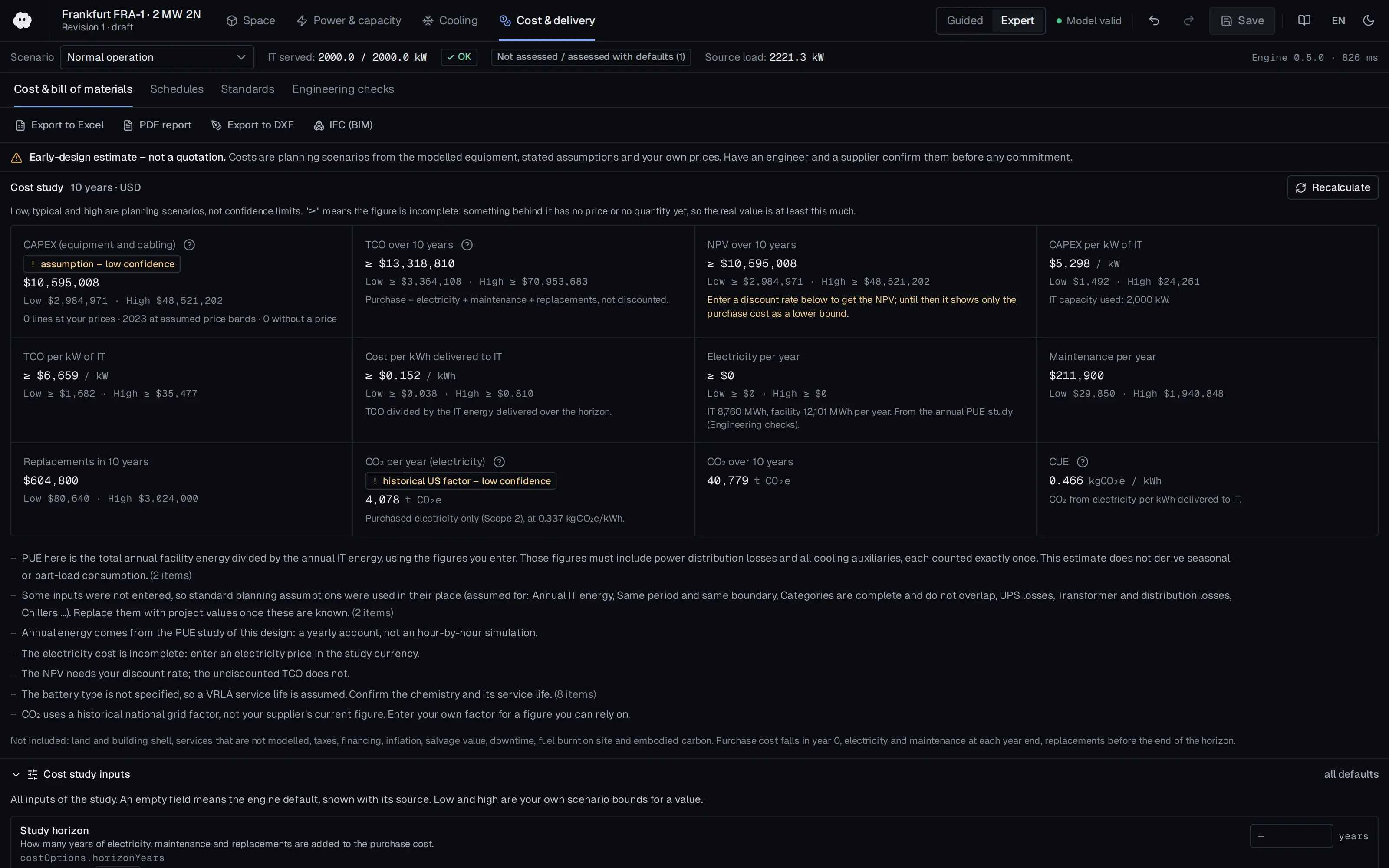
Who should read it
Operators tracking data center energy efficiency, teams planning server procurement and capacity, and engineers preparing KPI reports.
Related standards
- ISO/IEC 30134-5
- ISO/IEC 21836
- EN 50600-4-7
Publication details
- Authors
- ISO/IEC JTC 1
- Publisher
- ISO/IEC
- Year
- 2017
- Document number
- ISO/IEC 30134-4:2017
- Document language
- English
- Source type
- Standard
- Access
- Citation only
- Licence
- Copyright retained; citation only — the publisher’s terms apply to the original document
Original licence note
Paid standard. Record built only from the publisher's public catalogue abstract and product metadata; full text not redistributed.
Citation
ISO/IEC JTC 1 (2017). Information technology - Data centres - Key performance indicators - Part 4: IT Equipment Energy Efficiency for servers (ITEEsv). ISO/IEC. ISO/IEC 30134-4:2017. https://webstore.iec.ch/en/publication/61810
Events on this subject
- SC26 – International Conference for High Performance Computing, Networking, Storage and Analysis
- iMasons Climate Accord Summit
- Data Center World Middle East
All content and rights belong to the respective authors and publishers. SoSo CAD provides only the citation, its own summary and a link to the source, and is not responsible for the sources' content.
Related sources
All sources on this topic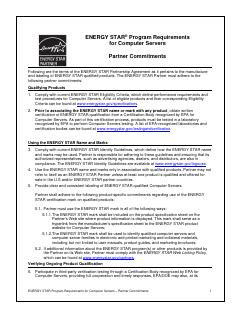
U.S. EPA / ENERGY STAR 2024
ENERGY STAR Program Requirements for Computer Servers, Version 4.0 (Partner Commitments, Eligibility Criteria, and Final Test Method Rev. April 2023)
Write ENERGY STAR Version 4.0 certification and the PSU efficiency steps (at 10% to 100% load points) into the server procurement specification; look especially at 10% and 20% load efficiency for redundant supplies that run lightly loaded.
- EffACTIVE = EXP(0.65 ln EffCPU + 0.30 ln EffMEMORY + 0.05 ln EffSTORAGE).
U.S. Environmental Protection Agency (ENERGY STAR) 2023
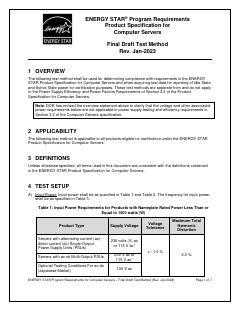
ENERGY STAR Program Requirements for Computer Servers: Final Draft Test Method (Rev. Jan-2023), Version 4.0
When importing server power data, keep the 25 ± 5 °C test ambient as metadata and warn that fan power rises at higher inlet set points.
- Ambient temperature during testing is 25 ± 5 °C and relative humidity 15% to 80%.
European Commission JRC 2020
Development of the EU Green Public Procurement (GPP) Criteria for Data Centres, Server Rooms and Cloud Services - Final Technical Report (JRC118558, EUR 30251 EN, 2020)
Ask in the specification for a designed PUE (dPUE) at a stated IT load (for example 50%) and conditions, under ISO/IEC 30134-2 or EN 50600-4-2, and write PUE demonstration at handover and the commissioning test into the contract.
- ASHRAE liquid cooling classes cited: W1 2-17 °C, W2 2-27 °C, W3 2-32 °C, W4 2-45 °C, W5 above 45 °C.
Swiss Federal Office of Energy SFOE (Energy Research and Cleantech); preprint on arXiv 2025
Temperature Optimisation in Data Centres (TODC) - Final report
Add an IT-side penalty of about 0.3-0.6% of IT power per C of inlet rise above about 23 C (a configurable default) to the setpoint optimiser and energy calculator, and model fan power with the cube of speed.
- Reported hyperscale inlet temperatures: Google 26.6 C, Microsoft 27 C, Meta 29.4 C.
Uptime Institute 2025
Uptime Institute Global Data Center Survey 2025 (15th annual) — press release and public highlights
Use PUE 1.54 as the 'industry average' line on the efficiency dashboard, year-stamped and user-overridable
- Survey run April-May 2025 with 800+ respondents
ASHRAE 2024
ASHRAE Datacom Series (TC 9.9) - series overview incl. IT Equipment Power Trends 3rd ed., Best Practices for Datacom Facility Energy Efficiency 2nd ed., Particulate and Gaseous Contamination 2nd ed., Green Tips
Use Book 2 (IT Equipment Power Trends) for default kW-per-rack growth projections.
- Book 10: Green Tips for Data Centers (2011), product 90554.