
Data Center Liquid Distribution Guidance & Reference Designs, Rev 1.0 (OCP Advanced Cooling Facilities)
Open Compute Project · Don Mitchell, John Menoche et al.
This 2024 OCP Advanced Cooling Facilities white paper gives concept-level guidance for integrating liquid-cooled IT into data centers: connecting to existing facility water systems through CDUs, door heat exchangers on facility water, and elevated-temperature loops that bypass chillers.
On this page
Overview
The method rests on the heat-transport relationship Q = volumetric flow x delta-T x density x specific heat, and by volume water carries about 3,300 times the heat of air. The paper uses it to give a table of pipe size against kW for concept sizing, but states clearly that the table is concept-level only and needs validation by a licensed engineer.
The temperature discussion matters: at W45 and above, cold plate and immersion allow evaporation-free free cooling in all climates, and 35-60 degC liquid loops are common. Door heat exchangers return air to the ASHRAE TC9.9 range (typically below 27 degC) and often connect directly to facility water without a CDU. The condensation section notes that the highest dew point supported by ASHRAE TC9.9 air classes is 28 degC, that TCS should be kept above dew point, and that alarms should cover transitions.
On redundancy the best practice is redundant pumps and backup power (UPS or generator) for CDUs and TCS. The paper also covers space planning for pipe routing and tap-offs. It is a reference-design white paper; it gives no detailed hydraulic calculation, valve selection or cost, so the pipe table and CDU layout results must be validated by an engineer under project conditions.
Key points
- Q = volumetric flow x delta-T x density x specific heat; by volume water carries about 3,300 times the heat of air.
- Cold plate and immersion allow evaporation-free free cooling in all climates at W45 and above; 35-60 degC liquid loops are common.
- Door heat exchangers restore air to the ASHRAE TC9.9 range (typically below 27 degC) and often connect to facility water without a CDU.
- The highest dew point supported by ASHRAE TC9.9 air classes is 28 degC; keep TCS above dew point and alarm during transitions.
- Best practice: redundant pumps and backup power (UPS/generator) for CDUs and TCS.
- The pipe size versus kW table is concept-level only; licensed-engineer validation is required.
Using it in design
- In the liquid-cooling calculator implement Q = m*cp*delta-T for TCS/FWS sizing (water cp 4.18 kJ/kg-K, PG25 option) and size pipes by maximum velocity.
- Add a dew-point check: TCS supply >= room dew point + 2 K (default margin).
- For Tier III/IV intent default CDU pumps to N+1 and put CDUs on UPS.
- Offer facility-water class presets W17/W27/W32/W40/W45/W+.
- Label pipe-table results as 'conceptual'.
Monthly newsletter · free
Keep your reading list current
Once a month: new library sources, changes to Turkish regulations and upcoming data centre events.
SoSo CAD
Check cooling capacity alongside your design
Review zone heat loads, available capacity and the capacity balance after the largest unit is lost in SoSo CAD.
Request a demo
Who should read it
Mechanical designers settling early-stage piping and CDU layout in liquid-cooled halls.
Related standards
- ASHRAE TC9.9 Liquid Cooling Guidelines
- ASHRAE 90.1
- OCP ACS Cold Plate Requirements
Publication details
- Authors
- Don Mitchell; John Menoche; John Gross; Vali Sorell; John Musilli
- Publisher
- Open Compute Project
- Year
- 2024
- Document number
- ACF Rev 1.0
- Document language
- English
- Source type
- Industry body
- Access
- Free to read
- Licence
- Copyright retained; citation only — the publisher’s terms apply to the original document
Citation
Don Mitchell; John Menoche; John Gross; Vali Sorell; John Musilli (2024). Data Center Liquid Distribution Guidance & Reference Designs, Rev 1.0 (OCP Advanced Cooling Facilities). Open Compute Project. ACF Rev 1.0. https://www.opencompute.org/documents/ocp-acf-reference-design-guidance-white-paper-r1-pdf/
Events on this subject
Browse the events calendarAll content and rights belong to the respective authors and publishers. SoSo CAD provides only the citation, its own summary and a link to the source, and is not responsible for the sources' content.
Related sources
All sources on this topicOpen Compute Project Foundation 2022
Warm Liquid Cooled Cloud Facilities: What Do We Achieve? (Microsoft submission to OCP)
Default liquid-cooled designs to warm facility water (W40/W45) in chiller-free or dry-cooler-only plant options, citing this paper as supporting evidence.
- The volumetric heat transfer ratio of water to air is cited as about 1900:1.
Fluids (MDPI AG) 2026
A Review of Thermal Management in Modern Data Centres: Water Usage Effectiveness and Heat Transfer Coefficients
Set WUE targets from the heat-rejection topology (dry, free-cooling, hybrid, evaporative) and not only the server-side cooling technology; WUE depends on the share of heat rejected by evaporation.
- Dry facilities with closed-loop liquid cooling need essentially no water, while evaporative systems typically report WUE up to 2.5 L/kWh.
U.S. DOE FEMP / NREL 2019
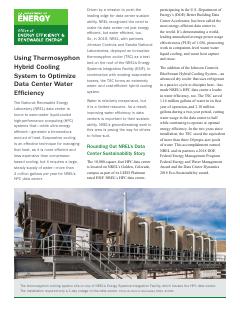
Using Thermosyphon Hybrid Cooling System to Optimize Data Center Water Efficiency (DOE/GO-102019-5172, May 2019)
Arrange the heat-rejection hierarchy as in the scheme: heat reuse first, then dry cooling, evaporative towers last; write the control logic in that order.
- Installing the TSC required only a 1-day data center outage.
National Laboratory of the Rockies (formerly NREL) 2026
High-Performance Computing Data Center Cooling System Energy Efficiency (ESIF)
Model heat rejection as a priority chain (reuse, dry cooler, evaporative tower) with hourly switching.
- The page was last updated on 17 February 2026.
Schneider Electric 2026
Water Usage at AI Scale: Insights from a 100 MW Comparative Analysis
Compute and display WUE (L/kWh IT) next to PUE for every cooling design.
- Dallas WUE falls from 0.42 to 0.22 L/kWh; Paris from 0.12 to 0.06 L/kWh.
Burns & McDonnell 2024
Fluid Dynamics: Liquid Cooling's Role in the Future of Data Centers
For liquid-cooled racks, always keep a residual air-cooling load (default 20-50% of IT, user-adjustable) and size CRAH or fan-wall capacity for it.
- Some solutions reach 80-120+ kW per rack versus a typical 8-12 kW.