
Warm Liquid Cooled Cloud Facilities: What Do We Achieve? (Microsoft submission to OCP)
Open Compute Project Foundation
A Microsoft white paper submitted to OCP in 2022 that argues for warm-water liquid-cooled cloud facilities and examines how facility water temperature class trades device performance against chiller use, water consumption and heat reuse.
On this page
Overview
This is a Microsoft white paper submitted to the Open Compute Project in 2022, arguing for warm-water liquid-cooled cloud facilities. It reviews efficiency trends and compares the heat-transfer capability of air, water and two-phase dielectric fluids. The volumetric heat transfer ratio of water to air is cited as about 1900:1. The PDF carries the notice 'Copyright Microsoft 2022.
The authors' processor tests compare air, cold-plate and two-phase immersion cooling. In those tests water-cooled cold plates gave about 41 percent higher CPU clock rates than air, and two-phase immersion close to 51 percent higher. These results come from the authors' own experiments, and applying them to other processors, workloads and hardware would need separate verification.
For design, the most valuable part of the paper is its discussion of facility water temperature classes (W27 to W45). Lower classes (W27, W32) may need chiller operation to reach peak performance, whereas warm classes (W40, W45) can match or beat air cooling and open the door to waste-heat reuse.
Section 7 explains that raising facility water temperature can remove chillers and adiabatic or evaporative cooling, along with the associated water use. The heat can serve district, space and water heating, or processes such as adsorption chillers, direct air capture (DAC) and desalination. The limit of the document is that it is a white paper expressing a manufacturer's view, and its results have not been independently verified.
Key points
- The volumetric heat transfer ratio of water to air is cited as about 1900:1.
- In the authors' tests, water-cooled cold plates gave about 41 percent higher CPU clock rates than air, and two-phase immersion close to 51 percent higher.
- Lower water classes (W27, W32) may need chiller operation to reach peak performance.
- Warm classes (W40, W45) can match or beat air cooling and open up waste-heat reuse.
- Raising facility water temperature can remove chillers and adiabatic or evaporative cooling and the water use that goes with them.
- Heat can serve district, space and water heating, and adsorption chillers, DAC and desalination.
Using it in design
- Default liquid-cooled designs to warm facility water (W40/W45) in chiller-free or dry-cooler-only plant options, citing this paper as supporting evidence.
- Show the WUE and chiller-energy penalty of lower water classes explicitly.
- Link warm-water designs to the heat-reuse module.
- Cross-check against the ASHRAE Liquid Cooling Guidelines W-classes and the OCP 30 C coolant roadmap.
Monthly newsletter · free
Keep your reading list current
Once a month: new library sources, changes to Turkish regulations and upcoming data centre events.
SoSo CAD
Check cooling capacity alongside your design
Review zone heat loads, available capacity and the capacity balance after the largest unit is lost in SoSo CAD.
Request a demo
Who should read it
Cooling designers planning liquid-cooled facilities, and sustainability and heat-recovery engineers.
Related standards
- ASHRAE Liquid Cooling Guidelines (W-classes, 2021)
- OCP 30 C Coolant - A Durable Roadmap
Publication details
- Authors
- Open Compute Project Foundation
- Publisher
- Open Compute Project Foundation
- Year
- 2022
- Document language
- English
- Source type
- Industry body
- Access
- Free to read
- Licence
- Bibliographic reference only — the document is not redistributed here; confirm reuse terms at the original source
Original licence note
License section (p.14) states copyright Microsoft 2022, all rights reserved.
Citation
Open Compute Project Foundation (2022). Warm Liquid Cooled Cloud Facilities: What Do We Achieve? (Microsoft submission to OCP). Open Compute Project Foundation. https://www.opencompute.org/documents/ocp-document-submission-msft-warm-liquid-cooled-cloud-facilities-legal-review-12-08-pdf/
Events on this subject
Browse the events calendarAll content and rights belong to the respective authors and publishers. SoSo CAD provides only the citation, its own summary and a link to the source, and is not responsible for the sources' content.
Related sources
All sources on this topic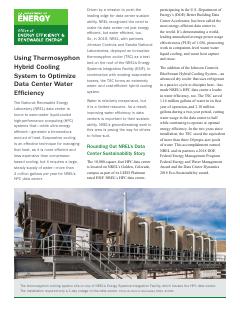
U.S. DOE FEMP / NREL 2019
Using Thermosyphon Hybrid Cooling System to Optimize Data Center Water Efficiency (DOE/GO-102019-5172, May 2019)
Arrange the heat-rejection hierarchy as in the scheme: heat reuse first, then dry cooling, evaporative towers last; write the control logic in that order.
- Installing the TSC required only a 1-day data center outage.
Schneider Electric 2026
Water Usage at AI Scale: Insights from a 100 MW Comparative Analysis
Compute and display WUE (L/kWh IT) next to PUE for every cooling design.
- Dallas WUE falls from 0.42 to 0.22 L/kWh; Paris from 0.12 to 0.06 L/kWh.
Huawei Digital Power 2023
White Paper on the Top 10 Trends of Data Center Facilities
Show WUE alongside PUE in the metrics panel, with region-specific targets as policy presets.
- At 16 kW per rack, power-room area roughly equals IT space (1:1).
NREL 2018
Thermosyphon Cooler Hybrid System for Water Savings in an Energy-Efficient HPC Data Center: Results (NREL/TP-2C00-72196, September 2018)
Check whether the warm return water from liquid cooling (here 84 °F after energy recovery) leaves enough temperature difference to ambient for a dry or hybrid stage, and size it against local dry-bulb hours.
- First-year heat rejection: 10.5% building heat reuse, 42.5% thermosyphon and 47% cooling towers.
Open Compute Project Foundation 2026
Guidelines: Impact of Strategies on Data Center Energy Consumption, Carbon Footprint, and Water Consumption (March 2026)
Evaluate cooling and siting options on energy, carbon, site water and water scarcity together, not on PUE or WUE alone.
- Same example: emissions fall from 3,500 to 2,700 t CO2/yr with the carbon factor of 0.26 kg CO2/kWh.

Open Compute Project Foundation 2026
Base Specification for Two-Phase Dielectric Fluid-Based Heat Transfer Fluid (Cold Plate), Version 1.0.0
Record ASHRAE 34 safety class, GWP, ODP, boiling point and latent heat in the two-phase cold-plate fluid catalogue.
- Operating temperature 4-75 C and storage -20 to 60 C; fluid purity monitored annually.