
Standardization and Modularity in Data Center Physical Infrastructure
Schneider Electric · Suzanne Niles
Schneider Electric WP 116 (Suzanne Niles, 2015) argues that data-centre physical infrastructure should be built from standardised, modular building blocks rather than uniquely engineered per site.
On this page
Overview
The benefits are traced to two roots: modular architecture (scalable, changeable, portable, swappable) and greater human understanding. These map onto the three parts of infrastructure business value: availability, agility and TCO. The largest availability entitlement is human error, which causes 50-60% of data centre downtime. On reliability the paper warns that analysis based on component count alone unfairly penalises modular systems; it must consider design, function and dependencies, plus fault tolerance and reliability growth. Citing MTechnology studies, factory-repaired UPS power modules are 500-2000 times less likely to cause outages, introduce new defects or inhibit return to full operation than field-repaired modules.
On agility, standardised modular deployment can cut concept-to-commissioning time from months to weeks and reconfiguration from weeks to days, partly through factory pre-test. With typical IT refresh cycles of two years, the ability to reconfigure, upgrade or move infrastructure is a significant part of agility.
A sidebar introduces micro data centres, self-contained factory-assembled and tested enclosures from 1 to 100 kW of IT load, as the next step. One example is Deloitte's twin Amsterdam data centres, which consolidated 109 IT facilities on standardised modular infrastructure and were built in four months. The text is a vendor view and rests on cited studies as evidence.
Key points
- Benefits come from two roots, modular architecture and human understanding; three business values: availability, agility, TCO.
- Human error causes 50-60% of downtime, the largest single availability entitlement.
- Reliability analysis by component count alone can be incomplete and misleading.
- Factory-repaired UPS power modules are 500-2000 times less likely to cause outages or new defects than field-repaired ones (MTechnology).
- Standardised modular deployment can cut concept-to-commissioning from months to weeks and reconfiguration from weeks to days.
- Typical IT refresh cycle is two years.
- Micro data centres are factory-assembled, tested enclosures of 1-100 kW IT load.
- Deloitte's twin Amsterdam sites consolidated 109 IT facilities and were built in four months.
Using it in design
- Let users define a reusable power/cooling/rack module and replicate it across phases and sites, with BOM and labelling generated consistently.
- Model installed versus ultimate capacity per block so the day-1 build matches current load.
- In the reliability engine, support module-level N+1 redundancy and MTTR for swappable modules instead of penalising higher part counts.
- Offer a 1-100 kW micro data centre as a prefab template type.
Monthly newsletter · free
Keep your reading list current
Once a month: new library sources, changes to Turkish regulations and upcoming data centre events.
SoSo CAD
Assess redundancy through scenarios
Compare normal operation and equipment failures in SoSo CAD, with supplied loads and capacity shortfalls in one view.
Request a demo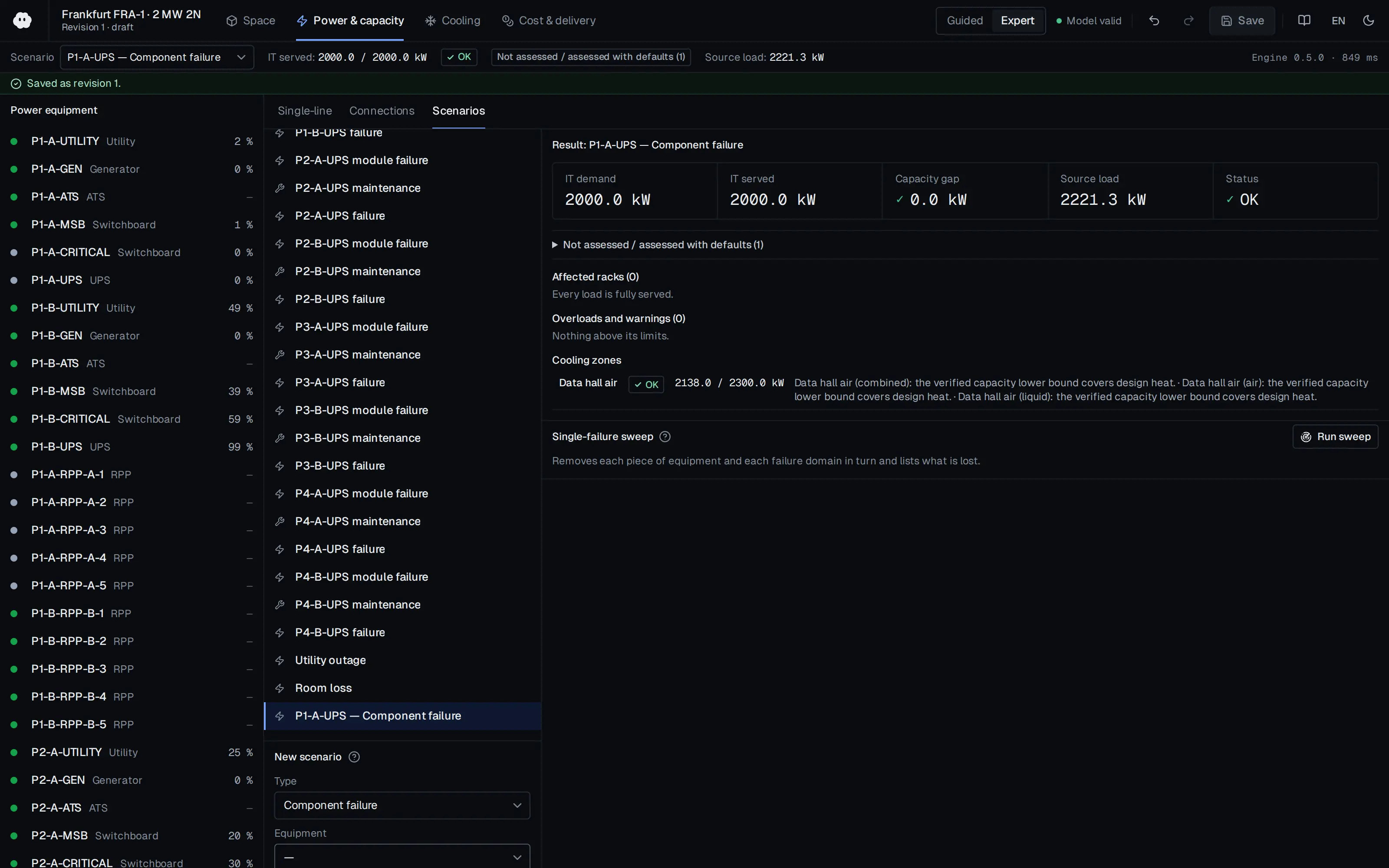
Who should read it
Engineers and decision makers weighing repeatable, phased data-centre design and a standard infrastructure block strategy.
Publication details
- Authors
- Suzanne Niles
- Publisher
- Schneider Electric
- Year
- 2015
- Document number
- WP 116
- Document language
- English
- Source type
- Manufacturer
- Access
- Free to read
- Licence
- Copyright retained; citation only — the publisher’s terms apply to the original document
Citation
Suzanne Niles (2015). Standardization and Modularity in Data Center Physical Infrastructure. Schneider Electric. WP 116. https://download.schneider-electric.com/files?p_Doc_Ref=SPD_VAVR-626VPD_EN
Events on this subject
Browse the events calendarAll content and rights belong to the respective authors and publishers. SoSo CAD provides only the citation, its own summary and a link to the source, and is not responsible for the sources' content.
Related sources
All sources on this topicSchneider Electric 2025
Direct Liquid Cooling System Challenges in Data Centers
Use the eight challenges as a DLC readiness checklist in the commissioning and design-review module.
- Heat capture ratio defines the air share: 80% liquid capture leaves 20% for air cooling.
Schneider Electric 2011
Data Center Projects: Commissioning
Default the commissioning budget to about 2% of capex.
- Rule of thumb: budget about 2% of overall project cost for commissioning; typical return about 5 to 10% in overall performance.

Open Compute Project Foundation 2022
Leak Detection and Intervention, Revision 1.0 (OCP Advanced Cooling Solutions white paper)
Run a probability-and-impact leak risk analysis at project start, specify BSPP/O-ring joints for serviceable connections and check the O-ring compound against the coolant chemistry using the full wetted-materials list.
- A UQD2 dry-break quick disconnect is specified to drip less than 0.063 cc when disconnected at 200 psi.
U.S. Army Corps of Engineers 2006
TM 5-698-2, Reliability-Centered Maintenance (RCM) for Command, Control, Communications, Computer, Intelligence, Surveillance, and Reconnaissance (C4ISR) Facilities (6 October 2006)
At design stage carry out an FMEA for each critical system and record failure modes, effects and detection methods as input to the RCM decision logic; the text stresses that RCM starts in design and continues for the life of the facility.
- For an exponential failure distribution with constant failure rate, an item with a 1000-hour MTBF has only a 37 percent probability of surviving 1000 hours of continuous operation.
U.S. Army Corps of Engineers (Headquarters, Department of the Army) 2006
TM 5-698-4 Failure Modes, Effects and Criticality Analyses (FMECA) for Command, Control, Communications, Computer, Intelligence, Surveillance, and Reconnaissance (C4ISR) Facilities (29 September 2006)
At design stage run a functional FMEA of each critical system (power, generators, cooling); do not start without schematics, bill of materials, block diagram and the mission requirement.
- The Risk Priority Number is Severity (1-10) x Occurrence (1-10), optionally multiplied by Detection: RPN = S x O x D.
U.S. Army Corps of Engineers (Headquarters, Department of the Army) 2002
TM 5-693 Uninterruptible Power Supply System Selection, Installation, and Maintenance for Command, Control, Communications, Computer, Intelligence, Surveillance, and Reconnaissance (C4ISR) Facilities (31 May 2002)
Calculate availability from MTBF and MTTR before choosing a UPS configuration; apply the same method to single-unit, N+1 and dual-redundant layouts to compare the gain from redundancy with the cost of the added components.
- C4ISR facilities require a reliability level of 99.9999 percent (the six-nine rule), which may call for greater redundancy.