
Data Center Projects: Commissioning
Schneider Electric · Paul Marcoux
Schneider Electric WP 148 describes commissioning as the step where power, cooling, fire, security and management systems are tested as one integrated system, and recommends rack-level heat simulators for testing.
On this page
Overview
In the paper, commissioning sits in the implementation phase of the Prepare-Design-Acquire-Implement project process, after components are started up individually and before orientation and training. The scope is not just product start-up but power, cooling, fire suppression, security, management, building/grounds and their interactions. Inputs are the design documents, criticality targets, redundancy levels and vendor start-up results. Delivery, installation and individual start-up come first.
Outputs are a test script, an error log, as-built drawings and a commissioning report, reused for trending day-one performance and for training. Test scripts are step-by-step pass/fail sequences, for example ATS closed-transition transfer tests. As a rule of thumb about 2% of overall project cost is budgeted for commissioning, with a typical return of about 5 to 10% in overall data center performance.
For high density the paper favours rack-mounted resistive heaters over a central load bank: central load banks test the electrical path but under-test CRAC/CRAH airflow. Heaters with adjustable kW and airflow, plugged into the real rack PDUs, commission distribution and cooling together. Commissioning is likened to insurance, with periodic recommissioning as the business changes. The paper has no L1 to L5 naming; it gives scope and inputs/outputs, and it dates from 2011, so newer load types such as liquid cooling are not addressed.
Key points
- Rule of thumb: budget about 2% of overall project cost for commissioning; typical return about 5 to 10% in overall performance.
- Commissioning follows component start-up and precedes orientation/training.
- Integrated test scope covers power, cooling, fire suppression, security, management, building/grounds and their interactions.
- Central load banks test the electrical path but under-test CRAC/CRAH airflow.
- Rack-mounted heaters with adjustable kW and airflow, plugged into real rack PDUs, test distribution and cooling together.
- Outputs: test script, error log, as-built drawings and commissioning report, reused for day-one trending and training.
- Test scripts are step-by-step pass/fail sequences (e.g. ATS closed-transition transfer).
Using it in design
- Default the commissioning budget to about 2% of capex.
- Generate an integrated test-script skeleton from the single-line diagram: each ATS/STS/UPS/generator transfer becomes a pass/fail step.
- Use the common L1 to L5 sequence as the plan skeleton (this naming is industry convention, not from this paper).
- For L4/L5 size rack load-bank heaters per rack at design kW and CFM.
Monthly newsletter · free
Keep your reading list current
Once a month: new library sources, changes to Turkish regulations and upcoming data centre events.
SoSo CAD
Bring standards pre-checks into your project
Review model-based TS EN 50600 and Tier pre-checks, missing inputs and items requiring engineering review in SoSo CAD.
Request a demo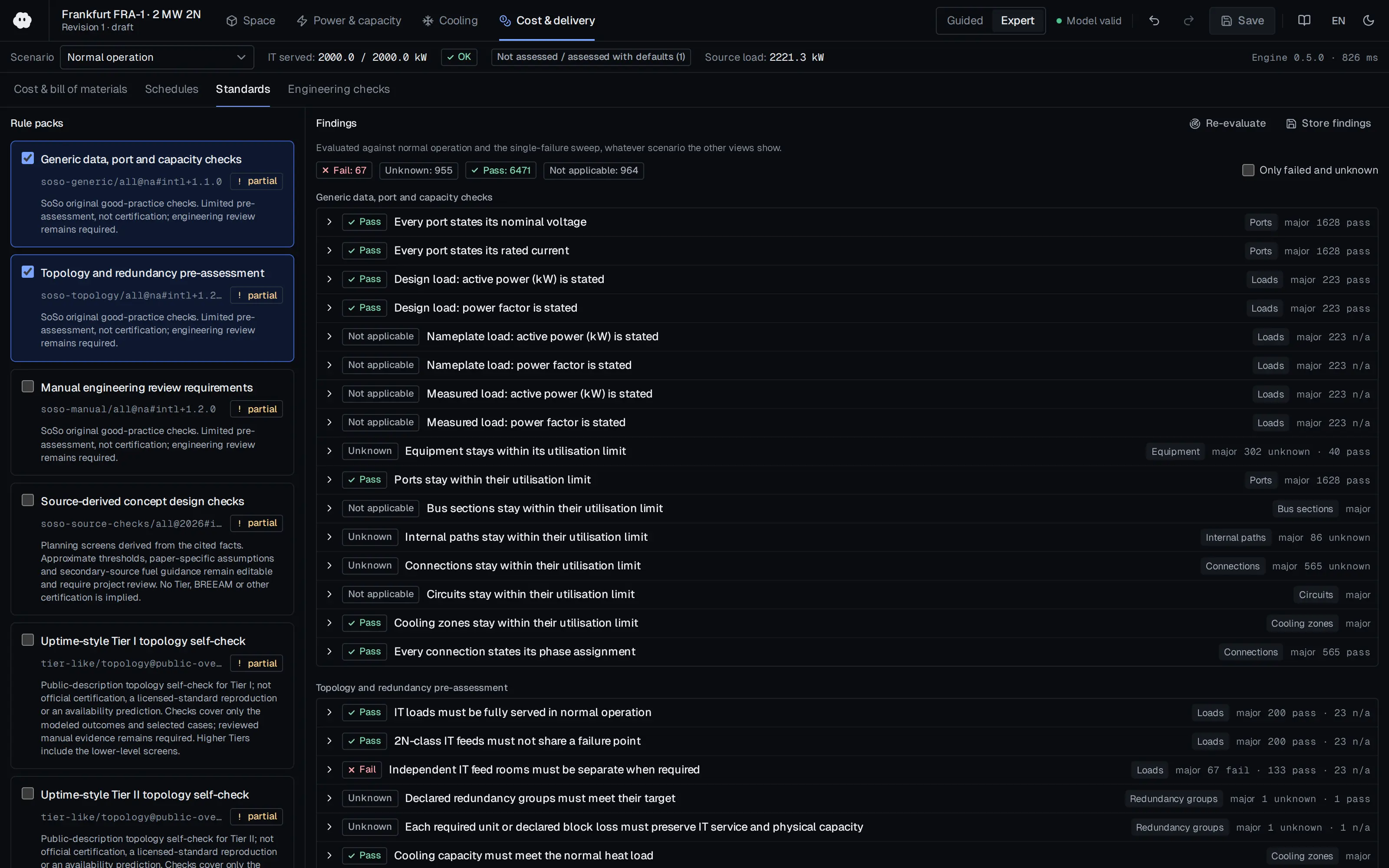
Who should read it
Project managers, operations teams and design engineers planning commissioning.
Related standards
- ASHRAE Guideline 0
- ASHRAE Guideline 1.1
- ASHRAE Standard 202
- Uptime Tier Certification of Constructed Facility
- EN 50600-2-1
Publication details
- Authors
- Paul Marcoux
- Publisher
- Schneider Electric
- Year
- 2011
- Document number
- WP 148
- Document language
- English
- Source type
- Manufacturer
- Access
- Free to read
- Licence
- Copyright retained; citation only — the publisher’s terms apply to the original document
Citation
Paul Marcoux (2011). Data Center Projects: Commissioning. Schneider Electric. WP 148. https://download.schneider-electric.com/files?p_Doc_Ref=SPD_DBOY-6NJNK6_EN
Events on this subject
Browse the events calendarAll content and rights belong to the respective authors and publishers. SoSo CAD provides only the citation, its own summary and a link to the source, and is not responsible for the sources' content.
Related sources
All sources on this topicSchneider Electric 2025
Direct Liquid Cooling System Challenges in Data Centers
Use the eight challenges as a DLC readiness checklist in the commissioning and design-review module.
- Heat capture ratio defines the air share: 80% liquid capture leaves 20% for air cooling.
Schneider Electric 2015
Standardization and Modularity in Data Center Physical Infrastructure
Let users define a reusable power/cooling/rack module and replicate it across phases and sites, with BOM and labelling generated consistently.
- Micro data centres are factory-assembled, tested enclosures of 1-100 kW IT load.

Open Compute Project Foundation 2022
Leak Detection and Intervention, Revision 1.0 (OCP Advanced Cooling Solutions white paper)
Run a probability-and-impact leak risk analysis at project start, specify BSPP/O-ring joints for serviceable connections and check the O-ring compound against the coolant chemistry using the full wetted-materials list.
- A UQD2 dry-break quick disconnect is specified to drip less than 0.063 cc when disconnected at 200 psi.
U.S. Army Corps of Engineers 2006
TM 5-698-2, Reliability-Centered Maintenance (RCM) for Command, Control, Communications, Computer, Intelligence, Surveillance, and Reconnaissance (C4ISR) Facilities (6 October 2006)
At design stage carry out an FMEA for each critical system and record failure modes, effects and detection methods as input to the RCM decision logic; the text stresses that RCM starts in design and continues for the life of the facility.
- For an exponential failure distribution with constant failure rate, an item with a 1000-hour MTBF has only a 37 percent probability of surviving 1000 hours of continuous operation.
U.S. Army Corps of Engineers (Headquarters, Department of the Army) 2006
TM 5-698-4 Failure Modes, Effects and Criticality Analyses (FMECA) for Command, Control, Communications, Computer, Intelligence, Surveillance, and Reconnaissance (C4ISR) Facilities (29 September 2006)
At design stage run a functional FMEA of each critical system (power, generators, cooling); do not start without schematics, bill of materials, block diagram and the mission requirement.
- The Risk Priority Number is Severity (1-10) x Occurrence (1-10), optionally multiplied by Detection: RPN = S x O x D.
U.S. Army Corps of Engineers (Headquarters, Department of the Army) 2002
TM 5-693 Uninterruptible Power Supply System Selection, Installation, and Maintenance for Command, Control, Communications, Computer, Intelligence, Surveillance, and Reconnaissance (C4ISR) Facilities (31 May 2002)
Calculate availability from MTBF and MTTR before choosing a UPS configuration; apply the same method to single-unit, N+1 and dual-redundant layouts to compare the gain from redundancy with the cost of the added components.
- C4ISR facilities require a reliability level of 99.9999 percent (the six-nine rule), which may call for greater redundancy.