
Selecting a Building Management System (BMS) for Sites with a Data Center or IT Room
Schneider Electric · Bryan Anderson, Patrick Donovan
A Schneider Electric white paper (WP 233, 2016) explaining why a BMS serving a data center or IT room must go well beyond comfort-oriented commercial functions.
On this page
Overview
The paper argues that a BMS serving a site with a data center or IT room must go well beyond comfort-oriented commercial BMS functions. Required capabilities are automatic physical response to cooling failures, end-to-end visibility from utility and mechanical plant to servers, awareness of redundancy and dependencies, capacity tracking, contextual alarming with attached procedures, data sharing with EPMS and DCIM, and strong cyber security. When a cooling unit fails, data center temperatures rise rapidly in the first 60 seconds, so the BMS must start redundant cooling automatically.
The operating-hours gap matters too: a commercial building occupied 7 am-6 pm on weekdays runs about 2,860 hours a year versus 8,760 for a data center, so efficiency changes yield roughly 3x the savings of comfort cooling. Human error is attributed with 70% of data center outages (Uptime Institute AIR database), split into active and passive errors. Verizon DBIR 2016 is cited: 63% of confirmed breaches used weak, default or stolen passwords, and 70% of insider-misuse breaches took months or years to discover.
The paper positions the BMS alongside EPMS for electrical monitoring and DCIM for the white space, connected over open protocols such as BACnet IP, MS/TP, Modbus IP and RTU on Ethernet TCP/IP, plus web-services APIs. The recommended split is DCIM for white-space applications, BMS for building and mechanical, and EPMS for electrical, because each UI is optimised for one domain. It closes with three implementation pitfalls (wrong tool, weak processes, lack of ownership) and four critical operator processes: inventory and asset management, system configuration, alarm integration and stakeholder reporting. Facilities and IT should jointly witness commissioning tests and agree pass/fail before go-live.
Key points
- After a cooling unit failure temperatures rise rapidly in the first 60 seconds; the BMS must start redundant cooling automatically.
- A commercial building runs about 2,860 h/year versus 8,760 for a data center; efficiency gains are roughly 3x.
- Uptime Institute AIR: 70% of outages attributed to human error.
- Verizon DBIR 2016: 63% of breaches used weak, default or stolen passwords; 70% of insider-misuse breaches took months or years to discover.
- Open protocols: BACnet IP, MS/TP, Modbus IP and RTU on Ethernet TCP/IP, plus web-services APIs.
- Split: DCIM for white space, BMS for building/mechanical, EPMS for electrical.
- Four critical operator processes: inventory, configuration, alarm integration, stakeholder reporting.
- Facilities and IT should jointly witness commissioning tests.
Using it in design
- In the monitoring design module let users scope BMS, EPMS and DCIM separately and assign each monitored asset (chillers, CRAHs, UPS, PDUs, rack PDUs) to one system with a protocol (BACnet IP/MS-TP, Modbus TCP/RTU, SNMP).
- Require every redundant cooling unit to have an automatic failover control point.
- Warn when the power and cooling chain from utility to rack has unmonitored nodes; require the BMS network to be segmented from the corporate or building network.
- Generate points lists and alarm matrices with severity, recipient role and linked MOP/EOP; add a joint Facilities/IT witness step to the commissioning checklist.
Monthly newsletter · free
Keep your reading list current
Once a month: new library sources, changes to Turkish regulations and upcoming data centre events.
SoSo CAD
Assess redundancy through scenarios
Compare normal operation and equipment failures in SoSo CAD, with supplied loads and capacity shortfalls in one view.
Request a demo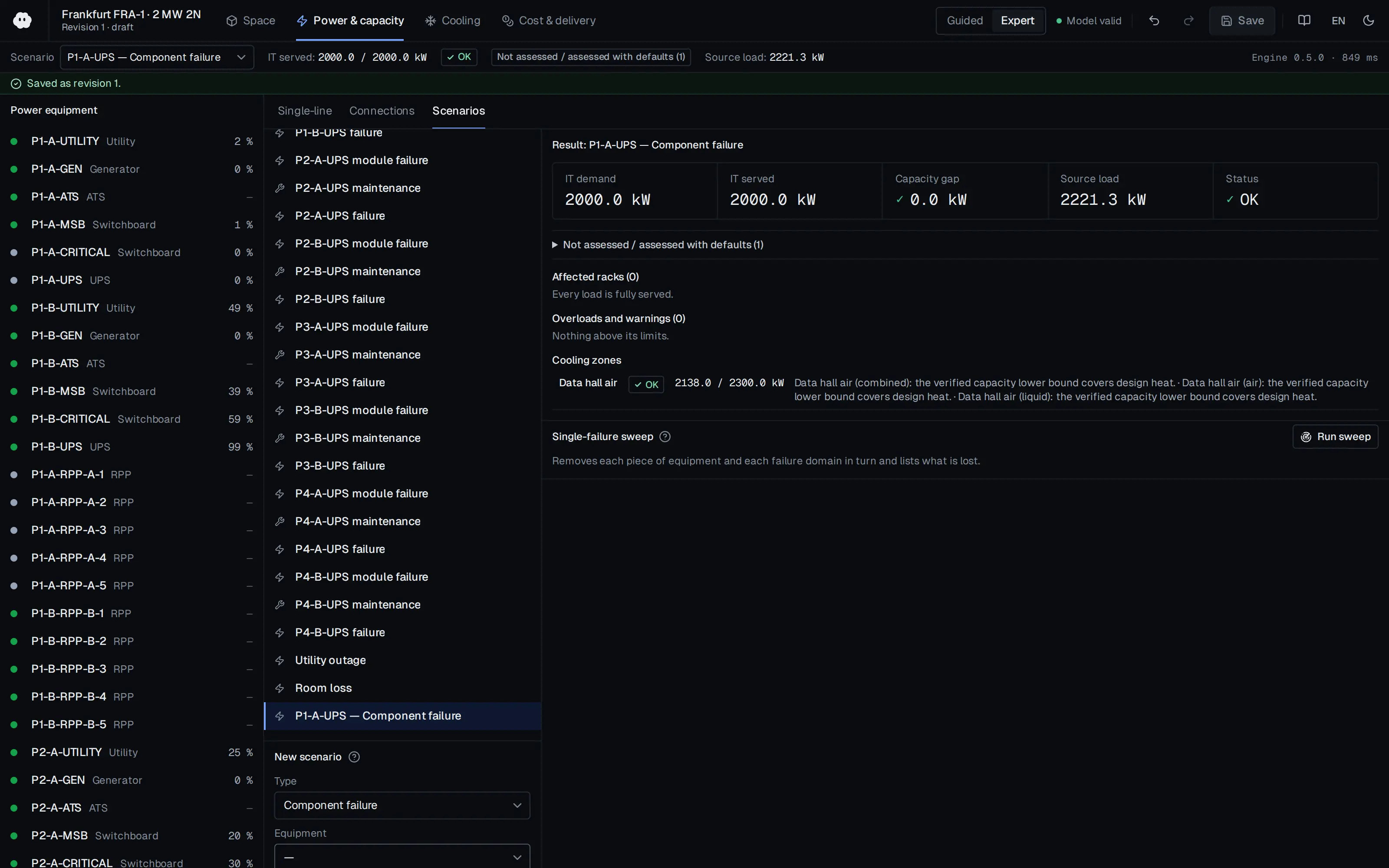
Who should read it
Designers and operations managers scoping BMS, EPMS and DCIM for sites with a data center.
Related standards
- ISO 16484-5 (BACnet)
- IEC 62443
- EN 50600-2-6
- ANSI/TIA-942
Publication details
- Authors
- Bryan Anderson; Patrick Donovan
- Publisher
- Schneider Electric
- Year
- 2016
- Document number
- WP 233
- Document language
- English
- Source type
- Manufacturer
- Access
- Free to read
- Licence
- Copyright retained; citation only — the publisher’s terms apply to the original document
Citation
Bryan Anderson; Patrick Donovan (2016). Selecting a Building Management System (BMS) for Sites with a Data Center or IT Room. Schneider Electric. WP 233. https://download.schneider-electric.com/files?p_Doc_Ref=SPD_PDON-A7UM7U_EN
Events on this subject
Browse the events calendarAll content and rights belong to the respective authors and publishers. SoSo CAD provides only the citation, its own summary and a link to the source, and is not responsible for the sources' content.
Related sources
All sources on this topicSchneider Electric 2026
Cybersecurity Guidance for Data Center Power and Cooling Infrastructure Systems
Add an OT-network section to the design: each monitored device class carries a protocol list and an IEC 62443 certification flag.
- Vulnerability handling should follow ISO/IEC 30111.
Schneider Electric 2025
Direct Liquid Cooling System Challenges in Data Centers
Use the eight challenges as a DLC readiness checklist in the commissioning and design-review module.
- Heat capture ratio defines the air share: 80% liquid capture leaves 20% for air cooling.
Open Compute Project Foundation Year not stated
Guidelines for Using Propylene Glycol-Based Heat Transfer Fluids in Single-Phase Cold Plate-Based Liquid Cooled Racks (OCP white paper)
Write the PG25 or PG55 choice into the fluid specification according to the freeze protection the climate needs, and record that keeping glycol above 25% by volume removes the need for biocide.
- Maximum corrosion rates under ASTM D8040-17: copper 0.22 mpy (5 mg/coupon), brass 0.46 mpy (10 mg/coupon).
T.C. Cumhurbaşkanlığı Siber Güvenlik Başkanlığı 2026
Bilgi ve İletişim Güvenliği Rehberi - 3.6.2 Sistem Odası/Veri Merkezine Yönelik Güvenlik Tedbirleri (Information and Communication Security Guide - measures for system rooms/data centres)
Provide a Turkey public-sector compliance checklist mapping the measures to design objects: dedicated IT UPS, N+1 air conditioning with auto changeover, redundant feeds, generator fuel redundancy, room adjacency checks against wet areas.
- Water, power, humidity, temperature and smoke must be monitored with thresholds and alarms; monitoring must not be exposed externally (3.6.2.5).
Türk Tesisat Mühendisleri Derneği (TTMD) - TTMD Dergisi 2026
TTMD Uluslararası Sempozyumu – Yapay Zeka ve Veri Merkezleri oturumları (TTMD International Symposium report: AI and data-centre sessions)
Offer sparse-sensor temperature-field reconstruction in monitoring and digital-twin features as a fast alternative to CFD, flagged as model-based.
- The report appeared in TTMD Dergisi issue 150 (April-June 2026).
Huawei Digital Power 2024
Top 10 Trends of Data Center Facility 2024 White Paper
For lithium BESS/UPS rooms, require detection and segregation sized for a 30-60 s runaway escalation.
- Rack power expected to rise from 6-8 kW to 30-40 kW.