
Fire extinguishing system functions and integration with other engineering disciplines (Söndürme Sistemleri Fonksiyonları, Diğer Mühendislik Disiplinleri ile Entegrasyonu)
Original title Söndürme Sistemleri Fonksiyonları, Diğer Mühendislik Disiplinleri ile Entegrasyonu (Fire extinguishing system functions and integration with other engineering disciplines)
TMMOB Makina Mühendisleri Odası (MMO) · Özlem Karadal Güneç
Özlem Karadal Güneç's TESKON 2019 paper explains how automatic suppression systems work and how they must be coordinated with architecture, HVAC and electrical systems.
On this page
Overview
The paper was presented at the 14th National Installation Engineering Congress (TESKON 2019, Izmir), organised by the Chamber of Mechanical Engineers (TMMOB MMO), and appears on p. 1516 of the proceedings. Its author is Özlem Karadal Güneç. It is a seminar paper on how automatic suppression systems work and how they must be coordinated with architecture, HVAC and electrical systems.
The paper describes pre-action sprinkler systems for rooms where accidental water discharge is unacceptable. These systems keep air in the piping; double-interlock types release water only when both a sprinkler opens and the detection system operates, and pipe air pressure is supervised so leaks raise a trouble signal. Non-interlock, single- and double-interlock types are introduced, and pre-action is recommended for computer rooms, archives, museums and data centres.
Clean-agent (gaseous) systems are covered for IT centres, LV rooms and control rooms. In such rooms the minimum extinguishing concentration should be held for at least 10 minutes, verified by room integrity testing. The enclosure needs a calculated pressure-relief vent area, no unsealed openings, and ventilation shut down before discharge. Most poor clean-agent performance stems from user errors: doors left open, missing sealing, or later modifications to the room.
High-pressure water mist produces 50-100 µm droplets and does not need room tightness; designs are test-based (VdS 3188, NFPA 750, CEN/TS 14972, FM 5560). High-expansion foam is also outlined. Limit: it is a seminar paper, so detailed calculation methods are absent from this record; related standards are NFPA 750, VdS 3188, CEN/TS 14972, FM 5560 and NFPA 2001.
Key points
- Pre-action systems keep air in the piping; double-interlock types release water only when both a sprinkler opens and the detection system operates; pipe air pressure is supervised so leaks raise a trouble signal.
- Pre-action is recommended for computer rooms, archives, museums and data centres where accidental discharge would cause serious damage.
- For clean-agent rooms, the minimum extinguishing concentration should be held for at least 10 minutes, verified by room integrity testing.
- Clean-agent enclosures need a calculated pressure-relief vent area, no unsealed openings, and ventilation shut down before discharge.
- Most poor clean-agent performance stems from user errors: doors left open, missing sealing, or later modifications to the room.
- High-pressure water mist produces 50-100 µm droplets and does not need room tightness; designs are test-based (VdS 3188, NFPA 750, CEN/TS 14972, FM 5560).
Using it in design
- When a room uses gaseous suppression, require HVAC damper/fan shutdown interlocks, a pressure-relief vent and a 10-minute hold-time integrity test in the commissioning list.
- Offer double-interlock pre-action as the default sprinkler type for data halls.
- Manage later room modifications (cable penetrations, new openings) as events that require repeating the integrity test.
- Specify water mist solutions only with test-proven designs (VdS 3188, FM 5560 and so on).
Monthly newsletter · free
Keep your reading list current
Once a month: new library sources, changes to Turkish regulations and upcoming data centre events.
SoSo CAD
Bring standards pre-checks into your project
Review model-based TS EN 50600 and Tier pre-checks, missing inputs and items requiring engineering review in SoSo CAD.
Request a demo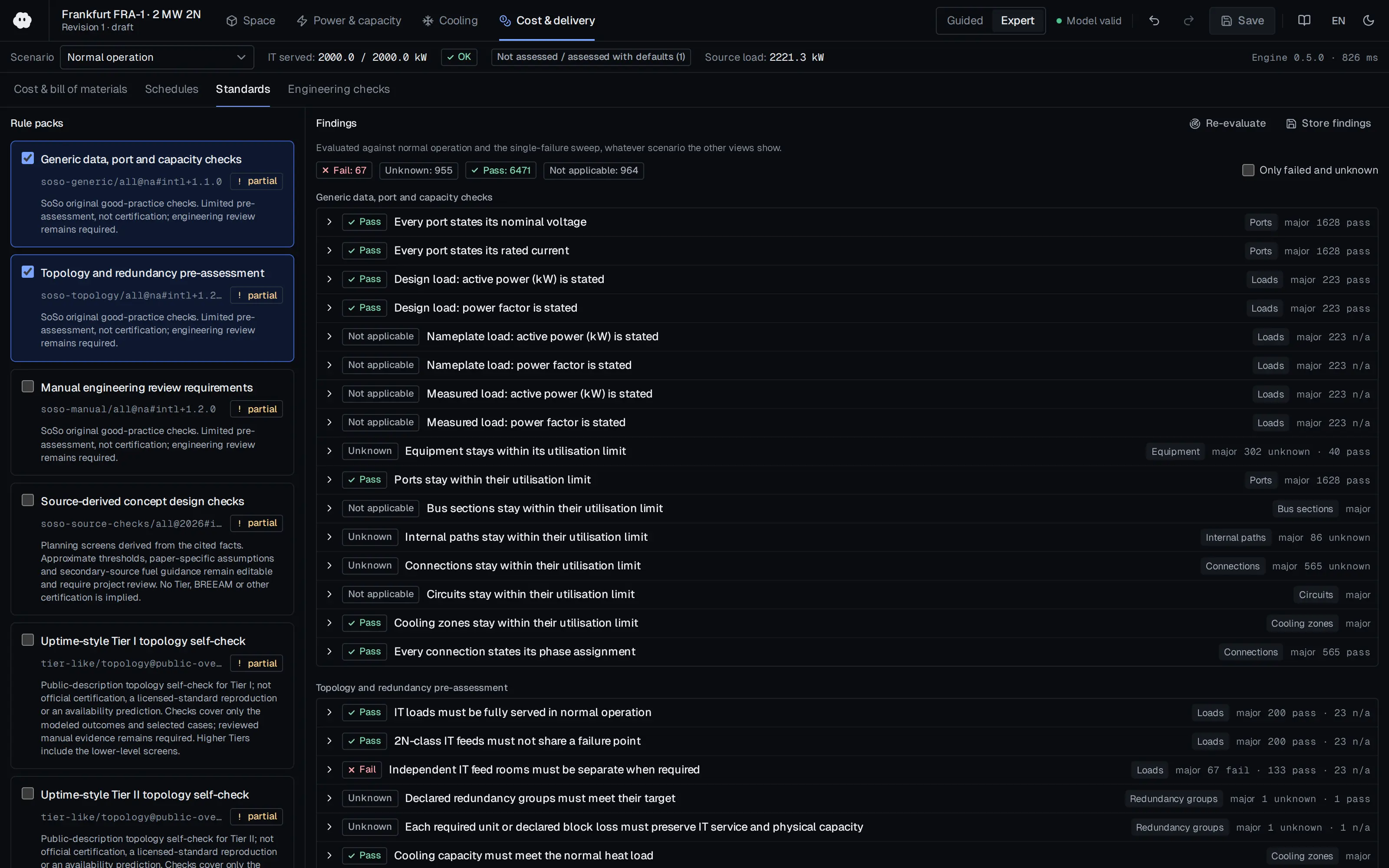
Who should read it
Engineers coordinating fire suppression, HVAC and electrical design for data centres.
Related standards
- NFPA 750
- VdS 3188
- CEN/TS 14972
- FM 5560
- NFPA 2001
Publication details
- Authors
- Özlem Karadal Güneç
- Publisher
- TMMOB Makina Mühendisleri Odası (MMO)
- Year
- 2019
- Document number
- TESKON 2019 Bildiriler Kitabı, s. 1516
- Event
- 14. Ulusal Tesisat Mühendisliği Kongresi (TESKON 2019), İzmir
- Document language
- English
- Source type
- Industry body
- Access
- Free to read
- Licence
- Copyright retained; citation only — the publisher’s terms apply to the original document
Citation
Özlem Karadal Güneç (2019). Söndürme Sistemleri Fonksiyonları, Diğer Mühendislik Disiplinleri ile Entegrasyonu (Fire extinguishing system functions and integration with other engineering disciplines). TMMOB Makina Mühendisleri Odası (MMO). TESKON 2019 Bildiriler Kitabı, s. 1516. 14. Ulusal Tesisat Mühendisliği Kongresi (TESKON 2019), İzmir. http://www.mmoteskon.org/wp-content/uploads/teskonkitaplar/teskon2019/teskon2019.pdf
Events on this subject
Browse the events calendarAll content and rights belong to the respective authors and publishers. SoSo CAD provides only the citation, its own summary and a link to the source, and is not responsible for the sources' content.
Related sources
All sources on this topic
Fire (MDPI AG) 2026
Reframing Data Center Fire Safety as a Socio-Technical Reliability System: A Systematic Review
Ask for a fire-safety design file that covers a lifecycle plan (aligned with NFPA 75 and NFPA 76) including emergency response, damage control and post-fire recovery, not only prevention and suppression.
- The search found 806 records (Scopus 330, Web of Science 476); twelve empirical studies were synthesised and benchmarked against NFPA 75 and NFPA 76.
Huawei Digital Power 2024
Top 10 Trends of Data Center Facility 2024 White Paper
For lithium BESS/UPS rooms, require detection and segregation sized for a 30-60 s runaway escalation.
- Rack power expected to rise from 6-8 kW to 30-40 kW.
Schneider Electric 2023
Comparison of Dielectric Fluids for Immersive Liquid Cooling of IT Equipment
Add a dielectric-fluid catalog with family (hydrocarbon, fluorocarbon), phase (1p, 2p), flash point, boiling point, GWP, PFAS status, cost per litre and annual loss percentage.
- Sealed two-phase systems can lose about 1 to 2% of fluid (evaporation) per year.
Uptime Institute Journal (Uptime Institute) 2017
Fire Suppression Systems Bring Unexpected Risk
In the fire module, when inert gas is selected, require low-noise nozzles or silencers and show a hard-drive acoustic risk warning.
- Related standards: NFPA 75 and NFPA 2001.
TMMOB Makina Mühendisleri Odası (MMO) 2025
Farklı Otomatik Söndürme Sistemlerinin Birbirleriyle Karşılaştırılması
Provide a suppression-option selector for white space, UPS/battery and electrical rooms showing reliability, water-damage risk, enclosure-integrity dependency and cost.
- Related standards: TS EN 12845, NFPA 13, TS EN 14972-1 and TS EN 15004-1.
TMMOB Makina Mühendisleri Odası (MMO) 2025
Design criteria by agent in clean-agent extinguishing systems and comparison (Temiz Gazlı Söndürme Sistemlerinde Söndürme Maddesi Seçimine Göre Değişen Tasarım Kriterleri ve Sistemlerin Karşılaştırılması)
In the fire-suppression catalog, store agent type, GWP, NOAEL/LOAEL, design concentration, safety factor and discharge time per standard.
- GWP: HFC-227ea = 3350, FK-5-1-12 = 1.