
Design criteria by agent in clean-agent extinguishing systems and comparison (Temiz Gazlı Söndürme Sistemlerinde Söndürme Maddesi Seçimine Göre Değişen Tasarım Kriterleri ve Sistemlerin Karşılaştırılması)
Original title Temiz Gazlı Söndürme Sistemlerinde Söndürme Maddesi Seçimine Göre Değişen Tasarım Kriterleri ve Sistemlerin Karşılaştırılması (Design criteria by agent in clean-agent extinguishing systems and comparison)
TMMOB Makina Mühendisleri Odası (MMO) · Olcay Cömert
Olcay Cömert's TESKON 2025 paper compares halocarbon (HFC-227ea, FK-5-1-12) and inert-gas clean-agent systems used in data centres, IT rooms and control rooms under European (EN 15004 / ISO 14520) and American (NFPA 2001) rules. It is a compact design-rule source for gaseous suppression of white space and electrical rooms.
On this page
Overview
The paper was presented at the 16th National Installation Engineering Congress (TESKON 2025, Izmir) and appears on p. 1362 of the proceedings; the author is Olcay Cömert and the publisher is the TMMOB Chamber of Mechanical Engineers. The text explains how fire class definitions, safety factors, discharge times, occupant-exposure limits (NOAEL/LOAEL) and altitude corrections differ between European and American rules.
Among halocarbon gases, GWP is 3350 for HFC-227ea and 1 for FK-5-1-12. NOAEL/LOAEL are 9% / 10.5% for HFC-227ea, 10% / over 10% for FK-5-1-12 and 43% / 52% for inert gases (about 12% / 10% O2 equivalent at sea level). Halocarbon systems must reach 95% of design concentration (including the 1.3 safety factor) within 10 s; inert systems within 60 s for class B and 120 s for class A and higher-hazard A.
Under NFPA 2001, inert gas below 43% is allowed with exposure limited to 5 min, 43-52% with exposure limited to 3 min, and 52-62% only in normally unoccupied rooms with exposure under 30 s. Inert systems reduce room oxygen to roughly 12-15% to stop combustion while remaining breathable. EN/ISO treat electrical fires within class A; higher-hazard conditions include cable bundles over 100 mm, trays filled over 20% and equipment energised above 5 kW during extinguishing.
Agent quantity is derived from net volume and a flooding factor, and altitude correction factors are required when ambient pressure differs from sea level by more than 11%. The paper also discusses the GWP and PFAS concerns that affect the future of chemical agents. The related sources are TS EN 15004-1, ISO 14520 and NFPA 2001.
Key points
- GWP: HFC-227ea = 3350, FK-5-1-12 = 1.
- NOAEL/LOAEL: HFC-227ea 9% / 10.5%; FK-5-1-12 10% / over 10%; inert gases 43% / 52% (about 12% / 10% O2 equivalent at sea level).
- Inert gas below 43% allowed with exposure limited to 5 min; 43-52% with 3 min; 52-62% only in normally unoccupied rooms with exposure under 30 s (NFPA 2001).
- Inert systems reduce room oxygen to roughly 12-15% to stop combustion while remaining breathable.
- Halocarbon systems must reach 95% of design concentration (incl. 1.3 safety factor) within 10 s; inert systems within 60 s for class B and 120 s for class A/higher-hazard A.
- EN/ISO treat electrical fires within class A; higher hazard: cable bundles over 100 mm, trays filled over 20%, equipment energised above 5 kW during extinguishing.
- Altitude correction factors are required when ambient pressure differs from sea level by more than 11%.
Using it in design
- In the fire-suppression catalog, store agent type, GWP, NOAEL/LOAEL, design concentration, safety factor and discharge time per standard.
- Warn when design concentration exceeds NOAEL in an occupied room without delay/abort.
- Warn when a room is not marked for integrity (door fan) testing.
- Warn when site altitude requires a correction.
Monthly newsletter · free
Keep your reading list current
Once a month: new library sources, changes to Turkish regulations and upcoming data centre events.
SoSo CAD
Bring standards pre-checks into your project
Review model-based TS EN 50600 and Tier pre-checks, missing inputs and items requiring engineering review in SoSo CAD.
Request a demo
Who should read it
Mechanical and fire safety engineers designing gaseous suppression for data center and electrical rooms.
Related standards
- TS EN 15004-1
- ISO 14520
- NFPA 2001
Publication details
- Authors
- Olcay Cömert
- Publisher
- TMMOB Makina Mühendisleri Odası (MMO)
- Year
- 2025
- Document number
- TESKON 2025 Bildiriler Kitabı, s. 1362
- Event
- 16. Ulusal Tesisat Mühendisliği Kongresi (TESKON 2025), İzmir
- Document language
- English
- Source type
- Industry body
- Access
- Free to read
- Licence
- Copyright retained; citation only — the publisher’s terms apply to the original document
Citation
Olcay Cömert (2025). Temiz Gazlı Söndürme Sistemlerinde Söndürme Maddesi Seçimine Göre Değişen Tasarım Kriterleri ve Sistemlerin Karşılaştırılması (Design criteria by agent in clean-agent extinguishing systems and comparison). TMMOB Makina Mühendisleri Odası (MMO). TESKON 2025 Bildiriler Kitabı, s. 1362. 16. Ulusal Tesisat Mühendisliği Kongresi (TESKON 2025), İzmir. https://mmoteskon.org/images/dosya/teskon-2025-bildiriler-kitabi-02.pdf
Events on this subject
Browse the events calendarAll content and rights belong to the respective authors and publishers. SoSo CAD provides only the citation, its own summary and a link to the source, and is not responsible for the sources' content.
Related sources
All sources on this topicTMMOB Makina Mühendisleri Odası (MMO) 2025
Farklı Otomatik Söndürme Sistemlerinin Birbirleriyle Karşılaştırılması
Provide a suppression-option selector for white space, UPS/battery and electrical rooms showing reliability, water-damage risk, enclosure-integrity dependency and cost.
- Related standards: TS EN 12845, NFPA 13, TS EN 14972-1 and TS EN 15004-1.
TMMOB Makina Mühendisleri Odası (MMO) 2019
Fire extinguishing system functions and integration with other engineering disciplines (Söndürme Sistemleri Fonksiyonları, Diğer Mühendislik Disiplinleri ile Entegrasyonu)
When a room uses gaseous suppression, require HVAC damper/fan shutdown interlocks, a pressure-relief vent and a 10-minute hold-time integrity test in the commissioning list.
- For clean-agent rooms, the minimum extinguishing concentration should be held for at least 10 minutes, verified by room integrity testing.
Fire (MDPI AG) 2026
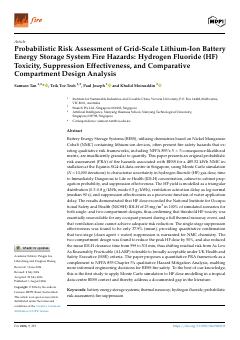
Probabilistic Risk Assessment of Grid-Scale Lithium-Ion Battery Energy Storage System Fire Hazards: Hydrogen Fluoride (HF) Toxicity, Suppression Effectiveness, and Comparative Compartment Design Analysis
Compare BESS compartmentation quantitatively: two compartments halve HF dose and IDLH clearance time, but IDLH is still exceeded for anyone in the room in full thermal runaway, so runaway prevention (BMS integrity, UL 9540A containment, emergency power off) must stay the primary control.
- Mean IDLH (25 mg/m³) clearance time with 9 ACH was 599 min for one compartment and 301 min for two; the probability of clearing within 5 min was 0% for both.
Fire (MDPI AG) 2026
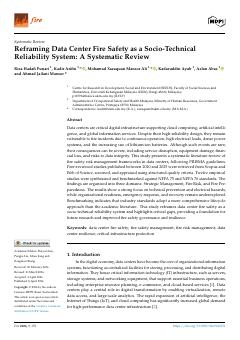
Reframing Data Center Fire Safety as a Socio-Technical Reliability System: A Systematic Review
Ask for a fire-safety design file that covers a lifecycle plan (aligned with NFPA 75 and NFPA 76) including emergency response, damage control and post-fire recovery, not only prevention and suppression.
- The search found 806 records (Scopus 330, Web of Science 476); twelve empirical studies were synthesised and benchmarked against NFPA 75 and NFPA 76.
Batteries (MDPI AG) 2026
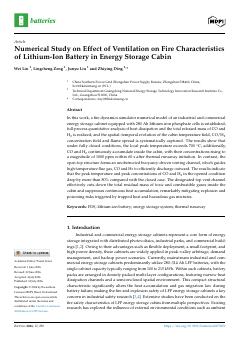
Numerical Study on Effect of Ventilation on Fire Characteristics of Lithium-Ion Battery in Energy Storage Cabin
Define a designed, buoyancy-driven vent or relief path at the top of a storage cabinet; in a closed cabinet H2 forms a flammable layer under the roof, so control gas and heat build-up.
- H2 rose quickly and formed a growing flammable layer under the roof of the closed cabinet.
Batteries (MDPI AG) 2026
Experimental Study on Fire Suppression of Lithium-Ion Battery Module with Different Extinguishing Agents in Confined Space
For confined battery packs and cabinets, evaluate a fast flame-knockdown agent (such as heptafluoropropane) together with an agent or approach giving long-lasting cooling (such as perfluorohexanone); no single agent stopped heat transfer to neighbouring cells.
- Without suppression, peak HRR reached 69.09 kW and total heat release was 8.05 MJ, with multiple deflagrations after venting in the confined space.