
Mitigating the impacts of integrating water-cooled servers into data centres (Turkish translation, TTMD)
Original title Su Soğutmalı Sunucuların Veri Merkezlerine Entegre Edilmesinin Etkilerinin Azaltılması (Mitigating the impacts of integrating water-cooled servers into data centres) – Turkish translation
Türk Tesisat Mühendisleri Derneği (TTMD) - TTMD Dergisi · Roger Schmidt, Mark Steinke et al.
A TTMD-published Turkish translation of an ASHRAE Journal article summarising points from the ASHRAE TC 9.9 water-cooled servers paper, covering CDU versus direct connection, dew point, water quality and filtration.
On this page
Overview
This article is the Turkish translation, published in the TTMD Journal, of an ASHRAE Journal piece that summarises points from the ASHRAE TC 9.9 water-cooled servers technical paper for Turkish facility engineers. It complements the full technical paper and does not replace it. The text compares coolant distribution units (CDUs) with direct (no-CDU) facility-water connection, and explains why supply water must stay above the room dew point, water quality, wetted-material compatibility, and filtration for plate heat exchangers and cold plates.
The introduction notes that air cooling worked well up to about 150 W processors, while GPUs at about 300 W and CPUs at about 205 W push toward liquid cooling. 28 water-cooled IT products announced 2010-2017 were analysed: the first seven allowed a maximum facility water of 10-24 C, and 8 of the remaining 21 allowed 40 C or more. The data show rising rack heat loads and increasing allowable facility-water temperatures.
The roles of a CDU are to transfer heat from the equipment loop (ESS) to the facility loop (TSS), circulate coolant, allow non-water coolants, keep supply above the room dew point and maintain coolant chemistry. No-CDU designs gain floor space, lower thermal resistance, shared pump redundancy and higher ΔT, but need stricter water quality, materials and filtration.
Supply water must stay above the room dew point; ASHRAE A1 allows a maximum room dew point of 17 C. Plate heat exchangers in CDUs typically have 2-8 mm passages, while cold plates may have fin gaps of only about 0.1 mm, which drives different filtration levels. The limit of the document is that it is a summary translation and contains no detailed calculation method.
Key points
- Air cooling worked well up to about 150 W processors; GPUs at about 300 W and CPUs at about 205 W push toward liquid cooling.
- Of 28 water-cooled IT products announced 2010-2017, the first seven allowed a maximum facility water of 10-24 C, and 8 of the remaining 21 allowed 40 C or more.
- CDU roles: transfer heat from ESS to TSS, circulate coolant, allow non-water coolants, keep supply above room dew point and maintain coolant chemistry.
- No-CDU designs gain floor space, lower thermal resistance, shared pump redundancy and higher ΔT, but need stricter water quality, materials and filtration.
- Supply water must stay above the room dew point; ASHRAE A1 allows a maximum room dew point of 17 C.
- Plate heat exchangers in CDUs have 2-8 mm passages, cold plates fin gaps of about 0.1 mm, driving different filtration levels.
Using it in design
- Require a CDU or an explicit water-quality and filtration specification when IT is connected to facility water.
- Check supply temperature against room dew point and warn below it.
- Catalogue cold-plate products with maximum facility-water temperature and required filtration (µm).
- Add wetted-material compatibility to the design checklist.
Monthly newsletter · free
Keep your reading list current
Once a month: new library sources, changes to Turkish regulations and upcoming data centre events.
SoSo CAD
Check cooling capacity alongside your design
Review zone heat loads, available capacity and the capacity balance after the largest unit is lost in SoSo CAD.
Request a demo
Who should read it
Turkish facility and cooling engineers connecting water-cooled servers to facility water.
Related standards
- ASHRAE TC 9.9 Water-Cooled Servers
- ASHRAE Liquid Cooling Guidelines for Datacom Equipment Centers
- ASHRAE Thermal Guidelines (A1)
Publication details
- Authors
- Roger Schmidt; Mark Steinke; Austin Shelnutt
- Publisher
- Türk Tesisat Mühendisleri Derneği (TTMD) - TTMD Dergisi
- Year
- 2021
- Document number
- TTMD Dergisi Sayı 130 (Nisan-Haziran 2021), s. 38
- Document language
- English
- Source type
- Industry body
- Access
- Free to read
- Licence
- Copyright retained; citation only — the publisher’s terms apply to the original document
Citation
Roger Schmidt; Mark Steinke; Austin Shelnutt (2021). Su Soğutmalı Sunucuların Veri Merkezlerine Entegre Edilmesinin Etkilerinin Azaltılması (Mitigating the impacts of integrating water-cooled servers into data centres) – Turkish translation. Türk Tesisat Mühendisleri Derneği (TTMD) - TTMD Dergisi. TTMD Dergisi Sayı 130 (Nisan-Haziran 2021), s. 38. https://www.ttmd.org.tr/upload/files/4859ttmd-dergisi-130.pdf
Events on this subject
Browse the events calendarAll content and rights belong to the respective authors and publishers. SoSo CAD provides only the citation, its own summary and a link to the source, and is not responsible for the sources' content.
Related sources
All sources on this topic
Fluids (MDPI AG) 2026
A Review of Thermal Management in Modern Data Centres: Water Usage Effectiveness and Heat Transfer Coefficients
Set WUE targets from the heat-rejection topology (dry, free-cooling, hybrid, evaporative) and not only the server-side cooling technology; WUE depends on the share of heat rejected by evaporation.
- Dry facilities with closed-loop liquid cooling need essentially no water, while evaporative systems typically report WUE up to 2.5 L/kWh.
U.S. DOE FEMP / NREL 2019
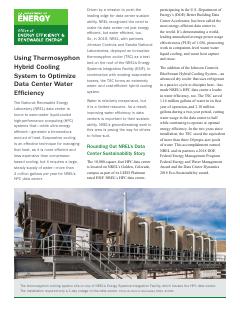
Using Thermosyphon Hybrid Cooling System to Optimize Data Center Water Efficiency (DOE/GO-102019-5172, May 2019)
Arrange the heat-rejection hierarchy as in the scheme: heat reuse first, then dry cooling, evaporative towers last; write the control logic in that order.
- Installing the TSC required only a 1-day data center outage.
National Laboratory of the Rockies (formerly NREL) 2026
High-Performance Computing Data Center Cooling System Energy Efficiency (ESIF)
Model heat rejection as a priority chain (reuse, dry cooler, evaporative tower) with hourly switching.
- The page was last updated on 17 February 2026.
Schneider Electric 2026
Water Usage at AI Scale: Insights from a 100 MW Comparative Analysis
Compute and display WUE (L/kWh IT) next to PUE for every cooling design.
- Dallas WUE falls from 0.42 to 0.22 L/kWh; Paris from 0.12 to 0.06 L/kWh.
Burns & McDonnell 2024
Fluid Dynamics: Liquid Cooling's Role in the Future of Data Centers
For liquid-cooled racks, always keep a residual air-cooling load (default 20-50% of IT, user-adjustable) and size CRAH or fan-wall capacity for it.
- Some solutions reach 80-120+ kW per rack versus a typical 8-12 kW.
Microsoft 2024
Sustainable by design: Next-generation datacenters consume zero water for cooling
Add 'closed-loop DLC + dry cooler / air-cooled economizing chiller (zero-evaporation)' to the cooling-option catalog with WUE_cooling about 0.
- Pilots in Phoenix and Mt. Pleasant were planned for 2026.